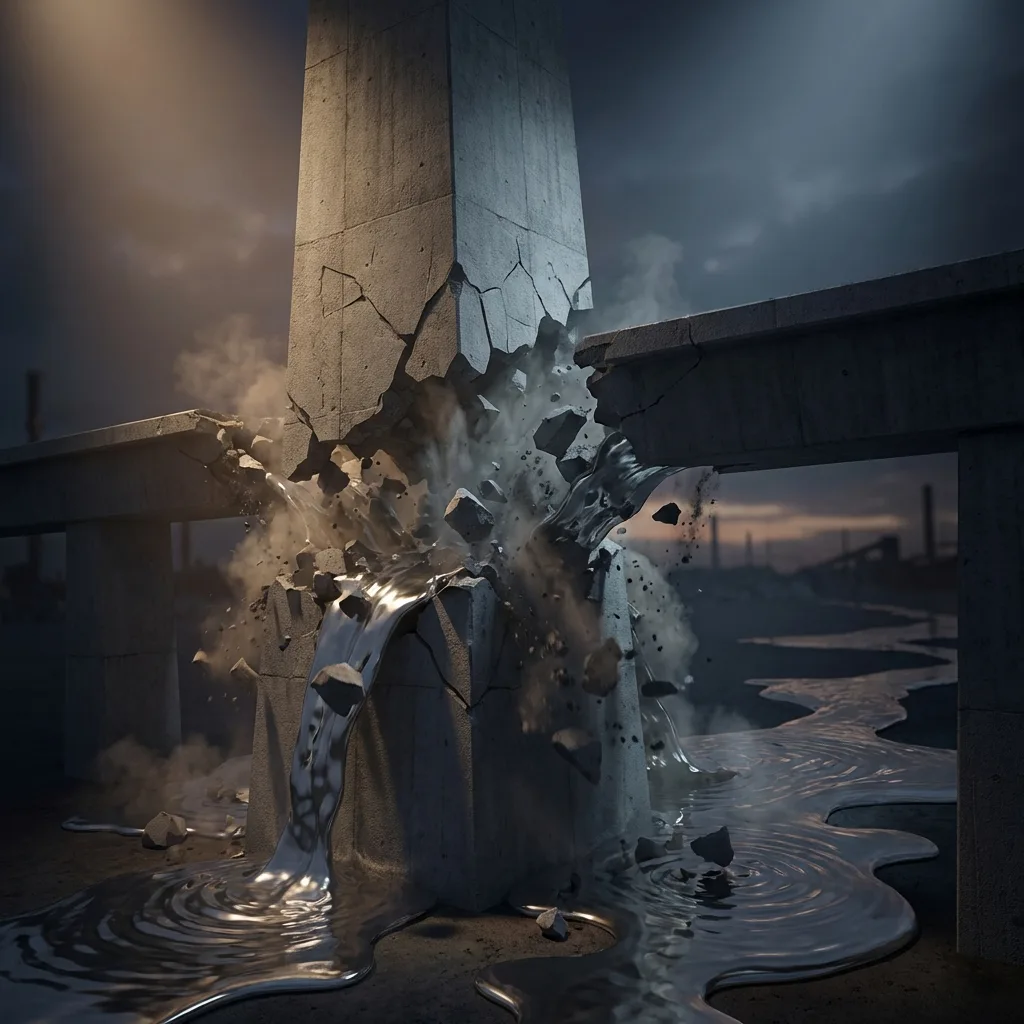
The Engineering of Chaos: Why the Waterfall Model Broke
Why the Waterfall model failed in software: unstable requirements, years-long feedback cycles, and risk that accumulates at the very end of the project.
✨TL;DR / Executive Summary
Why the Waterfall model failed in software: unstable requirements, years-long feedback cycles, and risk that accumulates at the very end of the project.
💡 TL;DR (Too Long; Didn't Read)
The Waterfall model, effective in physical engineering, failed catastrophically in software because it was applied to a domain of high uncertainty. Unstable requirements, years-long feedback cycles, and risk accumulation at the end led to a crisis of failed projects. The solution came from an unexpected place: Toyota's lean manufacturing. By adopting principles such as waste elimination, working in small batches, and continuous improvement, software engineering learned to manage uncertainty instead of fighting it, paving the way for Agile methodology.
The Promise of Order
Fellow engineers,
There is a deep comfort, almost a mathematical certainty, in our craft when dealing with the physical world. The laws of thermodynamics are non-negotiable. The tensile strength of steel or the conductivity of copper are universal constants that underpin our designs. In my early years in the telecommunications industry, this predictability was the foundation upon which we built complex systems. Designing hardware was an exercise in deterministic logic.
The process was a familiar ritual: we captured requirements in schematics, selected components with immutable specifications, designed the precise layout of a printed circuit board (PCB), generated Gerber files, and sent them to manufacturing. Months later, we received back a physical artifact, a piece of silicon and fiberglass that behaved exactly as the laws of physics and our equations predicted. There was a point of no return, a moment when the design was etched in metal, and this forced us into rigorous discipline.
This linear, sequential, highly structured process had a name: Waterfall. And for decades, it seemed not just the right way, but the only sane way to build anything complex. Today, I want us to perform an autopsy on this model. Not to mock its obsolescence, but to understand, from an engineering perspective, why such a logical and successful tool in so many domains became a catalyst for chaos in software engineering.
Before we talk about sprints, backlogs, or any agile jargon, we need to dissect the original problem. We need to understand the fundamental nature of the crisis that forced a generation of engineers to seek answers in a totally unexpected place: the floor of an automobile factory in Japan.
The Paradigm of Predictability: An Analysis of the Waterfall Model
The Waterfall model, as we know it, was largely popularized from a misinterpretation of a 1970 article by Winston W. Royce. Ironically, Royce himself highlighted the flaws of the simplistic model and proposed adding iterations and feedback loops — details that the industry conveniently ignored for decades in favor of the simplicity of a unidirectional flow.
The logic of pure Waterfall is seductive in its clarity:
- Requirements Gathering: An exhaustive phase to define and document everything the system needs to do. The result is a massive document, the project "bible," which is then "frozen" to avoid the chaos of changes.
- Design and Architecture: Based on the requirements bible, system architects design the complete structure. Class diagrams, data models, component architecture. Everything is planned before a single line of production code is written.
- Implementation (Coding): Development teams receive the design specifications and translate them into code. They operate in silos, each building their component according to the blueprint.
- Testing and Integration: All coded components are brought together for the first time in the integration phase. The Quality Assurance (QA) team then tests the complete system against the original requirements document.
- Deployment and Maintenance: Once verified, the system is deployed to production. Work shifts to maintenance mode, fixing bugs and making small updates.
The "Project Titan" Example
Imagine a typical 90s scenario: building a new ERP (Enterprise Resource Planning) system for a large corporation, let's call it "Project Titan." The contract is signed based on an 800-page requirements document. A team of architects spends a year designing the system. Two years are dedicated to coding by separate teams (finance, HR, logistics). Finally, it's time for "big bang integration."
The result is a predictable disaster. The components don't fit together. Interpretations of specifications varied between teams. The underlying hardware the system was designed for is already obsolete. Worse, during these three years, the company's business rules have fundamentally changed. The system, even if it worked perfectly as specified, now solves a set of problems the company no longer has. Project Titan becomes a resource black hole, a ghost in the company's servers.
This story, at different scales, has repeated itself countless times. It wasn't a problem of engineer competence, but a problem of fundamental inadequacy of the tool to the problem.
The Software Crisis: When Reality Collides with the Plan
What we call the "Software Crisis" was not a single event, but a slow and painful recognition that software development is a fundamentally different discipline from traditional engineering. The source of this difference can be summarized in one word: uncertainty.
The famous Chaos Report by the Standish Group, first published in 1994, threw brutal light on the situation. The data was damning:
- 31% of projects would be canceled before completion.
- 53% would cost more than 189% of their original estimates.
- Only 16% of projects would be completed on time and on budget.
As engineers, we are trained to analyze root causes. The causes for these numbers weren't laziness or incompetence. They were systemic, inherent to the Waterfall model applied to a high-uncertainty domain:
- The Illusion of Stable Requirements: Waterfall's central premise is false. Software is a means to solve human and business problems, and these are fluid. The very act of building and showing software generates new ideas and changes requirements. Requiring a client to know exactly what they want years in advance is unrealistic.
- Late Feedback Loops: The biggest value destroyer in any engineering process is a long feedback cycle. In Waterfall, a misinterpretation in requirements is only discovered in the testing phase, months or years later and at an exponentially higher cost to fix. Critical architectural decisions are made based on assumptions that can only be validated at the end.
- Risk Concentrated at the End: All project risk — technical, market, usability — is pushed to the integration and verification phase. The chance of failure is not distributed, but concentrated in a single catastrophic event at the end of the cycle.
- Communication Silos: The model creates walls between analysts, architects, developers, and testers. Information is passed through massive documents, losing context and nuance at each step. The developer implementing a feature may have no idea of the business problem it solves, and the business analyst has no visibility into real progress until it's too late.
We were trying to apply the rules of bridge engineering — where the terrain is fixed and materials are known — to software engineering, which is more like navigating a ship in a storm, where the map constantly changes and the final destination can be adjusted based on what we learn along the way.
The Unexpected Lesson: The Wisdom of the Factory Floor
Faced with this scenario, the search for a new way of working began. And the inspiration, as mentioned, came from the Toyota Production System (TPS), or Lean Manufacturing.
After World War II, Toyota couldn't compete with the mass production might of American automakers. They couldn't afford to build huge batches of cars and keep them in inventory. They needed a leaner, more adaptable system obsessively focused on waste elimination.
Software development pioneers, like Kent Beck, Ward Cunningham, and the future signatories of the Agile Manifesto, saw a brilliant parallel. They translated TPS principles to our world of code and ideas.
1. The Obsession with Waste Elimination (Muda)
Toyota identified 7 wastes in manufacturing. In software, a parallel (and expanded) list emerged, and it attacks the heart of Waterfall's problems:
- Partially Completed Work: Code written but not tested, integrated, and deployed. It's the equivalent of a car chassis rusting in the yard, an asset that consumes resources but delivers no value.
- Extra Features (Overproduction): Building features the customer didn't ask for "because they might need it someday." This adds complexity, bugs, and maintenance costs. It's the biggest waste of all.
- Context Switching: Forcing an engineer to jump between multiple projects or tasks. Each switch incurs a cognitive cost, a mental "reboot fee" that destroys productivity.
- Defects: Bugs that reach production. The cost to fix a defect increases dramatically the later it's found. Lean teaches us to build quality into the process (test automation, peer review), rather than trying to "inspect it in" at the end.
- Waiting: Time spent waiting for a decision, an approval, or for another team's work to be completed. Waterfall is, by definition, a system based on queues and waiting.
2. The Power of Continuous Flow and Small Batches
Instead of producing 10,000 fenders at once (mass production), Toyota perfected the art of producing only what was needed, when it was needed (Just-in-Time). In software, this translates to working in small batches of features. Instead of a 2-year release cycle, why not 2 months? Or 2 weeks?
Working in smaller batches drastically reduces risk, shortens feedback loops, and allows value to be delivered to the customer incrementally. Each small batch can be tested, integrated, and validated, allowing the course to be continuously corrected.
3. Kaizen: Continuous Improvement as the Engine
Perhaps Lean's most profound concept is Kaizen. The philosophy that everyone, from the CEO to the worker on the factory floor, is responsible for identifying and suggesting process improvements. This transfers the power of improvement from a "process optimization" department to the people who actually execute the work. They are the ones who best know the bottlenecks and wastes.
This was anathema to traditional project management, where the process was defined top-down. The idea that the development team should regularly stop to discuss how to improve their own work process was revolutionary.
Conclusion: From False Certainty to Managing Uncertainty
The Waterfall model wasn't stupid; it was a tool optimized for a low-uncertainty, high-cost-of-physical-change environment. Its failure was its dogmatic application to a domain, software, that is its opposite: high uncertainty and low cost of change (in theory).
The software crisis forced us to a humble and powerful conclusion: in complex systems, long-term prediction is impossible. Therefore, any process that depends on this prediction is doomed to fail.
The lesson from Lean Manufacturing gave us the alternative: if we can't predict, we must adapt. We must trade the comfort of a big upfront plan for the intelligence of an empirical process. We need a system that allows us to build a little, measure the result, learn from feedback, and adjust the course. Cycle after cycle.
This is the intellectual ground upon which the Agile Manifesto and, subsequently, frameworks like Scrum, were built. They are not a random collection of "best practices" or ceremonies. They are the implementation of a deeply pragmatic engineering philosophy, designed to manage uncertainty and deliver value amid chaos.
In our next article, we'll dive into the formal response to this crisis: the values and principles of the Agile Manifesto. We'll decode its statements and show how they establish the new rules for a game where the only constant is change.