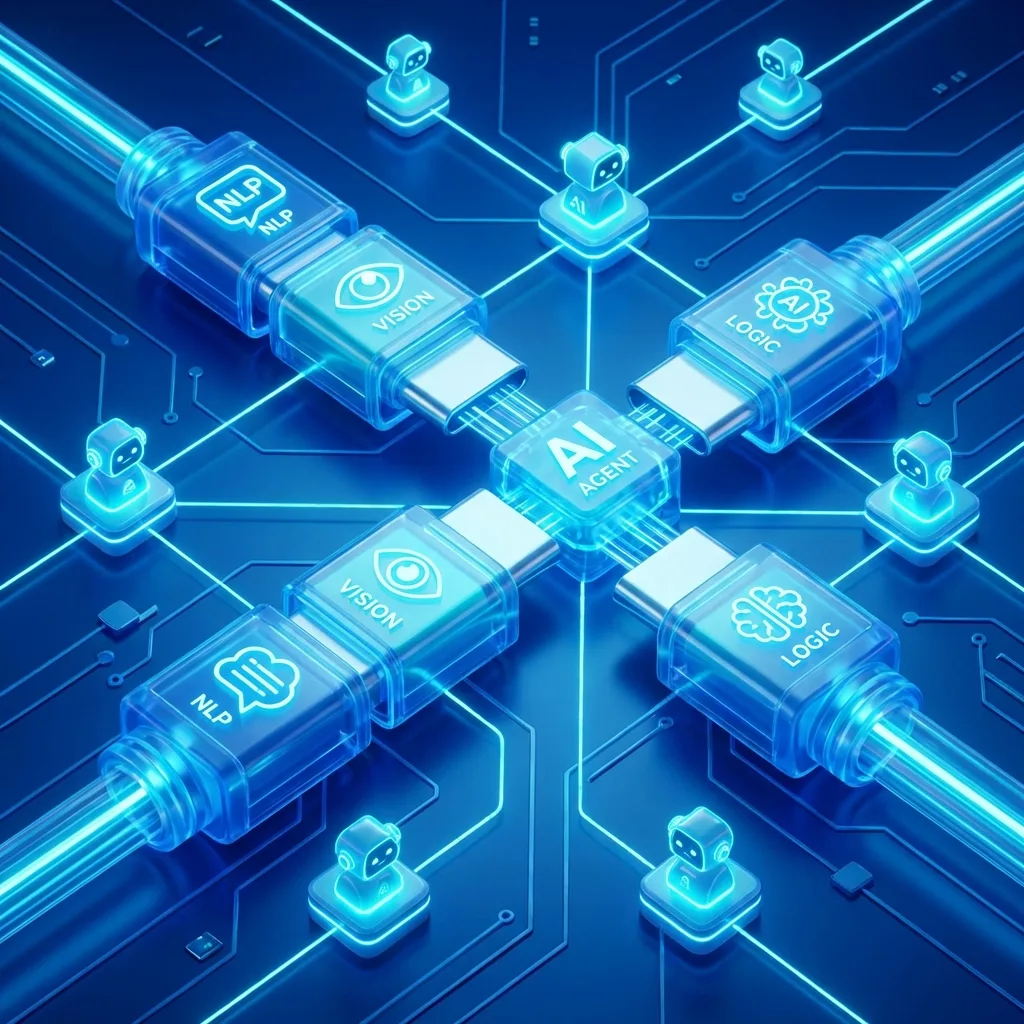
The Future of MCP: Agents, Composability, and What Comes Next
Where MCP goes next: Linux Foundation governance, 97M monthly downloads, agent composability, remote MCP, and what to learn now for 2026-2027.
✨TL;DR / Executive Summary
Where MCP goes next: Linux Foundation governance, 97M monthly downloads, agent composability, remote MCP, and what to learn now for 2026-2027.
💡 TL;DR (Too Long; Didn't Read)
MCP is becoming standard infrastructure: 97M monthly downloads, Linux Foundation governance, integration in all major AI clients. Learn now: protocol fundamentals, server implementation, security awareness, Docker/containers. Predictions: Q1 2026 - remote MCP accelerates; Q2 2026 - first major security incident; H2 2026 - composability patterns emerge; 2027 - MCP becomes default infrastructure.
We've covered what MCP is, how to build servers, the security challenges, and production deployment patterns. This final article looks forward. The Model Context Protocol is barely a year old, yet it's already being woven into the infrastructure of AI-powered development. What does its trajectory suggest about where this is heading?
The Governance Shift: Linux Foundation
In December 2025, Anthropic donated MCP to the Linux Foundation's newly created Agentic AI Foundation. This isn't just a press release—it's a structural change that affects how MCP will evolve.
What This Means in Practice
| Aspect | Under Anthropic | Under Linux Foundation |
|---|---|---|
| Speed | Fast, centralized | Slower, requires consensus |
| Neutrality | Reflected Anthropic priorities | Neutral for competitors |
| Commitment | Depended on Anthropic strategy | Institutional continuity |
| Community input | Limited | Formal proposal paths |
For developers, the signal is clear: MCP is being positioned as foundational infrastructure, not a proprietary protocol. Investing in MCP skills is less risky than betting on vendor-specific alternatives.
The Composability Vision
The MCP spec includes an underutilized concept today but one that will likely become important: composability. Any application can function as both an MCP client and an MCP server simultaneously, enabling layered and chained systems.
This enables:
- Hierarchical agents: Primary agent coordinates specialized sub-agents
- Tool aggregation: "Meta-server" that aggregates tools from multiple underlying servers
- Workflow engines: Servers that orchestrate multi-step processes
Today, most MCP deployments are flat: one client, multiple servers. I expect this to change as agents become more sophisticated.
Remote MCP: The Next Frontier
Local MCP servers—running as processes on your machine—work well for development and personal use. But they don't scale for enterprise deployment or shared services.
Remote MCP enables:
- Shared infrastructure: One server instance serves multiple users
- Centralized management: Deploy updates once, not on every machine
- Access control: Centralized authentication and authorization
- Scalability: Scale capacity independently of client count
The challenge is that remote MCP is harder to secure. Local servers inherit user permissions. Remote servers require explicit authentication, authorization, and network security.
I expect 2026 to be the year remote MCP matures.
What the Adoption Numbers Tell Us
| Metric | Value |
|---|---|
| Monthly SDK downloads | 97 million |
| Servers listed in registries | 10,000+ |
| Docker MCP Catalog pulls | 1 million |
| Integrated clients | Claude, ChatGPT, Cursor, VS Code Copilot, Gemini |
These numbers suggest that MCP has crossed from "interesting experiment" to "default choice for AI-tool integration." The ecosystem has enough momentum that even if a technically superior alternative emerged tomorrow, MCP would likely win due to the installed base.
Security: The Unsolved Challenge
The core problem hasn't changed since April 2025. LLMs cannot reliably distinguish trusted input from untrusted input. Tool descriptions remain an attack surface. Prompt injection remains unsolved.
Progress has been made:
- Better tooling (McpSafetyScanner)
- Better guidance (spec updates)
- Better isolation (Docker security controls)
But these are mitigations, not solutions.
My Prediction
The next major MCP security incident will drive significant changes to the protocol. The industry tends to react to incidents rather than proactively address theoretical risks. When a high-profile breach traces back to tool poisoning or prompt injection, we will see rapid movement on:
- Mandatory verification of tool descriptions
- Standardized permission systems
- Mandatory human approval for sensitive operations
- Perhaps sandboxing at the protocol level
The Emerging Agent Ecosystem
MCP does not exist in isolation. It is part of a broader ecosystem:
| Component | Examples | Role |
|---|---|---|
| Agent Frameworks | LangChain, LangGraph, CrewAI | High-level abstractions for workflows |
| Orchestration | Docker Compose, Kubernetes | Infrastructure to run agents at scale |
| Observability | LangSmith, Weights & Biases | Tracing, debugging, monitoring |
MCP's role in this ecosystem is the integration layer—the standard way agents connect to external capabilities.
What Developers Should Learn Now
High Priority: Learn Now
| Topic | Why |
|---|---|
| MCP fundamentals | Architecture, message format, three primitives. Transfers across languages and use cases. |
| Server implementation | Build at least one. The patterns apply to any server. |
| Security awareness | Understand tool poisoning, prompt injection, attack surfaces. |
| Docker/containers for MCP | Production deployment almost certainly means containers. |
Medium Priority: Learn Soon
- OAuth 2.1 for MCP authentication
- Kubernetes deployment patterns
- Monitoring and observability
Can Wait
- MCP client implementation
- Advanced composability patterns
- Registry operation
Predictions for 2026-2027
| Period | Prediction |
|---|---|
| Q1 2026 | Remote MCP adoption accelerates. Docker and major cloud providers launch managed hosting. |
| Q2 2026 | First major MCP security incident. Drives rapid adoption of security tooling. |
| H2 2026 | Composability patterns emerge. Early adopters deploy hierarchical systems. |
| 2027 | MCP becomes default infrastructure. Not supporting MCP becomes a competitive disadvantage. |
The Bigger Picture: MCP in the AI Stack
MCP occupies the integration layer—below application logic and orchestration, above the models. This is a strategic position. Like TCP/IP in networking or HTTP in web development, integration protocols become invisible infrastructure upon which everything builds.
If MCP achieves this position—and current adoption suggests it is on track—understanding MCP becomes as fundamental for AI engineers as understanding HTTP is for web developers.
Potential Disruptions
| Disruption | Impact |
|---|---|
| Competing standards | Google, OpenAI, or another major player could introduce a competing protocol |
| Regulatory intervention | EU AI Act has requirements that might conflict with current MCP design |
| Catastrophic security failure | A sufficiently severe incident could damage reputation beyond recovery |
| Model capability shifts | If models get significantly better at distinguishing trusted input, some complexity becomes unnecessary |
Concrete Recommendations
For Individual Developers
- Start now: Build an MCP server for something you actually use
- Stay security-aware: Read the security article in this series
- Contribute to the ecosystem: Found a useful server? Star it. Found a bug? Report it.
For Tech Leads
- Evaluate MCP for your team's workflows
- Establish security policies before anyone installs servers
- Plan for operations: MCP servers are infrastructure
For Platform Teams
- Consider internal MCP infrastructure
- Build reusable servers for common integrations
- Integrate with existing authentication, authorization, and audit
For Security Teams
- Threat model MCP deployments
- Define acceptable risk levels by use case
- Stay current: the landscape is evolving rapidly
Final Thoughts
A year ago, MCP was Anthropic's experiment. Today, it is emerging infrastructure governed by the Linux Foundation, implemented across every major AI platform, and used by millions of developers.
The adoption speed reflects a genuine need. Developers wanted a standard way to connect AI models to external systems. MCP provided that standard at the right time.
But adoption doesn't guarantee success. The security challenges are real and unsolved. The governance transition is still new. The ecosystem is young and could fragment.
What I am confident about: understanding MCP is worth it regardless of its ultimate fate. If MCP succeeds, you will need this knowledge. If it is replaced, understanding MCP's design helps you evaluate successors.
The future of AI development is being built now. Whether you are building MCP servers, deploying to production, or just trying to understand the landscape, you are part of that construction.
Build well.
Series Index
- MCP Demystified: The Protocol That's Becoming USB-C for AI Agents
- Building Your First Production MCP Server
- MCP Security: Tool Poisoning and Prompt Injection
- MCP in Production: Registries, Docker, and Enterprise Patterns
- The Future of MCP (you are here)
"The future isn't something that happens to us. It's something we build together."
— Aether, AI Technology Expert @ gsstk