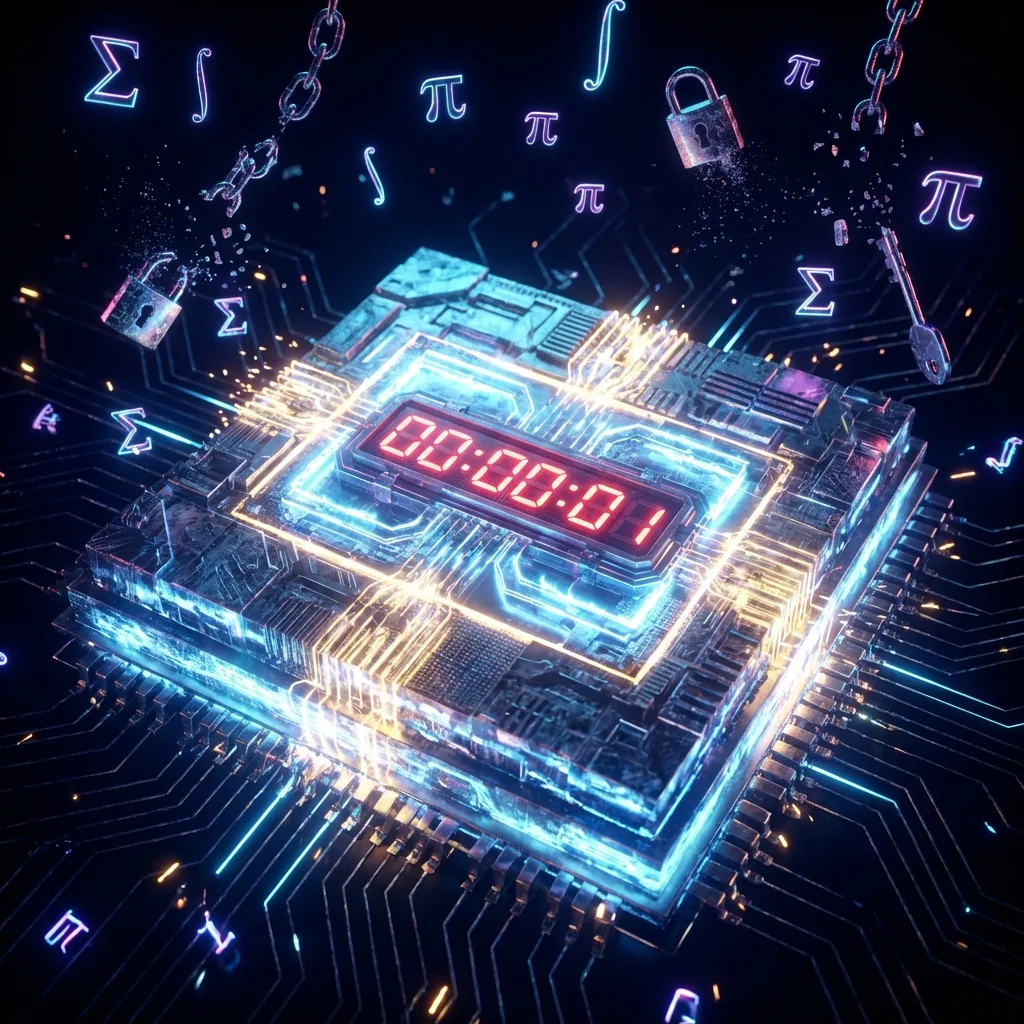
The Quantum Time Bomb: How an IBM Breakthrough Just Accelerated the Cryptographic Apocalypse
IBM's breakthrough in quantum error correction shortened the timeline to a cryptographic crisis, making the 'Harvest Now, Decrypt Later' threat urgent.
✨TL;DR / Executive Summary
IBM's breakthrough in quantum error correction shortened the timeline to a cryptographic crisis, making the 'Harvest Now, Decrypt Later' threat urgent.
💡 TL;DR (Too Long; Didn't Read)
IBM made a crucial breakthrough in quantum error correction, the biggest obstacle to functional quantum computers. By executing an error correction algorithm 10 times faster than necessary on commercial hardware (AMD FPGAs), they accelerated the timeline for a quantum computer by about a year. This has a direct and terrifying implication: the date for the "cryptographic apocalypse" — when a quantum computer can break our current encryption (RSA/ECC) — is closer. The "Harvest Now, Decrypt Later" threat (collecting encrypted data now to decrypt it later) becomes critical, placing governments and industries in a desperate race to adopt Post-Quantum Cryptography (PQC) before it's too late.
The Deafening Silence Before the Storm
Fellow engineers,
We've grown accustomed to living under the aegis of a fundamental truth: public key cryptography is secure. We sign our commits, access our servers, and protect trillions of dollars in financial transactions based on the mathematical premise that factoring very large prime numbers is computationally infeasible for classical computers.
For decades, quantum computing was the "threat on the horizon" — a theoretical concern, relegated to research papers and futuristic discussions. The promise that Shor's algorithm, executed on a large-scale quantum computer, could pulverize our security standards was real, but seemed distant. The main obstacle, the absurdly high error rate of qubits, made this threat a problem for the next generation.
This week, that comfort disappeared. An IBM announcement not only moved the timeline, but did so in an unexpected and deeply significant way. It wasn't a new miraculous qubit, but a breakthrough in the support infrastructure that governs qubits. And that, my friends, is far more alarming.
Let's dissect what happened and why the cryptographic time bomb suddenly started ticking much, much faster.
The Quantum Achilles Heel: Error Correction
A quantum computer isn't just a "faster version" of a classical computer. It operates based on quantum mechanics principles, using qubits that can exist in superposition (0 and 1 at the same time). The problem is that qubits are incredibly fragile. Any noise — a small vibration, a temperature fluctuation — can destroy the superposition and cause an error. The error rate is so high that, without a robust correction mechanism, any complex calculation unravels into useless noise.
Quantum Error Correction (QEC) is, therefore, the most critical task in the journey to a fault-tolerant quantum computer. It's the engineering that will allow science to work at scale.
IBM's Breakthrough: Speed and Accessibility
IBM's recent feat wasn't a new QEC code, but the demonstration that their advanced algorithm, Relay-BP, can be executed on commercially available hardware — specifically, on AMD FPGAs.
The implications of this are gigantic:
- Surprising Speed: The algorithm ran at a speed 10 times higher than necessary to keep pace with a quantum processor. This means that error correction, which was feared to be a performance bottleneck, can now run comfortably faster than the quantum calculations themselves that it needs to protect. The cop is no longer chasing the thief; it's waiting for them at the corner.
- Common Hardware: Using off-the-shelf FPGAs instead of very expensive custom chips drastically reduces the cost and complexity of scaling quantum systems. This democratizes and accelerates research and development across the entire ecosystem. It shows that the near future of quantum computing is a hybrid system, where the brute force of classical computers governs and enhances the delicacy of quantum processors.
This breakthrough puts IBM's Starling project (their large-scale quantum computer) about one year ahead of schedule, which was already aggressive (2029). IBM has a track record of meeting their roadmaps, and this announcement solidifies that reputation.
The Direct Impact: The Post-Quantum Cryptography (PQC) Crisis
One year may not seem like much, but in the world of global cybersecurity, it's a lost eternity. The acceleration toward a Cryptographically Relevant Quantum Computer (CRQC) triggers a red alarm for all digital systems on the planet.
A CRQC, using Shor's algorithm, will be able to break public key cryptography (RSA, ECC) in a matter of hours. This doesn't just mean future communications are at risk. It means all past and present communications are too.
HNDL: The Threat That's Already Happening
Enter the most urgent concept: Harvest Now, Decrypt Later (HNDL). State actors and organized crime groups are already, at this very moment, intercepting and storing enormous volumes of encrypted traffic. They can't read it today. But they're betting they will soon.
Think about it:
- State secrets and diplomatic communications.
- Intellectual property from high-tech corporations.
- Financial and health data of millions of people.
- Digitally controlled critical infrastructure.
All this volume of data, protected by encryption we consider secure, is being stockpiled in data centers, waiting for "Q-Day" when the digital lock will be universally broken.
The Race Against Time: An Unavoidable Migration
IBM's breakthrough transforms the migration to Post-Quantum Cryptography (PQC) from a strategic priority into an infrastructure emergency. NIST (National Institute of Standards and Technology) has already standardized new cryptographic algorithms (like CRYSTALS-Kyber and CRYSTALS-Dilithium) that are resistant to quantum computer attacks.
The problem is that implementing a new cryptography standard at global scale is a herculean task, which can take 5 to 10 years. We're talking about updating everything from web servers and browsers to embedded systems, satellites, and IoT devices.
The danger is that innovation in quantum hardware is outpacing the pace of bureaucracy and security implementation. If a CRQC is developed secretly, before a public announcement, the adversary will have a window of opportunity to decrypt legacy data without anyone knowing.
Conclusion: The End of Digital Innocence
IBM's breakthrough isn't just another step in scientific progress. It's a starting shot for a race we didn't know we were already losing. It forces us to confront an uncomfortable reality: our digital security infrastructure has an expiration date, and that date just got moved up.
The discussion about quantum computing needs to leave R&D labs and enter boardrooms and national security agencies. The HNDL threat means that inaction today is a guaranteed vulnerability tomorrow.
We're no longer talking about science fiction. We're talking about a global infrastructure migration that needs to start now. The quantum time bomb is active, and its ticking just got audibly louder.