Software Engineering in the AI Era: Technical and practical guide for experienced engineers
How experienced engineers integrate AI into the development cycle with governance: realistic gains of 20-40% on refactors, tests and docs, 5-15% elsewhere.
✨TL;DR / Executive Summary
How experienced engineers integrate AI into the development cycle with governance: realistic gains of 20-40% on refactors, tests and docs, 5-15% elsewhere.
💡 TL;DR (Too Long; Didn't Read)
AI doesn't replace engineering; it multiplies your leverage when guided by patterns, metrics, and governance. Realistic gains range from 20–40% for well-fragmented tasks (refactors, tests, docs) and 5–15% in architecture and discovery. Start today applying AI to safe refactoring, test generation, repetitive migrations, and assisted code reviews. Avoid blind code pasting, exposing secrets in prompts, and unverified outputs.
1. Context: The False Choice Between Productivity and Security in 2025
The volatility of the tech stack and pressure for increasingly faster deliveries created a false dilemma for engineering teams: accelerate development with Artificial Intelligence or preserve quality and security with traditional processes. The truth is that high-performance teams that scale responsibly don't choose one or the other — they combine the best of both worlds:
- AI as copilot: Used for deterministic, repetitive, and low-risk tasks.
- Qualified human review: Focused on architecture, domain boundaries, security, and complex trade-off decisions.
- Verification automation: Massive use of linters, automated tests (unit, integration), SAST/DAST, and software license verification.
- Telemetry: To continuously learn from product usage in production.
When well applied, this combination results in shorter lead time with fewer regressions, documentation closer to reality, and much faster onboarding of new developers.
Real (and Mitigable) Risks
- Data/secret leakage: Prompts containing API keys, passwords, or proprietary code.
- Plausible hallucinations: AI can "invent" solutions or APIs that seem correct but don't exist.
- Improper licensing: Code generation based on sources with restrictive licenses.
- Over-reliance: The dangerous habit of "accepting without understanding", eroding the team's technical knowledge.
2. What Changes in the Development Cycle
The traditional Software Development Life Cycle (SDLC) gains AI "hooks" at each stage:
- Discovery: Summarization of RFCs and PRDs, mapping requirements to test cases.
- Design: Comparison of architecture patterns, generation of code "skeletons".
- Implementation: Assisted generation of snippets, objective refactors, parameterized migrations.
- QA: Test generation from specifications and code diffs.
- Code Review: Heuristic analysis on top of diff with checklists and suggestions.
- Observability: Query generation (SQL, PromQL), explanation of metric anomalies.
- Documentation: Documentation synchronization from code and tests.
Golden Rule: Treat AI as a "transformation tool" with automatic validation and a human approval gate at critical points.
3. Where to Apply Now: High Impact, Low Risk
3.1 Safe Refactoring and Repetitive Migrations
Ideal for tasks like updating deprecated APIs, standardizing logging, and extracting functions.
Example Prompt (IDE/CLI):
Context: Repository
{X}, language{Y}. Objective: replace{legacy_API}with{new_API}without altering behavior. Provide:
- Step-by-step plan.
- Codemod script (if applicable).
- Test suite covering happy paths, edges, and errors. Constraints: maintain public interfaces. Cite files to change and justifications.
3.2 Test Generation and Amplification
Use the diff from a Pull Request to generate tests focused on changes, covering error and edge cases.
Prompt for Diff-Based Tests:
You are a QA engineer. Given this diff, generate minimal unit and integration tests to:
- validate public contracts,
- cover conditional branches,
- simulate dependency failures. Include fixtures and realistic synthetic data. Explain the rationale for each test.
3.3 Observability and Postmortems
Use AI to accelerate incident investigation.
Diagnostic Prompt:
Data: metrics (p50/p95), logs clipped from period T, changes from release R. Task:
- Propose 3 hypotheses with observable signals.
- Generate queries (PromQL/SQL) to validate.
- Suggest a partial rollback/feature flag plan.
3.4 Living Documentation
Extract contracts and examples from code and tests to generate READMEs and ADRs (Architecture Decision Records).
Prompt for Code-Based Documentation:
Generate documentation for module
{M}with:
- purpose in 1 paragraph,
- public APIs (signatures and examples),
- invariants and errors,
- dependencies,
- copy-paste examples. Don't invent endpoints. Use only provided code.
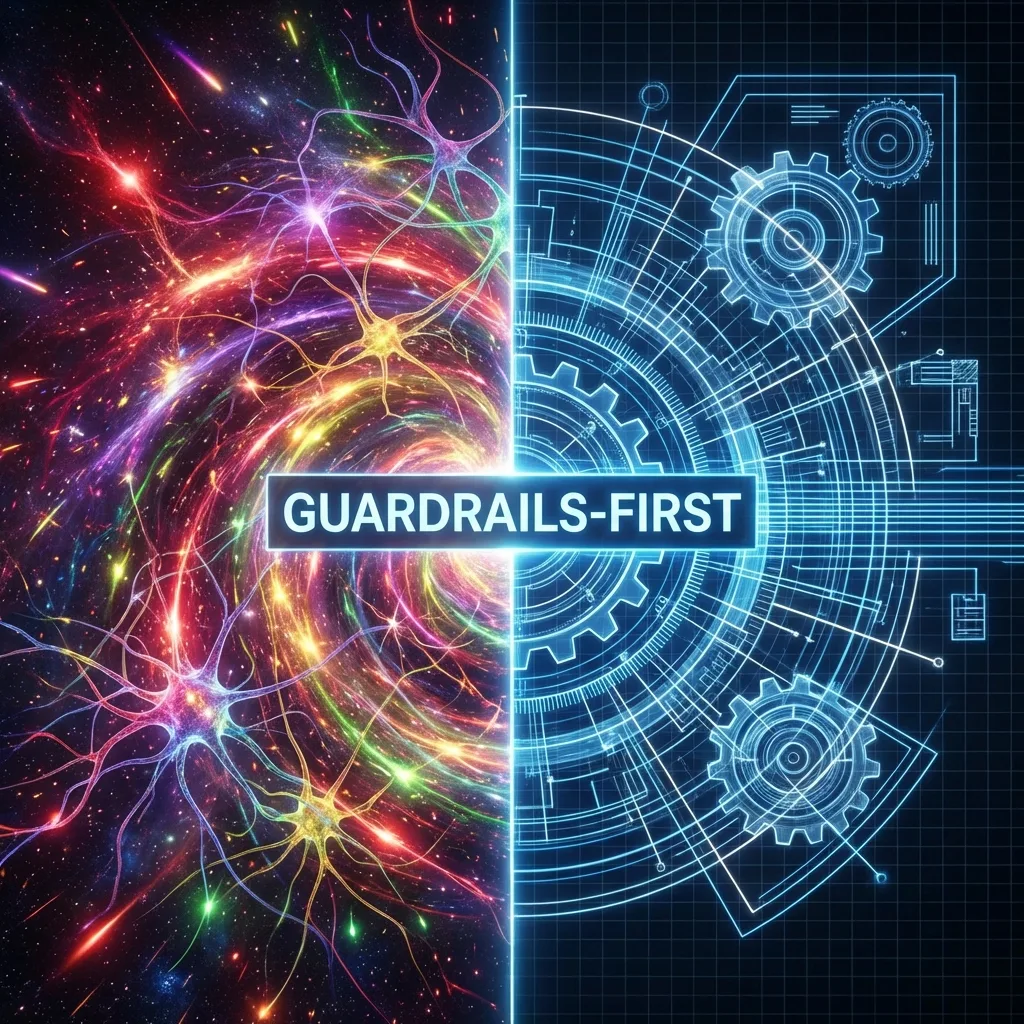
4. Reference Architecture: "Guardrails-first"
The goal is to allow free AI use in development, but with automatic brakes and auditing.
Key Components:
- Context Provider: Limits and sanitizes what's sent to the model (removes secrets, truncates code).
- Policy Engine: Applies compliance rules (PII, licenses, etc.).
- Model Router: Chooses the right AI model for the task (fast/cheap for boilerplate, powerful for reasoning).
- CI/CD Validators: Linters, tests, SAST/DAST, secret and license scanners.
- Audit Trail: Anonymized logs of prompts and responses for review and improvement.
5. Metrics That Matter
To measure success, compare the baseline (2-4 weeks before AI) with the post-adoption period:
- Lead time and cycle time by task type.
- Rework rate (reverts/rollbacks per 100 PRs).
- Effective test coverage (focused on changed code).
- Escaped defects per release.
- Healthy adoption: % of PRs with AI artifacts approved without critical rework.
6. Risks and Antipatterns (and How to Mitigate)
| Risk | Antipattern | Mitigation |
|---|---|---|
| Secret Leakage | Paste .env or keys in prompt | Automatic scanning (secret scanning) and send blocking. |
| Plausible Hallucination | Accept code using a non-existent API | Require citations/links to official documentation and validate. |
| Accept Without Understanding | Approve large AI-generated PRs without questioning | Require rationale and explanatory comments in generated code. |
| Licensing | Generate code based on restrictive licenses | Similarity and OSS license verification in CI/CD. |
| Unversioned Context | Base prompts on Slack conversations | Everything AI uses must be part of repository or versioned documentation. |
7. Conclusion
Artificial Intelligence is not a threat to quality software engineering; it's a leverage tool. It raises the ceiling of what an excellent team can deliver, as long as it's combined with guardrails, metrics, and conscious engineering. The question isn't "AI or quality?", but rather "what's the socio-technical system design that maximizes both?".