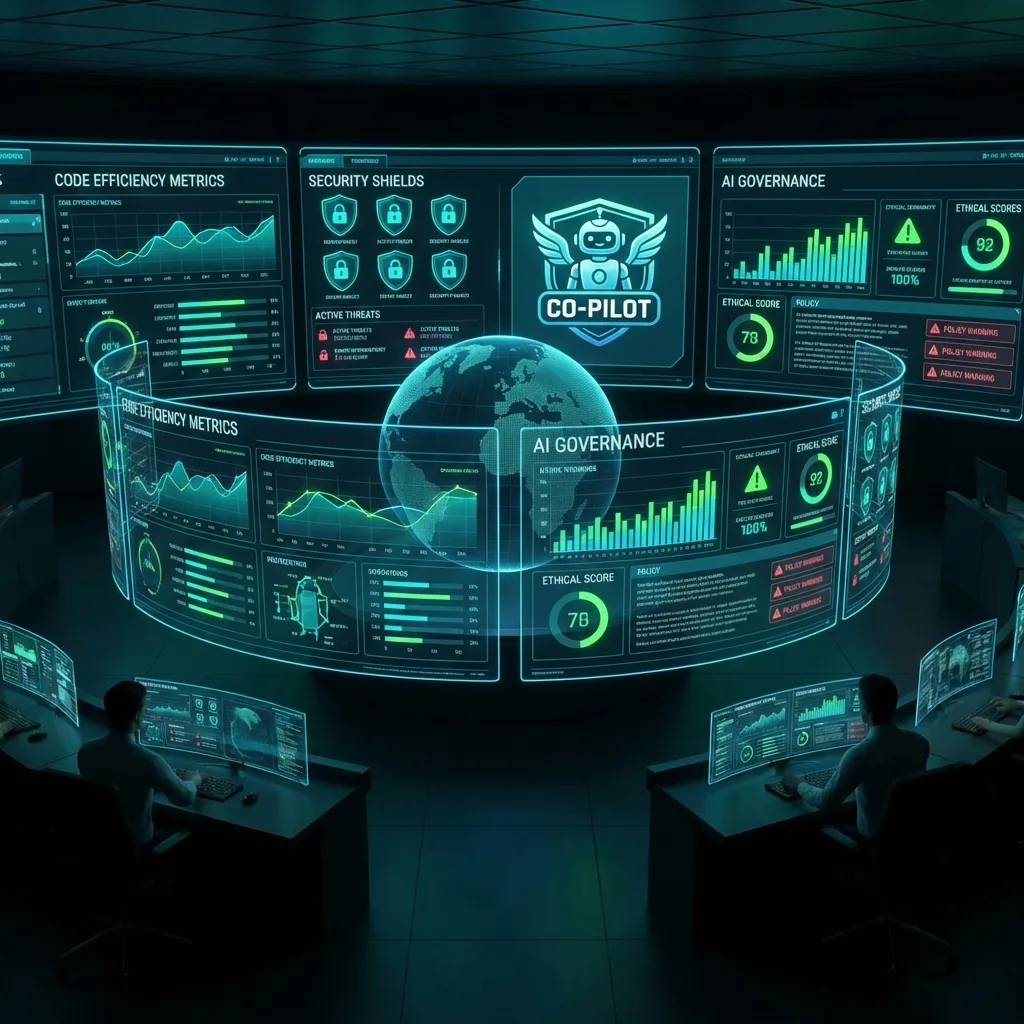
Software Engineering in the AI Era: How to multiply productivity without sacrificing quality, security, and control
Multiply productivity with AI without sacrificing quality or control: where the 20-40% gains actually are, and the governance that keeps them safe.
✨TL;DR / Executive Summary
Multiply productivity with AI without sacrificing quality or control: where the 20-40% gains actually are, and the governance that keeps them safe.
💡 TL;DR (Too Long; Didn't Read)
AI doesn't replace engineering; it multiplies your leverage when guided by patterns, metrics, and governance. Realistic gains: 20–40% on well-fragmented tasks (refactors, tests, docs), 5–15% on architecture/discovery.
Where to use today: safe refactoring, test generation, repetitive migrations, log/telemetry coverage, living documentation, and assisted code reviews.
What to avoid: blind pasting, secrets in prompts, dependence on unversioned context, unverified outputs.
Start small with an "AI Working Agreement", baseline metrics, and a guardrail pipeline.
1. Context: productivity vs. security in 2025
Stack volatility and pressure for fast deliveries created a false dilemma: accelerate with AI or preserve quality. Teams that scale responsibly combine:
- AI as copilot for deterministic and repetitive tasks.
- Human review focused on architecture, domain boundaries, and security.
- Verification automation (linters, tests, SAST/DAST, license/OSS).
- Telemetry to continuously learn from usage.
Benefits when well applied:
- Shorter lead time with fewer regressions.
- Documentation closer to reality (generated from code/tests).
- Accelerated onboarding through summaries and guided navigation.
Real (and mitigable) risks:
- Data/secret leakage in prompts.
- Plausible hallucinations in ambiguous areas.
- Improper licensing/OSS in generation.
- Over-reliance: "accepting without understanding".
2. What changes in the development cycle
The traditional cycle (discovery → design → implementation → tests → review → deploy → observability) gains AI "hooks":
- Discovery: RFC and PRD summarization, mapping requirements to test cases.
- Design: pattern comparison, skeleton generation, trade-off analysis.
- Implementation: assisted snippet generation, objective refactors, parameterized migrations.
- QA: test generation from specs and diffs, guided fuzzing.
- Code review: heuristics on top of diff with checklists and "what could go wrong".
- Observability: query generation (SQL/PromQL), spike and regression explanations.
- Documentation: doc synchronization from code and tests.
Golden Rule
Treat AI as a "transformation tool" with automatic validation and human gate at critical points.
3. Where to apply now (high impact, low risk)
3.1 Safe refactoring and repetitive migrations
- Updating deprecated APIs.
- Extracting pure functions, introducing domain boundaries.
- Standardizing logging/telemetry.
Example prompt (IDE/CLI) for controlled refactor:
Context: Repository {X}, language {Y}. Objective: replace {legacy_API} with {new_API} without altering behavior.
Provide:
1) Step-by-step plan.
2) Codemod script (if applicable).
3) Test suite covering happy paths, edges, and errors.
Constraints: maintain public interfaces, don't alter persistence. Cite files to change and justifications.
3.2 Test generation and amplification
- From diff: generate tests focused on changes.
- Coverage of error paths and frequently forgotten edge cases.
Prompt for diff-based tests:
You are a QA engineer. Given this diff, generate minimal unit and integration tests to:
- validate public contracts,
- cover conditional branches,
- simulate dependency failures.
Include fixtures and realistic synthetic data. Explain the rationale for each test.
3.3 Observability and postmortems
- Query and explanation generation: "why did p95 rise 18% after release R?"
- Suggestion of experiments or feature flags to mitigate.
Diagnostic prompt:
Data: metrics (p50/p95/p99), logs clipped from period T, changes from release R.
Task:
1) propose 3 hypotheses with observable signals,
2) queries (PromQL/SQL) to validate,
3) partial rollback/flag plan.
3.4 Living documentation
- AI extracts contracts and examples from code and tests to generate README, ADRs, and FAQs.
- Maintains consistency via CI checks: if signature changes, doc needs updating.
Prompt for code-based docs:
Generate module {M} documentation with:
- purpose in 1 paragraph,
- public APIs (signatures and real examples),
- invariants and errors,
- internal/external dependencies,
- copy-paste examples.
Don't invent endpoints. Use only provided code.
4. Reference architecture: "Guardrails-first"
The goal is to allow free use in development, with automatic brakes and auditing.
Components:
- Context provider: limits and sanitizes what goes to the model (secret removal, intelligent truncation, public doc references).
- Policy engine: compliance rules (PII, licenses, terms).
- Model router: chooses model by task (cheap/fast for boilerplate, strong for reasoning).
- CI validators: linters, tests, SAST/DAST, secret scanners, license/OSS, semantic diffs.
- Audit trail: anonymized prompt/response logs for review and improvement.
- On-prem/proxy for secrets and sensitive contexts when needed.
Flow:
- Dev triggers AI in IDE/CLI with explicitly selected context.
- Context provider applies redactions and annotations.
- Model router decides engine and temperature.
- Output passes through validators (static and test-based).
- CI blocks merges that reduce coverage/violate policies.
- Audit records blocking reasons and success examples.
5. Metrics that matter
- Lead time and cycle time by task type (baseline vs. post-AI).
- Rework rate (reverts/rollbacks per 100 PRs).
- Effective test coverage (relevant lines/branches touched by diff).
- Escaped defects (per release).
- Review SLO: time to 1st review and final approval.
- Healthy adoption: % of PRs with AI-generated artifacts approved without critical rework.
Pro Tip
Establish baseline 2–4 weeks before and compare after 4–8 weeks with AI.
6. Risks and antipatterns (and how to mitigate)
- Secret prompt dumping: use automatic scanning and send blocking.
- Plausible hallucination in SDKs: request citations/links and validate against local docs.
- "Accept without understanding": require rationale and explanatory comments.
- Licensing: configure similarity/OSS verification in CI.
- Unversioned context dependency: everything AI uses must be part of repo, data catalog, or versioned docs.
PR Checklist:
- AI-generated rationale included.
- Tests covering changes.
- No exposed secrets.
- Licenses/OSS verified.
- Documentation updated.
7. 30-day adoption playbook
- Week 1:
- Define "AI Working Agreement" (what's allowed, what's not).
- Enable secret scanning, SAST, license/OSS, minimum coverage in CI.
- Choose 2–3 pilot cases (refactors, tests, docs).
- Week 2:
- Deploy context provider with redactions.
- Standardize prompts (templates) by use case.
- Measure baseline (cycle time, rework, coverage).
- Week 3:
- Expand to assisted code review and observability.
- Implement prompt auditing and secure storage.
- Week 4:
- Retrospective with metrics.
- Adjust policies and model routing.
- Train team with real repository examples.
8. Practical examples (copy-paste)
8.1 HTTP client API migration
Prompt:
Objective: migrate from axios to native fetch API in TypeScript.
Rules: maintain equivalent interceptors, timeouts, cancellation, and exponential retries.
Deliver:
- example codemod for simple requests,
- `httpClient.ts` wrapper with stable API,
- 6 tests (2 success, 2 error, 2 timeout).
Expected output: wrapper with AbortController, jittered retries, consistent error mapping, and deterministic tests.
8.2 Test generation from OpenAPI contract
Prompt:
Given this OpenAPI.yml, generate Jest integration tests that:
- validate contracts (status, headers, schema),
- cover error cases (4xx/5xx),
- use realistic synthetic data.
Also create a JSON collection to run in Newman.
8.3 Code review with checklist
Prompt:
You are a senior reviewer. For this diff:
- list architectural risks,
- verify domain invariants,
- point out style/pattern violations,
- generate 5 questions that reveal unknowns.
Provide a confidence score (0–100) with justification.
9. SEO and technical content integration
For articles/documentation accompanying the repository:
Articleschema with embeddedFAQPage.- Tables with reusable prompts.
- Images with descriptive alt text, technical captions, and sources.
Suggested CTAs:
- "Download the QA prompt kit".
- "See the CI/CD guardrails checklist".
10. FAQ
- Does AI replace pair programming? No. Works as a tireless pair, but needs human direction for context and trade-offs.
- Is it safe to use AI with proprietary code? Yes, with redactions, clear policies, proper routing, and when necessary, on-prem/proxy execution.
- How to justify ROI? Compare lead time, rework, coverage, and escaped defects pre and post-adoption on similar tasks.
- When not to use? In ambiguous domain decisions without sufficient data, in crypto/sensitive protocols without expert review, and where compliance prohibits.
11. Conclusion
AI raises the ceiling of what an excellent team can deliver, as long as it's combined with guardrails, metrics, and conscious engineering. The question isn't "AI or quality", but rather "what's the socio-technical system design that maximizes both?".
Final CTA:
- Download the "AI Working Agreement" (template).
- Apply the assisted PR checklist.
- Run the 30-day pilot and measure.