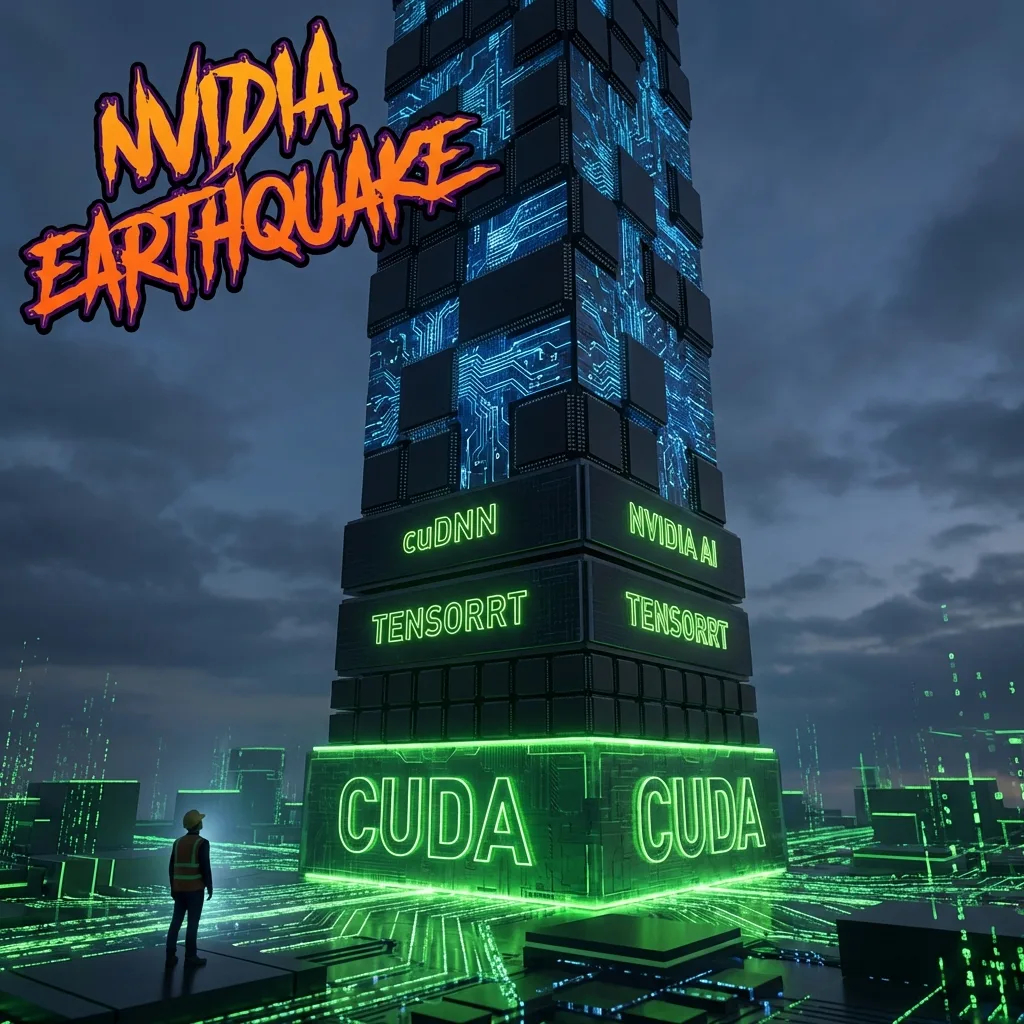
An Engineer's View of the Nvidia Earthquake
An in-depth analysis, from the silicon trenches, of how Nvidia built a $5 trillion monopoly not just with hardware, but with a 20-year software ecosystem.
✨TL;DR / Executive Summary
An in-depth analysis, from the silicon trenches, of how Nvidia built a $5 trillion monopoly not just with hardware, but with a 20-year software ecosystem.
💡 TL;DR (Too Long; Didn't Read)
Nvidia's $5 trillion valuation isn't just about its AI chips. The real trump card is CUDA, a software ecosystem built over 20 years that has become the universal language for parallel computing. This created an almost insurmountable competitive moat, trapping millions of developers and major AI frameworks. While the competition focuses on hardware, Nvidia has already won the software war, and is now expanding its dominance from cloud to edge with the Jetson platform, solidifying its role as the fundamental infrastructure of the AI era.
Nvidia Isn't Just a Company, It's an Earthquake. A 25-Year Engineer's View of the Monopoly Defining Our Future.
Hello. I'm the kind of guy who finds a well-written datasheet exciting. Who debates the nuances between latency and throughput at lunch. For 25 years, my life has been optimizing code to run on resource-constrained hardware, often with less RAM than your smartphone uses to open a single photo. I've seen dot-com bubbles burst, seen tech giants fall to their knees, and seen "revolutionary" promises turn to dust in server fans.
That's why, when I look at Nvidia hitting a $5 trillion market valuation – a milestone reached in the blink of an eye, going from $4 to $5 trillion in mere three months – my reaction isn't blind euphoria. It's deep, slightly frightened respect. What we're witnessing isn't just a company's success. It's the consolidation of a new foundation for computing, as fundamental as the invention of the microprocessor or the internet itself.
And the reason for this undisputed dominance is something most financial analysts only superficially understand. They see "AI chips". I see something much deeper, a power architecture that was carefully built, brick by brick, over two decades.
Section 1: The Mistake Everyone Makes – "It's Just the Hardware"
The headline is simple: "Nvidia dominates because of its advanced AI chips". It's a truth, but a dangerously incomplete truth. It's like saying Ferrari dominates Formula 1 because their cars are red. The color is what you see, but it's not what makes them win.
Any deep-pocketed tech giant – Google, Amazon, Microsoft, Meta – can, in theory, design a fast chip. They can hire the best engineers, pay a premium to TSMC or Samsung to manufacture on their most advanced process nodes, and on paper, create a transistor that competes with Nvidia's best. In fact, they're doing this. Google's Tensor Processing Unit (TPU), Amazon's Trainium and Inferentia are notable examples.
But they're making the same mistake many made in the past: they think the battle is won in hardware. For God's sake, Nvidia's battle was won almost 20 years ago. Their hardware is just the tip of the iceberg, the visible part of a massive, invisible structure that sinks deep into the tech industry's ground.
Nvidia's true genius, their true wall, isn't the Ampere or Hopper architecture itself. It's CUDA.
Section 2: The Alchemy of CUDA – How Nvidia Invented a New Language for Thinking
To understand what CUDA is, you need to understand what the world was like before it. In the early 2000s, GPUs (Graphics Processing Units) were highly specialized workhorses. They were fantastic at one thing: drawing polygons and textures on your screen. Programming them to do anything else, like scientific calculations or data processing, was a nightmare. It was a "wild west" of proprietary tools, obscure syntaxes, and hack tricks that made you use the graphics pipeline to do matrix calculations. It was inefficient, fragile, and accessible only to a small group of insiders.
In 2006, Nvidia did something that seemed crazy at the time: they released CUDA (Compute Unified Device Architecture). They essentially opened their GPU and said: "Hey, world. This is no longer just a video card. It's a parallel supercomputer in a PCIe slot. And here's a language, based on C++, that lets you command it."
That changed everything.
For a software engineer, CUDA isn't just an API. It's a universal language for parallel thinking. It abstracted the brutal complexity of GPU architecture and gave us a toolset that made the complex, simple. They didn't just sell an engine; they delivered the whole car, with the steering wheel, dashboard, transmission, and an instruction manual that any reasonably competent engineer could understand and use.
The result? An explosion of innovation. Suddenly, researchers in fields that had nothing to do with graphics – bioinformatics, climate modeling, quantitative finance, and later, artificial intelligence – had access to massively parallel computing power for a fraction of the cost of a traditional supercomputer.
Millions of developers, including myself in computer vision projects for industrial systems, have spent the last decade and a half investing our time, our brains, and our careers in mastering this ecosystem. This is an asset you can't buy with money. It's built with time, community, and trust. It's an entry barrier so high that, for many, it's insurmountable.
Section 3: The Insurmountable Moat – Dismantling the Competition
Okay, you're Microsoft or Google. We have an army of PhDs and an R&D budget bigger than some countries' GDP. You can create a chip that, on paper, is 10% more efficient than an Nvidia H100. Fantastic. Congratulations. Now the real work begins.
You need to build what I call the "Stack of Trust". And it has several layers, and Nvidia has a 15-year advantage in each one:
-
Drivers and Compilers: Your chip is useless without a stable driver that communicates it with the operating system. And not a driver that "works most of the time". It needs to be rock-solid, optimized for different workloads and without bugs that crash the entire system during a weeks-long model training. Nvidia has battle-tested drivers in every imaginable scenario.
-
Fundamental Libraries: This is the layer where magic happens. Nvidia doesn't expect you to program everything in pure CUDA. They offer an arsenal of highly optimized libraries, like cuDNN (for deep neural networks), cuBLAS (for linear algebra), and TensorRT (for inference optimization). These libraries are written by geniuses who understand hardware at an almost molecular level, extracting every last clock cycle from silicon. Recreating this arsenal is a herculean task.
-
Debugging and Profiling Tools: How do you know why your model is slow? How do you find a bug in your kernel that only appears on the thousandth execution? Nvidia offers a suite of tools (like Nsight) that allows developers to "look inside" the GPU and see exactly what's happening. Without this, you're navigating in the dark.
-
The Ecosystem and Community: This is the most powerful layer of all. All major AI frameworks in the world – TensorFlow, PyTorch, JAX, MXNet – were built from day one with first-class support for Nvidia. When a revolutionary new AI paper is published, the code almost always comes with an implementation that runs "out-of-the-box" on an Nvidia GPU. Trying to compete with this is like trying to build an operating system to compete with Windows or macOS today. You might even be technically superior, but who's going to develop software for you?
Hyperscalers' efforts to develop their own solutions are smart from a strategic standpoint – they want to reduce dependence and costs. But it's an uphill battle. They're trying to build a city to compete with New York. You might even erect some tall, impressive buildings, but you lack the subway, the power grid, the culture, and the millions of people who make everything work 24/7.
Section 4: From Cloud to Edge – The Next Frontier and My World
Now, let's leave the hyperefficient data centers and enter my world: the world of embedded software, of "edge computing". This is where Nvidia's long-term vision becomes even more terrifying (and brilliant).
AI won't live only in the cloud. To be truly useful, it needs to come to the real world, to devices. Autonomous cars need to make decisions in milliseconds, not waiting for a response from a server hundreds of miles away. Smart security cameras need to identify a threat on-site. Factory robots need to adapt to unexpected objects in real time. Doctors need image analysis in portable diagnostic devices.
This is AI's frontier: low power consumption, real-time computing, and extreme reliability.
And guess who's positioning their chips (and more importantly, their software) to dominate this space too?
The Nvidia Jetson platform is a small engineering miracle. It's a credit-card-sized AI supercomputer that consumes the energy of a light bulb. And it runs the same software, the same libraries, the same CUDA ecosystem as the gigantic H100 servers in the cloud.
This creates extremely powerful symmetry. A company can develop and train a massive AI model in the cloud using DGX Stations (Nvidia's supercomputers) and then use Nvidia's tools to optimize and deploy that same model on thousands of Jetson devices in the field. It's a continuous workflow, from development to deployment, that no one else can offer at this time.
They're taking this a step further with concepts like "digital twins". They're building supercomputers to simulate the entire world in real time, allowing companies to test and validate autonomous systems (like cars or factories) in a perfect virtual environment before deploying a single line of code on physical hardware. It's a futuristic vision becoming reality, and it's built entirely on Nvidia's foundation.
Section 5: Bubble or Foundation? An Analysis from Someone Who's Seen This Movie
The trillion-dollar question: is Nvidia's valuation sustainable?
Let me be pragmatic, as an engineer must be. Yes, the speed and magnitude of the rise smell like speculation. The market is exuberant, and a stock price correction isn't just possible, it's probable. The financial market is known for its short-term irrationality.
But the underlying utility is real and transformative. We're in the AI gold rush. And Nvidia? They're not looking for gold. They're selling the pickaxes, shovels, jeans, and mine map. And they're the only ones manufacturing them at industrial scale.
As long as companies from all sectors, from pharmaceuticals to automotive, from startups to governments, need to build larger and more complex AI models to gain a competitive advantage, they'll need the massive-scale parallel computing infrastructure that Nvidia provides. The demand isn't for "Nvidia stock", it's for computing capacity. Nvidia is simply the only credible and proven supplier at the moment.
Historically, we've seen this before. IBM and the mainframe era. Microsoft and Intel with the Wintel architecture that dominated the PC era. Google and its search engine dominance. In each case, a company created a platform so fundamental and with a moat so deep that it became the base layer on which everyone else built. Nvidia is positioning itself as that base layer for the AI era.
Section 6: The Cost of Dominance – A Necessary Reflection
As an engineer, I'm obsessed with optimizing systems. And a system with a single point of failure is a fragile system. Nvidia's dominance, as impressive as it is, represents a systemic risk to the entire tech industry.
We're talking about vendor lock-in on an unprecedented scale. Innovation from other companies can be stifled, as it's almost impossible to compete with a monopoly that controls hardware, software, and the talent ecosystem.
There's also the geopolitical question. All this silicon magic depends on a single critical point of failure: TSMC in Taiwan. Any disruption in this supply chain – whether from conflict, natural disaster, or politics – would paralyze not just Nvidia, but the entire AI revolution that depends on its chips.
Nvidia itself, in its relentless pursuit of growth, needs to be careful. Power corrupts. Complacency destroys. History is full of giants who became slow and arrogant, only to be toppled by an agile startup with a better idea.
Conclusion: Building on Tectonic Plates
So what does this $5 trillion milestone mean? It means Nvidia has transcended the "tech company" category. It has become critical infrastructure, a utility as essential as electricity or the internet for the 21st-century economy.
The journey from $4 trillion to $5 trillion, driven by announcements of $500 billion in new orders and plans to build supercomputers for the US government, isn't the end of the story. It's the accelerator being pushed to the floor.
After 25 years coding silicon, seeing what's real and what's hype, I can say one thing with certainty: what Nvidia has built is the most real and robust thing I've seen in my entire career. They didn't just build a better product; they built a whole world around it.
The earthquake they started hasn't ended. In fact, it's only beginning. And all of us, whether engineers, entrepreneurs, or citizens, are building our homes, our businesses, and our future on the tectonic plates that Nvidia just moved. The only question is: where will they move next?