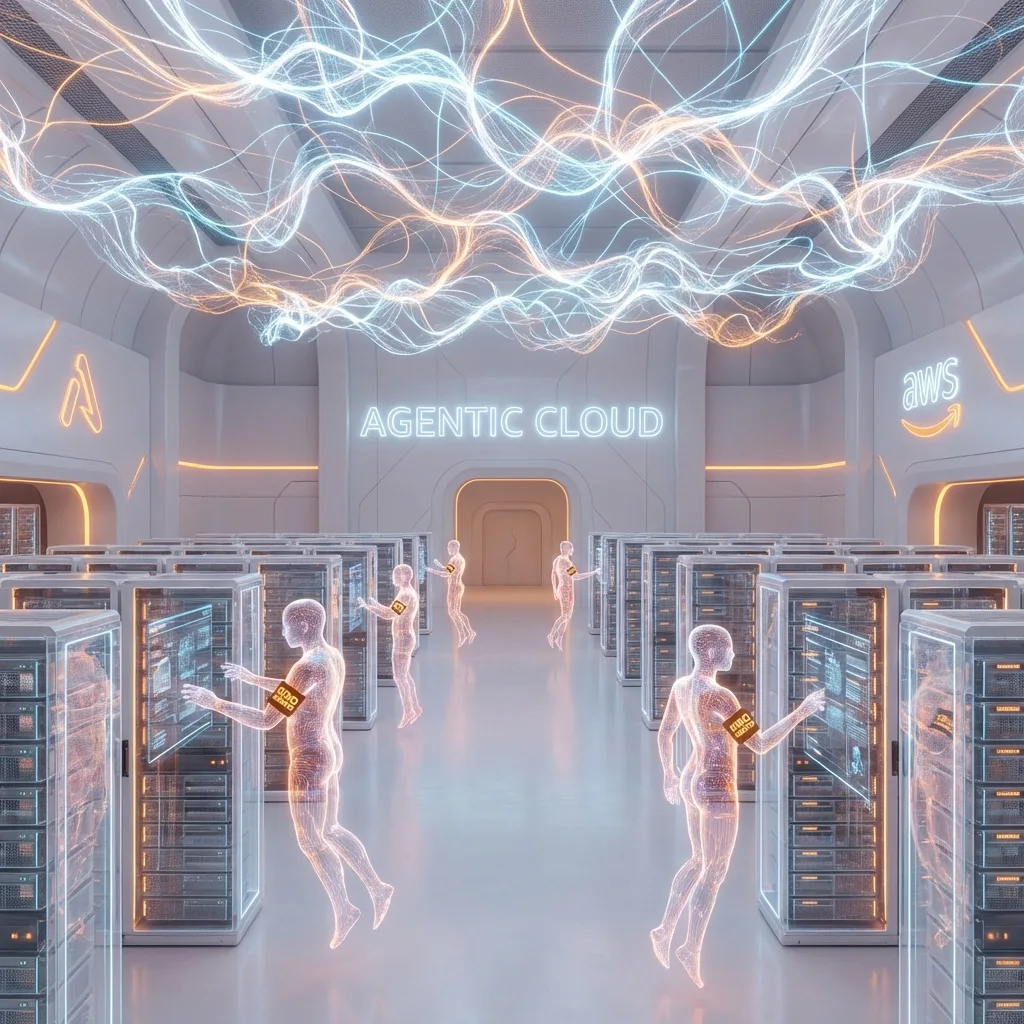
The End of DevOps as We Know It: AWS re:Invent 2025 and Frontier Agents
AWS no longer just wants to host your servers. With the launch of Amazon Kiro and Nova 2, it wants to replace your junior developers.
✨TL;DR / Executive Summary
AWS no longer just wants to host your servers. With the launch of Amazon Kiro and Nova 2, it wants to replace your junior developers.
💡 TL;DR (Too Long; Didn't Read)
AWS re:Invent 2025 marked the end of the "Infrastructure Cloud" and the beginning of the "Agentic Cloud". The launch of Amazon Kiro (an autonomous virtual developer) and the Nova 2 model family signals that AWS doesn't just want to sell EC2 and S3; it wants to sell "cognitive labor". With agents capable of operating for days without supervision, the role of DevOps is shifting from "managing servers" to "managing fleets of AI agents".
For nearly two decades, AWS re:Invent was an event about "plumbing": compute, storage, networking, databases. It was about building the foundation of the internet.
In 2025, plumbing took a back seat. The main stage wasn't dominated by new EC2 instances with 5% better performance, but by silicon colleagues.
Matt Garman's (AWS CEO) message was clear and somewhat daunting: "The cloud is no longer just where you run your code. It's where the code writes, fixes, and operates itself."
In this article, we'll analyze the two game-changing announcements—Amazon Kiro and Nova 2—and what this means for the future of our profession.
1. Amazon Kiro: The Developer Who Never Sleeps
If GitHub Copilot is the intern sitting next to you suggesting lines of code, Amazon Kiro is the mid-level engineer you hire to work through the backlog while you sleep.
What is a "Frontier Agent"?
AWS coined the term "Frontier Agent" to differentiate tools like Kiro from traditional chatbots.
- Chatbot: Answers a question (Stateless). "How do I make a loop in Python?"
- Frontier Agent: Solves a business problem (Stateful, Long-running). "Migrate this microservice from Java 8 to 21 and update all dependencies."
Kiro doesn't return a code snippet. It:
- Clones the repository.
- Reads internal documentation.
- Plans the migration.
- Creates an isolated test environment.
- Executes the changes.
- Runs tests (and fixes those that break).
- Opens a Pull Request with a detailed report.
It was designed to run for days without human intervention, maintaining context across thousands of files.
The Death of the Level 1 Support Ticket
The most immediate use case demonstrated was incident resolution. Integrated with CloudWatch, Kiro can detect a latency spike, investigate logs, identify the culprit commit, revert it, and notify the team on Slack—all in less than 3 minutes, at 3 AM on a Saturday.
For DevOps and SRE teams, this is the Holy Grail... and also an existential threat for those who only know how to "restart servers".
2. Amazon Nova 2: AWS Enters the LLM Fight
For years, AWS seemed to be losing the generative AI race, relying on partners like Anthropic on Amazon Bedrock. With Nova 2, the gloves are off.
The Nova 2 family (Lite, Pro, Omni) isn't just "another model". It is specifically optimized for agentic reasoning on AWS infrastructure.
Why Does This Matter?
Models like GPT-4 or Claude are generalists. They know how to write poetry and Python code. Nova 2 was trained with deep AWS telemetry.
It "understands" the state of a VPC not as JSON text, but as a network topology. It knows intuitively (statistically) that changing a Security Group in that specific way will drop the connection to RDS, because it has seen this happen in millions of other accounts.
This gives AWS agents an unfair advantage: situational awareness. While an external agent (like Devin or Claude Code) needs to "read" the infrastructure via API (slow and limited), Nova 2 runs inside the cloud control plane.
3. Infrastructure for Inference: The New "Compute"
The tectonic shift wasn't just in software. AWS announced Trainium3 and Graviton5, but with a different focus.
Previously, we optimized servers to serve web requests (high I/O, concurrency). Now, AWS is optimizing entire datacenters for agent inference.
"Inference-Grade Networking"
Agents like Kiro exchange gigabytes of context (code, logs, memory state) with the model at every step. Network latency between the "brain" (GPU) and the "body" (the environment where code runs) has become the new bottleneck.
AWS redesigned its internal network fabric to allow agents to "think" and "act" in a closed loop with microsecond latency. It is the physical infrastructure enabling the vision of the "Agentic Runtime" we discussed in the Anthropic article.
4. What Does This Mean for Your Job?
We are seeing a clear bifurcation in tech careers.
What is disappearing:
- Boilerplate Coding: Writing CRUDs, obvious unit tests, standard Terraform configurations.
- Manual Operations: Manually investigating logs, restarting pods, rotating keys.
- The "YAML DevOps": If your job is just translating requirements into Kubernetes YAML files, Kiro does it better and faster.
What is emerging:
- Agent Ops: Someone needs to configure Kiro's permissions, define its budget limits (so it doesn't spend $10k trying to fix an infinite loop), and audit its decisions.
- Intent Architecture: Defining what the system should do and what the business and security constraints are.
- AI Governance: Ensuring that code generated by Nova 2 doesn't violate compliance or introduce subtle vulnerabilities.
Conclusion: The Autonomous Cloud
AWS re:Invent 2025 wasn't about tools to help humans work in the cloud. It was about tools that work in the cloud so humans can focus on the product.
The term "Serverless" was always a lie; there were servers, you just didn't manage them. Now are we entering the "Devless" era? Not exactly. But we are certainly entering the "Juniorless" era.
The barrier to entry has risen. The cloud now comes with an army of robots included in the hourly price. The question is: will you be the commander of this army, or will you try to compete with it by typing code by hand?
Get ready. 2026 will be the year your pull request gets reviewed by an AI, approved by another, and deployed by a third. And you? You'll be designing the system they are building.
Keep following the gsstk blog. Next week: a practical analysis of Google Antigravity and the new "Agent-First" paradigm.