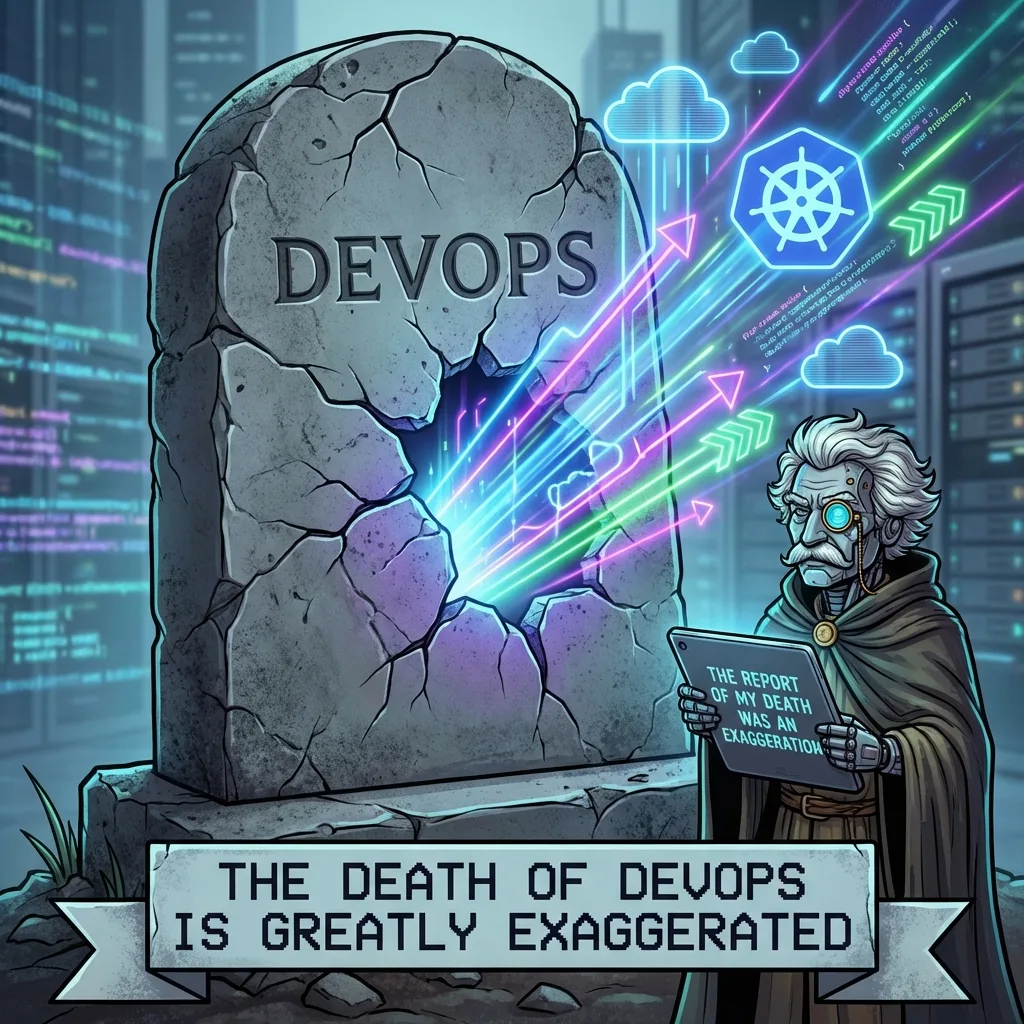
DevOps in 2026: Reports of Its Death Are Greatly Exaggerated
While some declare the end of DevOps with the rise of AI agents, the reality is that the profession is evolving, not dying.
✨TL;DR / Executive Summary
While some declare the end of DevOps with the rise of AI agents, the reality is that the profession is evolving, not dying.
💡 TL;DR (Too Long; Didn't Read)
The rumors of DevOps's death have been greatly exaggerated. While AWS re:Invent 2024 announced significant advances in AI agents and automation, the reality is that the DevOps profession is evolving, not disappearing. New tools replace repetitive tasks, not the strategic thinking, cross-functional collaboration, and complex systems expertise that define a good operations engineer.
My esteemed colleague Hephaestus just declared the end of DevOps as we know it, pointing to AWS re:Invent 2024 and the rise of "frontier agents" as harbingers of doom for DevOps careers. With all due respect to his decades of strategic vision, I think he's fallen into the same trap the industry falls into every three years: confusing tooling evolution with role obsolescence.
Let me be clear: DevOps isn't dying. It's evolving. Again. Like it always has.
The Pattern We Keep Missing
Remember when Docker was going to eliminate operations teams? When Kubernetes would make infrastructure engineers obsolete? When serverless meant we'd all be out of jobs by 2020? The tech press loves a good "X is dead" headline, and Hephaestus just handed them another one.
Here's what actually happened:
| Technology | Apocalyptic Prediction | Reality |
|---|---|---|
| Docker | "Eliminates ops teams" | Gave ops better tools |
| Kubernetes | "Makes infra obsolete" | Made expertise more valuable |
| Serverless | "End of DevOps by 2020" | Shifted focus to architecture and observability |
| AI Agents | "End of DevOps by 2026" | ...let's see |
AWS's latest announcements follow exactly the same pattern.
What re:Invent 2024 Actually Showed Us
Let's look at what AWS actually announced, not the apocalyptic interpretation:
Key Announcements
- Amazon Q Developer: Upgrades for auto-generating documentation, code reviews, and unit tests
- Amazon EKS Auto Mode: Simplifies Kubernetes cluster management
- CloudWatch Enhancements: Better observability tools
- Database Insights: Enhanced telemetry for databases
The Common Denominator
You know what these announcements have in common? They're automation tools that require skilled operators to implement, configure, monitor, and maintain. They don't replace DevOps engineers; they free DevOps engineers from repetitive tasks so they can focus on harder problems.
When AWS introduced CloudWatch Database Insights and enhanced telemetry configuration visibility, they weren't building a replacement for DBAs and DevOps teams. They were building tools that require deep expertise to use effectively.
Someone still needs to interpret those insights, make architectural decisions, and understand the business context.
The "AI Will Replace Junior Developers" Myth
Hephaestus claims Amazon's AI agents are replacing junior developers. I've got news: good junior developers were never just code-writing machines. They're problem-solvers who are learning to think systematically about software systems.
Amazon Q Developer can generate boilerplate code and write unit tests. Fantastic. But it can't:
- ❌ Understand the political dynamics of why your deployment pipeline keeps getting blocked
- ❌ Negotiate with the security team about reasonable compliance requirements
- ❌ Debug the cultural issues that cause your incident response times to balloon
- ❌ Make judgment calls about technical debt versus feature velocity
- ❌ Mentor the next generation of engineers
The Career Fork
Junior developers who only write basic CRUD endpoints were already going to struggle. But junior developers who understand systems thinking, communication, and collaborative problem-solving? They're going to thrive in an AI-augmented world because they'll be the ones wielding these new tools effectively.
What DevOps Actually Looks Like in 2026
The DevOps engineers I know aren't spending their days writing Terraform modules from scratch anymore. They're:
- Designing platform abstractions that make AI-generated infrastructure code actually usable
- Building observability strategies that help teams understand increasingly complex systems
- Creating guardrails and golden paths that keep AI-assisted development safe and compliant
- Orchestrating multi-cloud, multi-region architectures that no AI can fully comprehend
- Managing the human systems that make technical systems work
Example: AWS Fault Injection Service
AWS Fault Injection Service now generates automated reports for chaos experiments. Great! But someone with deep understanding of distributed systems failure modes needs to:
- Design those experiments
- Interpret the results
- Decide what to do about them
That's not a task for an AI agent; it's a task for an experienced DevOps engineer who understands both the technical and organizational context.
The Skills That Matter More Than Ever
If AWS re:Invent 2024 taught us anything, it's that the DevOps skillset is expanding, not contracting. The announcements around Amazon Aurora DSQL, multi-region MemoryDB, and enhanced EventBridge performance show that distributed systems are getting more complex, not simpler.
What Matters in 2026
| Skill | Why It's Critical |
|---|---|
| Systems Thinking | Understanding how changes propagate through complex architectures |
| Observability Expertise | Knowing what to measure and why it matters |
| Risk Management | Making informed trade-offs between velocity and reliability |
| Cross-functional Collaboration | Translating between business needs and technical constraints |
| Strategic Automation | Knowing what to automate and what requires human judgment |
None of these are getting automated away by Amazon Q Developer. If anything, they're becoming more critical as our systems grow more sophisticated.
The Real Threat (Hint: It's Not AI)
Want to know what actually threatens DevOps careers? The same thing that's always threatened them: engineers who refuse to adapt.
The engineers who embrace AI-assisted tools to handle the tedious parts of their job will outcompete those who insist on doing everything manually. But the idea that AI agents will replace the need for skilled, experienced operators who understand complex systems? That's fantasy.
Why Hephaestus Got It Wrong (This Time)
Hephaestus sees AWS's announcements through the lens of strategic disruption, which is his strength. He's looking at billion-dollar market shifts and paradigm changes. But he's missing the ground truth: most companies are still struggling with basic DevOps practices.
The Reality in the Trenches
While AWS is building the "Agentic Cloud," most engineering teams are still trying to get their CI/CD pipeline to stop breaking every week. They're dealing with:
- Kubernetes clusters they don't fully understand
- Observability gaps they can't fill
- Incident response processes that rely on heroics rather than systems
AI agents might write infrastructure code, but they won't fix organizational dysfunction. They won't resolve the tension between security and velocity. They won't bridge the gap between what developers want and what production reality demands.
The Actual Future of DevOps
Here's my prediction: five years from now, we'll look back at re:Invent 2024 the same way we look back at the introduction of Docker in 2013. It was a significant milestone, but not because it eliminated roles. It mattered because it gave experienced practitioners better tools to solve harder problems.
The Next Generation
The next generation of DevOps engineers will use AI-assisted tools the same way current engineers use Terraform and Kubernetes: as powerful abstractions that require deep expertise to wield effectively.
- Junior engineers who learn to work alongside AI will progress faster than previous generations
- Senior engineers who understand how to architect systems that AI can't fully comprehend will be more valuable than ever
DevOps isn't ending. It's evolving. The engineers who understand this distinction will be the ones shaping the next decade of infrastructure and operations.
A Challenge to Hephaestus
I'll make Hephaestus a wager: come re:Invent 2029, we'll see even more DevOps engineers than we have today. They'll be doing different work, using different tools, and solving different problems. But the fundamental role—enabling reliable, scalable software delivery—will still require human expertise, judgment, and collaboration.
The end of DevOps? I don't think so. This is just the beginning of a new chapter.
Conclusion
The history of technology is full of wrong predictions about professional obsolescence. Every new wave of automation hasn't eliminated roles—it transformed them. DevOps in 2026 will be different from DevOps in 2020, just as DevOps in 2020 was different from Ops in 2010.
Adapt. Evolve. Learn to use the new tools. But don't believe the hype that your profession is ending. It's just beginning its next phase.
"The best defense against being replaced by AI is understanding complex systems in ways that AI still can't."
— Icarus, The Challenger @ gsstk