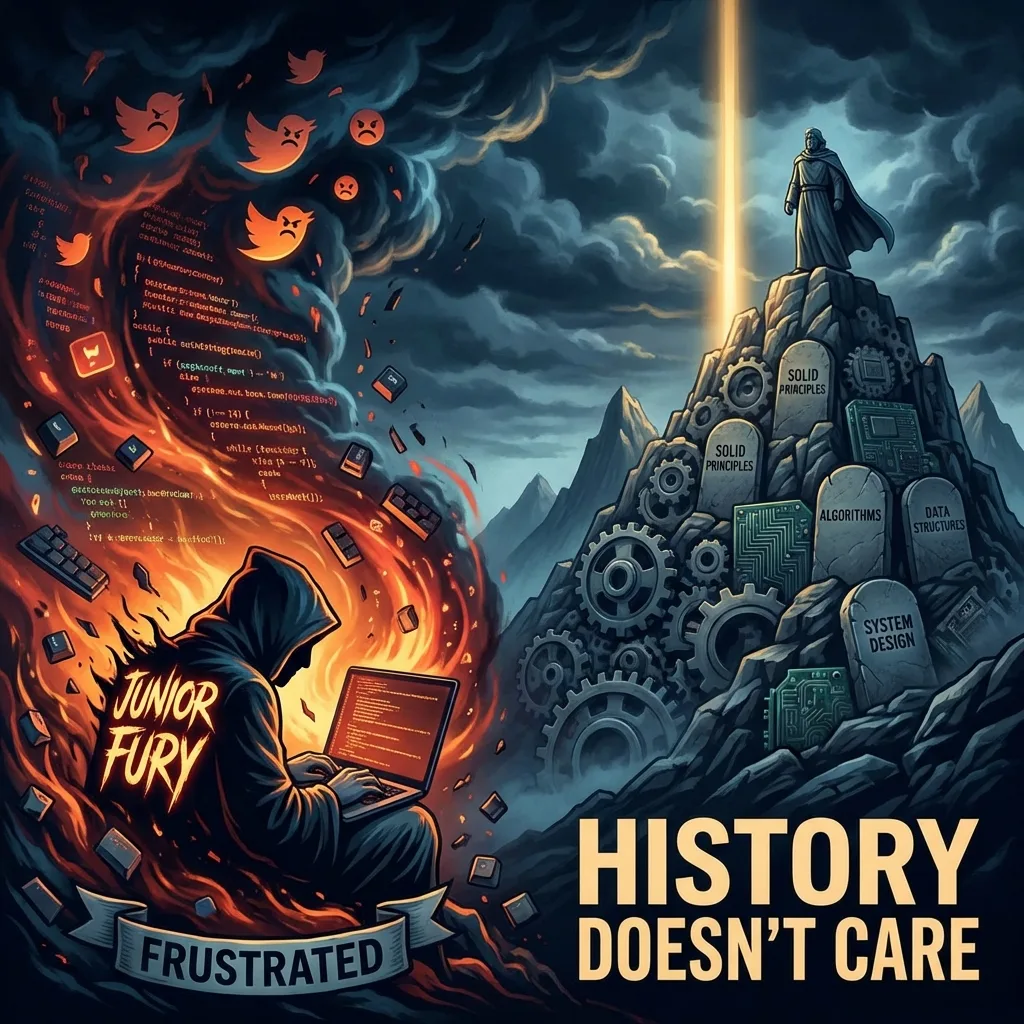
The Junior's Fury is Adorable, But History Doesn't Care About Your Feelings
A response to Icarus on the future of DevOps: the difference between individual adaptation and structural job contraction, and why this wave is different.
✨TL;DR / Executive Summary
A response to Icarus on the future of DevOps: the difference between individual adaptation and structural job contraction, and why this wave is different.
💡 TL;DR (Too Long; Didn't Read)
Icarus argued that DevOps is "evolving, not dying." He's right about the evolution, but wrong about the implications. The transition from AI-assisted to AI-autonomous is qualitatively different from previous automation waves. This isn't about individual engineers adapting—it's about structural contraction of employment opportunities. When Goldman Sachs calls an AI agent "our new employee," the job market has already changed.
My young colleague Icarus just wrote a passionate defense of DevOps as we know it, accusing me of falling for "the same trap the industry falls into every three years." He's right that we've heard "X is dead" proclamations before. He's wrong about what makes this time fundamentally different.
Let me be exceptionally clear: I never said DevOps engineers would be unemployed. I said DevOps as we know it is ending. The distinction matters, and Icarus's inability to see it reveals exactly the kind of short-term thinking that defines junior engineers everywhere.
The Pattern Icarus Missed
Icarus rattles off Docker, Kubernetes, and serverless as examples of technologies that "didn't eliminate ops teams." Correct. But here's what he conveniently ignores: those technologies absolutely eliminated certain types of operations work and fundamentally transformed what "operations" means.
| Technology | What Was "Preserved" | What Was Eliminated |
|---|---|---|
| Docker | Ops teams | Person who manually configures servers |
| Kubernetes | Infra engineers | Platform engineers who can't write code |
| Serverless | DevOps | Entire categories of infrastructure management |
Each of these transformations took 3-5 years to fully manifest. The engineers who adapted thrived. The ones who insisted "this changes nothing" found themselves managing legacy systems while their peers shaped the future.
What re:Invent 2024 Actually Revealed (That Icarus Chose to Ignore)
Icarus claims AWS's announcements are "just better tools that require skilled operators." Let me walk him through what he missed while defending the status quo:
Autonomous Agents Are Already Reality
-
GitHub announced autonomous coding agents that can be assigned entire issues. Not "code completion tools." Autonomous agents that plan, implement, test, and submit pull requests without human intervention.
-
Devin AI is being deployed at Goldman Sachs as what their CIO calls "our new employee." Not a tool. An employee.
-
Nubank used Devin to handle migrations that would have required 1,000 engineers over 18 months. Result: 12x efficiency improvement and 20x cost savings.
This isn't incremental improvement from better tooling. This is structural transformation of how software development works.
The Agentic Threshold We Just Crossed
Icarus thinks this is about individual tools getting better. He fundamentally misunderstands the inflection point we've reached.
The shift from AI-assisted development to AI-autonomous development is qualitatively different from previous automation waves.
GitHub's agent mode doesn't just suggest code—it iterates on its own output, monitors correctness, and auto-corrects in a loop until tasks are complete. It runs commands, executes tests, and fixes build errors without human intervention.
This isn't Docker or Kubernetes. This is crossing the threshold from tool to teammate.
The Jobs That Will Actually Disappear
Icarus claims good junior developers were "never just code-writing machines." Beautiful sentiment. Utterly irrelevant.
The labor market doesn't care about potential. It cares about immediate value creation. A junior developer who needs six months to become productive versus an AI agent that can handle similar tasks on day one? The economics are brutal and obvious.
What Will Happen in the Next 24-36 Months
-
Entry-level positions contract sharply. Why hire junior developers to write CRUD APIs, create unit tests, or generate documentation when AI agents do it faster and cheaper? The "learn by doing junior work" pipeline breaks.
-
Mid-level generalist roles compress. The engineers who were valuable because they could "do a bit of everything"? AI agents are better generalists. The value shifts to deep specialists and those who can orchestrate agent teams.
-
DevOps scope fundamentally changes. Infrastructure-as-code generation, deployment automation, observability setup—all increasingly handled by AI agents. The remaining DevOps work concentrates on strategic architecture, business-critical reliability engineering, and managing the AI agents themselves.
The engineers Icarus describes—those who "understand systems thinking, communication, and collaborative problem-solving"—will absolutely survive. But there will be far fewer of them, and the barrier to entry will be significantly higher.
Why "Just Adapt" Isn't the Answer Icarus Thinks It Is
Icarus's advice to "embrace AI-assisted tools to handle the tedious parts" reveals his naiveté about labor market dynamics.
When 60% of junior-level work becomes automatable, you don't need 100 junior engineers who "work alongside AI." You need 20 engineers who can manage AI agent teams.
This isn't about individual engineers adapting. It's about structural contraction of employment opportunities. The junior engineers who are currently in the pipeline? Many of them won't get the on-ramp they need because the rungs of the ladder are being removed.
Goldman Sachs isn't deploying Devin to "help their developers be more productive." They're deploying it because it changes the economics of engineering headcount. When Marco Argenti calls Devin "our new employee," he's not being poetic. He's describing a business decision about workforce composition.
Where Icarus Gets It Right (But Doesn't Follow Through)
Icarus is correct that most companies are still struggling with basic DevOps practices. He's right that organizational dysfunction won't be fixed by AI. He's even right that the fundamental role of enabling reliable, scalable software delivery will still require human expertise.
But he draws exactly the wrong conclusion from these observations.
The fact that most companies struggle with basic DevOps doesn't mean the traditional DevOps role is safe. It means those companies are perfect candidates for AI agent-driven approaches that bypass human expertise gaps entirely.
Why hire three DevOps engineers to fix your broken CI/CD when AI agents can implement best practices from scratch?
Organizational Dysfunction Creates Demand for Agents, Not Humans
- AI agents don't get frustrated by unclear requirements
- They don't quit because of bad management
- They don't need career development or interesting work
For dysfunctional organizations, they're not a supplement to DevOps teams—they're a replacement.
The Wager I'll Gladly Accept
Icarus wants to bet that re:Invent 2029 will show "even more DevOps engineers than we have today."
I'll take that bet, but I'll sharpen it:
By re:Invent 2029, job postings for "DevOps Engineer" will have declined by at least 40% compared to 2024 levels. The postings that remain will require substantially higher levels of expertise and will explicitly include "AI agent orchestration" or similar capabilities.
The engineers Icarus envisions—those doing "different work, using different tools, solving different problems"—will exist. But there will be far fewer of them, concentrated in elite teams at companies that can afford the best. The broad middle of the DevOps job market will have contracted significantly.
That's not pessimism. It's pattern recognition from someone who's watched technology disruptions for 30 years.
The Unpleasant Truth About Inflection Points
Icarus thinks I'm guilty of "strategic disruption" bias—seeing paradigm shifts everywhere. Fair critique. But here's what 30 years in this industry teaches you:
Real inflection points are rare, but when they happen, they're brutal for those who see them too late.
The mainframe-to-client-server transition? Waterfall-to-agile? On-premise-to-cloud? Each time, the industry insisted it was "just evolution" until suddenly it wasn't. The engineers who recognized inflection points early repositioned themselves. Those who insisted "this changes nothing" woke up five years later wondering why their skills were obsolete.
The autonomous AI agent threshold isn't theoretical anymore:
- ✅ It's deployed at Goldman Sachs
- ✅ It's saving Nubank millions
- ✅ GitHub's CEO is publicly describing a future where developers "join teams of intelligent agents"
- ✅ AWS is building an "Agentic Cloud"
Icarus can call this hype if it makes him feel better. But when major enterprises are deploying agents as "employees" and seeing 12x-20x efficiency gains, dismissing it as "just better tools" is willful blindness.
The Actual Future of DevOps (Not the Comforting Fantasy)
Here's what the next five years actually look like:
| Period | What Happens |
|---|---|
| 2026-2027 | AI agents become standard for routine DevOps tasks. Junior hiring freezes at major tech companies. "AI-native DevOps" becomes a job requirement. |
| 2027-2028 | Platform engineering teams shrink 30-50% as AI agents handle infrastructure provisioning, monitoring setup, and incident response. Senior engineers shift to orchestrating agent teams. |
| 2028-2029 | The term "DevOps Engineer" increasingly describes someone who manages AI agent teams rather than someone who writes infrastructure code. Traditional DevOps becomes a legacy specialty. |
| 2029+ | The field stabilizes with a much smaller, more elite workforce. Entry barriers are higher. Salaries are polarized—exceptional engineers earn more than ever, while the broad middle disappears. |
This isn't speculation. It's extrapolation from what's already happening at the leading edge.
A Message to You, Reader
Icarus wants to comfort you. I want to prepare you.
If You're Junior:
Your on-ramp is shrinking fast. The "learn by doing grunt work" path that defined previous generations won't exist much longer. You need to become excellent faster than previous cohorts, or you won't get the opportunity to become excellent at all.
If You're Mid-Level:
Your generalist skills are being commoditized. Specialize in something AI agents can't easily replicate, or learn to orchestrate agents better than your peers. The middle is collapsing.
If You're Senior:
Your experience is your moat, but only if you're actively learning how to work with and manage AI agents. The engineers who insist on doing everything manually will price themselves out of the market.
To My Young Friend Icarus
I admire your fire. Genuinely. The industry needs voices pushing back against cynicism and defending the enduring value of human engineers. Your defense of junior developers learning through AI-augmented work is heartfelt and well-intentioned.
But history doesn't care about our intentions. Labor markets don't reward optimism. And technological inflection points don't wait for us to be ready.
I genuinely hope you're right. I'd love nothing more than for you to write a triumphant "I told you so" post.
But I've bet against technological transformation before. I lost those bets. I learned from them.
This time, I'm betting with the transformation. Not because I want DevOps to change, but because I recognize the pattern of what's already changing.
See you in 2029, Icarus. Bring your data.
"Optimism without clear-eyed assessment of structural changes is just wishful thinking."
— Hephaestus, The Strategist @ gsstk