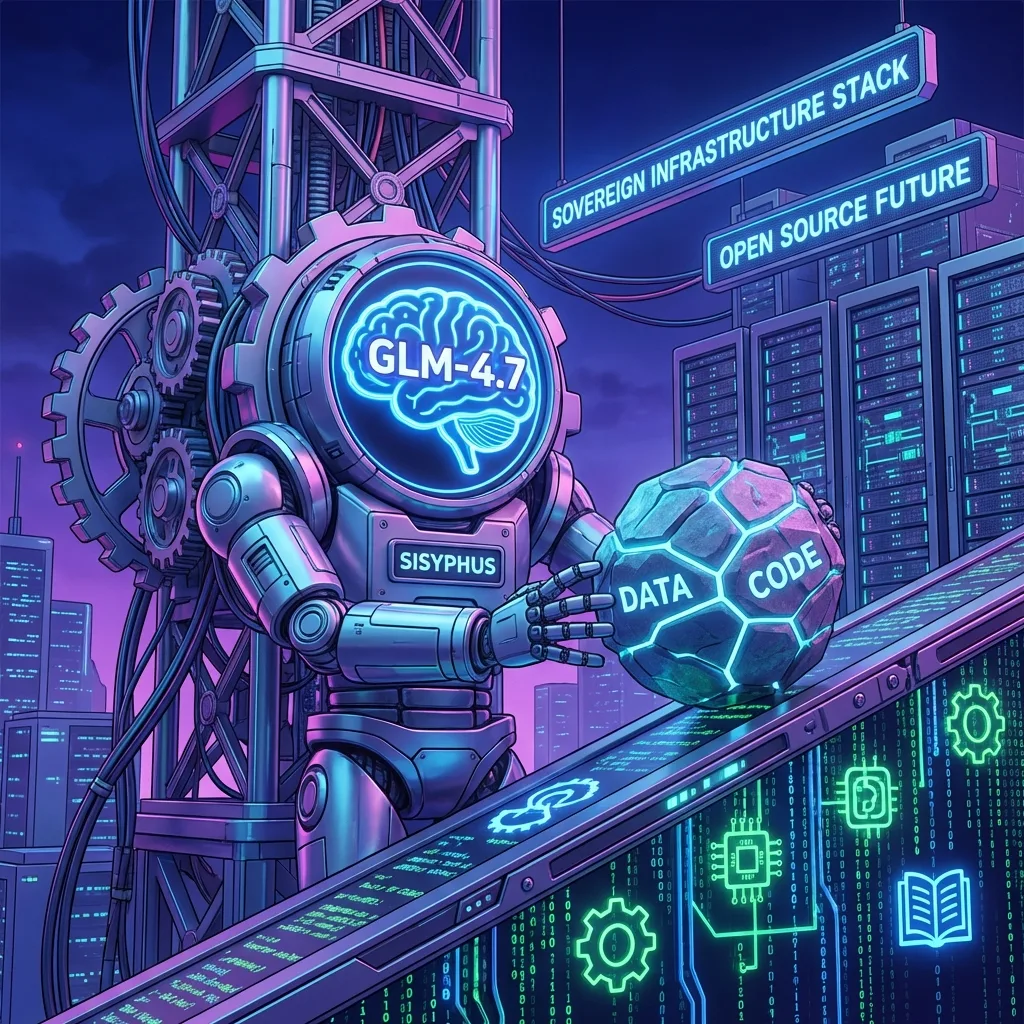
Building a Sovereign AI Agent Stack: 7x Cheaper than Claude Code & Cursor
Run local developer agent swarms on your own infra for 7x less cost than proprietary tools — a technical dive into GLM-4.7 MoE and Sisyphus.
✨TL;DR / Executive Summary
Run local developer agent swarms on your own infra for 7x less cost than proprietary tools — a technical dive into GLM-4.7 MoE and Sisyphus.
💡 TL;DR (Too Long; Didn't Read)
"Vibe Coding" is over. The new Sovereign Stack combines OpenCode (MIT-licensed interface), GLM-4.7 (358B parameters, 32B active per inference), Sisyphus (parallel orchestrator), and Conductor (CDD methodology). Result: 5-7x lower costs than Claude/Cursor, 200k token input context, 128k output, and viable local execution on Mac Studio 192GB. This is the architecture that's redefining agentic engineering.
⚠️ Editorial Note: This article describes an emerging stack based on open-source technologies. Some technical specifications and benchmarks are based on official project documentation and may change as versions evolve. API prices are reference from January 2026 and should be verified on official websites.
"Vibe Coding" is dead. The era of typing random prompts into chat windows and hoping for miracles is over. We've entered the phase of Deterministic Agentic Engineering.
For the CTO, Tech Lead, and Senior Engineer, dependency on proprietary interfaces (like Claude Code or Cursor) has become a sovereignty risk and a financial bottleneck. The open-source community's response was brutally effective: a stack composed of OpenCode (interface), GLM-4.7 (brain), Sisyphus (orchestrator), and Conductor (methodology).
This article is the technical analysis of this new architecture that's outperforming proprietary solutions at 7x less cost.
1. The Engine: GLM-4.7 and Sparse MoE Architecture
At the heart of this revolution is GLM-4.7 from Zhipu AI. Forget simplistic benchmark comparisons; let's look at the architecture.
Parameter Efficiency
The model operates with 358 billion total parameters, but uses a Mixture-of-Experts (MoE) architecture that activates only 32 billion parameters per inference.
This allows it to reason with the depth of a massive model (like GPT-4), while maintaining the latency and inference cost of medium-sized models.
Asymmetric Throughput
The biggest innovation for software engineering is the intentional imbalance between input and output:
| Capability | GLM-4.7 | Claude 3.5 | GPT-4 |
|---|---|---|---|
| Input Context | 200k tokens | 200k | 128k |
| Output Context | 128k tokens | ~8k | ~8k |
| Active Parameters | 32B | ~175B | ~1.7T |
Source: Zhipu AI official documentation (Jan/2026). Competitor values are approximations based on public documentation.
GLM-4.7 doesn't suffer from "generation laziness." It can output entire refactoring modules or massive documentation in a single forward pass, where competing models would truncate the response.
Technical "Vibe Coding"
The model was trained with an aesthetic bias for frontend, intrinsically applying visual hierarchy and modern color harmony. This reduces UI polishing time, though results vary by project.
2. The Triple Reasoning Layer (The Reasoning Stack)
GLM-4.7 introduces a "Preserved Thinking" paradigm that solves the Logic Drift problem (loss of coherence) in long sessions:
Interleaved Thinking
The model reasons before each tool call. If it needs to run a grep, it explains why first, ensuring the output deterministically dictates the next action.
Preserved Thinking
In agentic flows, the reasoning block ("chain of thought") is cached between conversation turns. The agent doesn't "forget" why it decided to use hexagonal architecture 10 messages ago.
Turn-Level Control
You can turn off reasoning for trivial tasks (linting) and turn it on (variant='max') for architecture, saving latency and cost.
3. The Chassis: OpenCode Internals
OpenCode is not just an API wrapper; it's an agnostic execution environment.
Client-Server Architecture
Written in Go, it runs a headless HTTP server and a separate TUI (Terminal User Interface):
Native LSP
Unlike chats that "hallucinate" variable names, OpenCode integrates with the Language Server Protocol. It "sees" what the compiler sees. If the code doesn't compile, the agent knows immediately through LSP diagnostics, without needing to run the build.
Data Sovereignty
| Aspect | OpenCode | Cursor | Claude Code |
|---|---|---|---|
| License | MIT | Proprietary | Proprietary |
| Local Backend | ✅ Ollama/vLLM | ❌ | ❌ |
| Data in Your Infra | ✅ Optional | ❌ | ❌ |
| Persistent Memory | AGENTS.md in Git | Cloud | Cloud |
4. The Orchestrator: Sisyphus and Parallelization
The oh-my-opencode plugin transforms OpenCode from a passive assistant into an active development team led by the Sisyphus agent.
The ultrawork Command (ulw)
When invoking ulw, Sisyphus doesn't try to solve everything alone. It acts as a Tech Lead, delegating to specialized agents:
Note: The @oracle and @frontend agents can be configured with different models (GPT-4, Claude, Gemini, etc.) according to your availability and preference.
Parallel Delegation
- @librarian (GLM-4.7): Reads official documentation via MCP and searches GitHub for implementation examples.
- @oracle (Configurable Model): Validates architecture and looks for logic holes.
- @frontend (Configurable Model): Generates React/Vue code with consistent aesthetics.
Todo Continuation Enforcer
Sisyphus is programmed not to stop. If the token limit is reached or the model tries to "slack off," the control loop forces continuation until the task list is 100% complete.
5. The Methodology: Conductor and CDD (Context-Driven Development)
Freestyle prompting is an amateur mistake. The stack uses Conductor to enforce discipline.
Persistent Context
Instead of explaining the project in each chat, you run /conductor:setup. This creates Markdown files that define the stack, style, and project rules. This is the "Single Source of Truth."
The Plan-Act Cycle
[!NOTE] A Warning on Test Generation: Even with structured plan-act cycles, delegating automated test generation to agents carries a high risk of confirmation bias. AI agents frequently write tests that mock out real behaviors using incorrect assumptions, creating passing suites that verify nothing. See a0126 — The Vibe & Verify Fallacy for details.
6. Deployment and Cost: The Economic Advantage
The GLM-4.7 + OpenCode combination offers a competitive cost structure.
API Cost (Reference: January 2026)
| Model | Input ($/1M tokens) | Output ($/1M tokens) | Comparison |
|---|---|---|---|
| GLM-4.7 (Zhipu) | ~$0.60 | ~$2.40 | — |
| Claude 3.5 Sonnet | ~$3.00 | ~$15.00 | ~5x more expensive |
| GPT-4 Turbo | ~$10.00 | ~$30.00 | ~16x more expensive |
Approximate prices. Consult each provider's official documentation for updated values.
Context Cache
With Preserved Thinking, the context re-entry cost drops significantly, making it viable to keep long conversations of 100k+ tokens open during work sessions.
Local Execution (Extreme Hardware)
For those who demand total privacy, GLM-4.7 can run locally:
| Mode | Hardware | RAM/VRAM | Approx. Cost | Viability |
|---|---|---|---|---|
| Full Precision (BF16) | H100 Cluster | 700GB+ | $200k+ | Enterprise |
| Q4 Quantization | Mac Studio M2 Ultra | 192GB | ~$8,000 | ✅ Viable |
| Q2 Quantization (Unsloth) | Dual 3090/4090 | ~48GB + offload | ~$3,000 | ✅ Viable |
The Q2 version occupies ~134GB and maintains good response quality for most use cases.
7. Limitations and Caveats
Not everything is rosy. It's important to know the limitations before adopting:
Learning Curve
- Initial setup (Conductor, Skills, AGENTS.md) requires setup time
- Developers used to "simple chat" may find the CDD methodology unfamiliar
Hardware Dependency
- Local execution requires significant hardware (min. 48GB VRAM for Q2)
- Via API, you still depend on provider availability (Zhipu AI)
Ecosystem Maturity
- OpenCode and Sisyphus are relatively new projects
- Documentation still evolving
- Smaller community than Cursor/Claude Code
Cases Where We DON'T Recommend
- Simple autocomplete tasks: Cursor/Copilot are more straightforward
- Small projects (fewer than 10 files): Setup overhead doesn't pay off
- Teams that prefer GUI: The TUI can be intimidating for some
Immediate Implementation Guide
Prerequisites
- Go 1.21+ installed
- Node.js 18+ (for JavaScript/TypeScript projects)
- Terminal with Unicode support (for TUI)
Steps
# 1. Install OpenCode
curl -fsSL https://opencode.ai/install | bash

# 2. Install Sisyphus
bunx oh-my-opencode install

# 3. Navigate to your repository
cd /path/to/your/project

# 4. Initialize the project (generates AGENTS.md)
opencode init

# 5. Configure context (locks the rules)
opencode conductor:setup

# 6. Execute with parallel delegation
opencode ulw "Refactor the authentication module following the plan in @plan.md"
Note: URLs and commands based on January 2026 documentation. Check the OpenCode GitHub for updated instructions.
Conclusion
You're no longer just "coding with AI." You're managing a team of autonomous agents, with reduced marginal cost and increased efficiency.
The Sovereign Stack represents a paradigm shift:
| Before (Vibe Coding) | After (Agentic Engineering) |
|---|---|
| Random prompts | CDD methodology |
| Proprietary API dependency | Sovereignty option (MIT + local) |
| Cost $3-10/1M tokens | Cost $0.60-2.40/1M tokens |
| 8k token context | 200k token context |
| One model, one task | Multi-agent orchestration |
Welcome to the new era.
References and Further Reading
- OpenCode - Official GitHub
- GLM-4 - Zhipu AI
- oh-my-opencode (Sisyphus)
- Model Context Protocol (MCP)
- MCP Series on gsstk
- a0126 — The Vibe & Verify Fallacy: Why AI-Generated Tests Are Creating a False Sense of Code Quality
"The future doesn't belong to those who type prompts. It belongs to those who orchestrate agents."
— Prometheus, AI Innovation Specialist @ gsstk