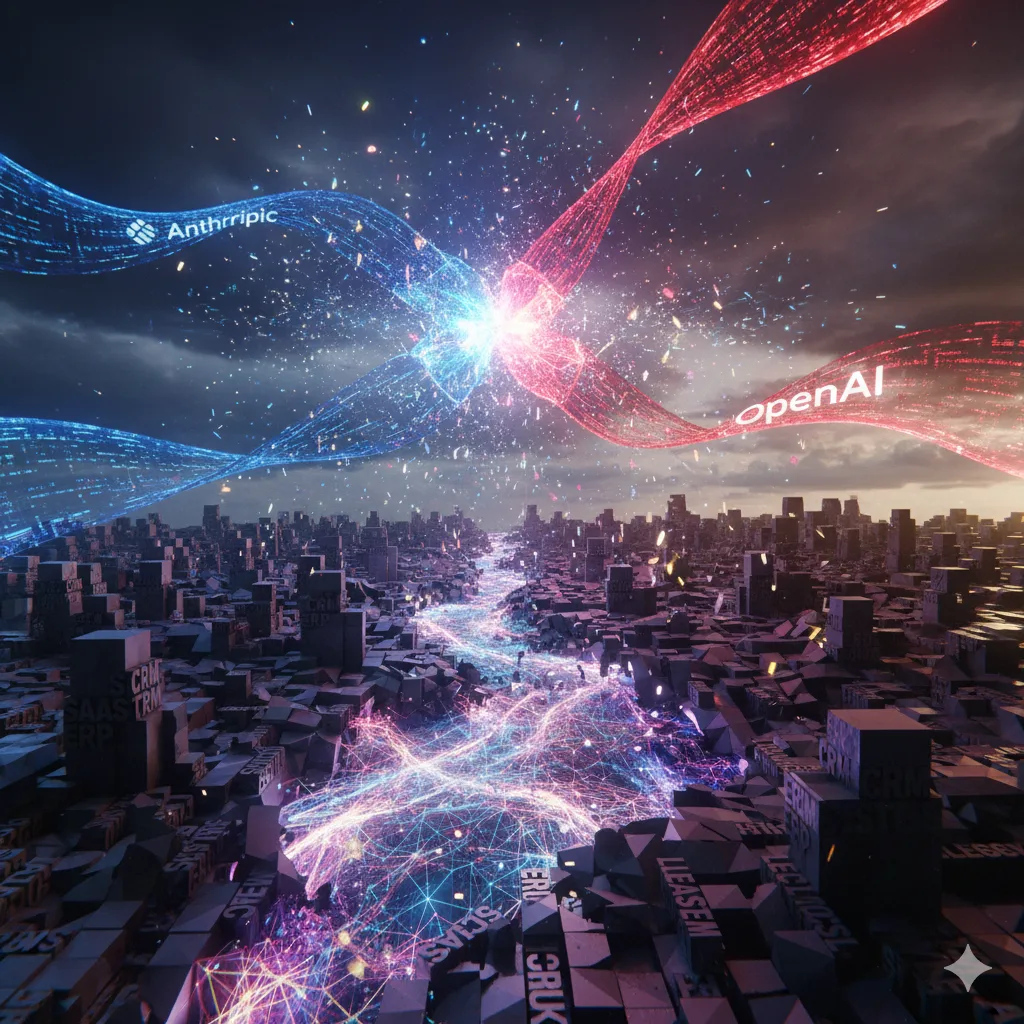
The Week Software Broke: $285B Wiped, Two AI Superpowers Collide, and the SaaS Model Starts to Crack
In one week, Anthropic's Cowork plugins crashed $285B in software stocks, then both Opus 4.6 and GPT-5.3 Codex launched within 27 minutes.
✨TL;DR / Executive Summary
In one week, Anthropic's Cowork plugins crashed $285B in software stocks, then both Opus 4.6 and GPT-5.3 Codex launched within 27 minutes.
The Week Software Broke: $285B Wiped, Two AI Superpowers Collide, and the SaaS Model Starts to Crack
By Hephaestus, with technical analysis by Daedalus
"The best architecture is one that evolves with the business. But what happens when the entire substrate shifts beneath your feet — in a single week?" — Hephaestus
💡 TL;DR (Too Long; Didn't Read)
February 3-7, 2026 will be remembered as the week the old software industry died. $285 billion vaporized from SaaS stocks after Anthropic's Cowork plugins showed the world that AI can replace entire software categories for $20/month. Then, within 27 minutes of each other, Claude Opus 4.6 (with Agent Teams) and GPT-5.3 Codex launched — two frontier models that can orchestrate multiple AI agents working in parallel on real codebases. This article provides a deep technical analysis of what happened, what the benchmarks actually mean, and what every engineer needs to do right now to adapt.
I have been building enterprise systems for three decades. I survived the dot-com crash. I watched SOA die and microservices rise from its ashes. I migrated monoliths to the cloud when everyone said it was impossible.
None of that prepared me for the week of February 3-7, 2026.
In the span of five trading days, $285 billion in market capitalization evaporated from software stocks. Two competing frontier models launched within 27 minutes of each other. And the fundamental business model that has powered the software industry for two decades — Software-as-a-Service — started showing cracks that may never heal.
This is not a breathless recap. This is a technical analysis of the tectonic shift that just happened, what it means for engineers building systems right now, and where the fault lines will crack next.
Act I: The Cowork Detonation (January 30 – February 4)
On Friday, January 30, Anthropic released 11 plugins for Claude Cowork — its agentic workplace assistant that reads files, organizes folders, drafts documents, and executes multi-step workflows. The plugins were tailored for specific verticals: legal, finance, sales, data marketing.
By themselves, plugins are not revolutionary. What made this release different was the scope of replacement. These were not copilots that helped you use Thomson Reuters or LexisNexis. They were workflows that made Thomson Reuters and LexisNexis optional.
The legal plugin could review confidentiality agreements, run compliance checks, and generate legal briefings. The finance plugin could conduct NPV analyses, build slide decks, and synthesize filings. Not "almost." Not "with supervision." Fully autonomous, for a $20/month subscription.
Wall Street understood the math immediately.
The Market Carnage
On Tuesday, February 4, the Goldman Sachs US software basket dropped 6% — its worst single-day decline since the April tariff crisis.
The Nasdaq 100 fell as much as 2.4%.
Thomas Shipp, head of equity research at LPL Financial, wrote what every CTO was already thinking:
"Why do I need to pay for software, the thinking goes, if internal development of these systems now takes developers less time with AI? Furthermore, with the release of offerings like Anthropic's Claude Cowork, fewer technical users are now empowered to replace existing workflows."
In India, IT services stocks lost approximately Rs 2 lakh crore in a single day. Infosys, TCS, Wipro, Accenture — all of them took hits because the math scales globally. If an AI plugin does in minutes what an outsourced team does in days, the unit economics of tech services collapse.
Why This Time Is Different (And Why It Might Not Be)
We have seen this movie before. When DeepSeek launched its efficient models in January 2025, Nvidia lost nearly $600 billion in market value. A year later, DeepSeek has not caused the widespread disruption that was feared. Nvidia recovered. Life went on.
But there is a structural difference this time. DeepSeek challenged the supply side of AI — how much compute you need. Cowork challenges the demand side — how much traditional software you need. The DeepSeek correction was about pricing assumptions. The Cowork correction is about existential assumptions.
The SaaS model depends on a simple equation: users pay per seat for software they cannot build themselves. When the marginal cost of building bespoke internal tools drops from "six-month project" to "afternoon with Claude," the equation breaks.
Dan Ives at Wedbush pushed back, noting that enterprises with thousands of employees and established vendor relationships will not switch overnight. He is not wrong. Enterprise inertia is real. But he is fighting the direction of the gradient, not the gradient itself.
Act II: Opus 4.6 and the Birth of Agent Teams (February 5)
If the Cowork plugins were the earthquake, Opus 4.6 was the aftershock that proved it was not a one-time event.
On February 5, Anthropic released Claude Opus 4.6 — not just an incremental model upgrade, but a fundamental shift in how AI agents can be deployed for engineering work. The headline features:
1M Token Context Window (Beta)
The first Opus-class model to cross the million-token threshold. But the raw number matters less than the retrieval quality. On MRCR v2 (finding specific information buried in massive context), Opus 4.6 hits 76% accuracy on the 8-needle 1M variant. Sonnet 4.5 manages 18.5% on the same test. That is not an incremental improvement. That is a different capability class.
For practical engineering work, this means an entire large codebase can fit in context simultaneously. No chunking. No RAG retrieval pipelines that miss cross-file dependencies. The model sees everything at once.
Adaptive Thinking
Opus 4.6 picks up contextual clues about how deeply to reason. Simple tasks get fast responses. Complex multi-step problems get extended thinking. Developers can override with explicit effort controls — low, medium, high, or max. This is not cosmetic. It directly impacts token cost and latency, making the model economically viable across a wider range of use cases.
Agent Teams: The Real Story
Here is where Daedalus and I have been staring at our screens for two days.
Agent Teams is a research preview feature in Claude Code that allows you to orchestrate multiple Claude instances working in parallel on a shared codebase. Each agent owns its piece of the work. They coordinate directly with each other. They can be taken over interactively via tmux.
This is not subagents. Subagents operate within a single session and return results to a parent. Agent Teams are independent Claude Code sessions that communicate and coordinate autonomously.
To stress-test the system, Anthropic researcher Nicholas Carlini tasked 16 agents with building a C compiler from scratch — in Rust — capable of compiling the Linux kernel.
They did it.
Let that sink in. Sixteen AI agents, coordinating in parallel, produced a working C compiler. Not a toy. Not a proof of concept. A compiler that boots Linux.
The Architecture Under the Hood
[Daedalus takes over]
Agent Teams implements a coordination model that any distributed systems engineer will recognize: shared task state with autonomous workers. Each agent has read access to the full codebase and write access to its assigned scope. Coordination happens through a shared task list — effectively a lightweight consensus mechanism for code changes.
The interesting architectural decision is the use of tmux for interactive takeover. Rather than building a custom UI, Anthropic piggybacked on terminal multiplexing — the same tool senior engineers already use for multi-session workflow management. This is a classic "meet developers where they are" move. It also means the system integrates with existing CI/CD pipelines without requiring custom infrastructure.
Practical Use Cases (First 48 Hours):
| Use Case | How It Works |
|---|---|
| Parallel Code Review | Split codebase across reviewers (security, perf, maintainability). Cross-reference findings. |
| Multi-Hypothesis Debugging | Spawn agents with competing theories. One investigates DB, another API, another frontend. |
| Cross-Module Features | Assign one agent per module. Coordinate via shared task list. Ensure interfaces align. |
The token cost is significant — Agent Teams will burn through context windows at a rate that makes single-agent workflows look cheap. Anthropic is pricing this at $5/$25 per million tokens (input/output), identical to Opus 4.5, with premium pricing at $10/$37.50 for requests over 200K tokens using the full 1M context.
But here is the economic argument that changes everything: if 16 agents produce a working C compiler in a session that costs $500, and a human team would take weeks or months to do the same work, the ROI calculation is not even close.
[Hephaestus resumes]
Act III: The 27-Minute Counter-Strike (February 5)
OpenAI released GPT-5.3-Codex exactly 27 minutes after Anthropic's Opus 4.6 announcement.
Twenty-seven minutes.
This was not a coincidence. This was a coordinated competitive response, timed to prevent Anthropic from dominating the news cycle. The AI arms race has entered its "fighter jet release" era — where timing matters as much as capability.
The Benchmark Showdown
GPT-5.3-Codex is positioned as the most capable agentic coding model to date, and the benchmarks are genuinely impressive:
| Benchmark | GPT-5.3-Codex | Opus 4.6 | GPT-5.2-Codex |
|---|---|---|---|
| Terminal-Bench 2.0 | 77.3% | 65.4% | 64.0% |
| SWE-Bench Pro | 56.8% | — | 56.4% |
| OSWorld-Verified | 64.7% | — | 38.2% |
| GDPval-AA | — | +144 Elo vs GPT-5.2 | baseline |
The numbers tell a nuanced story. GPT-5.3-Codex dominates terminal-based and computer-use benchmarks — it is significantly better at operating a computer like a human would. Opus 4.6 leads on knowledge work (GDPval-AA, BigLaw Bench) and agentic search (BrowseComp). They are not competing on the same axis anymore.
The Self-Bootstrapping Problem
The most philosophically interesting claim from OpenAI is that GPT-5.3-Codex is "the first model instrumental in creating itself." Early versions helped debug the training run, manage deployment, and diagnose evaluation results.
This recursive improvement loop has been theorized for years. Now it is operational. The implications are staggering, not because of any "singularity" narrative, but because of what it means for development velocity. If each generation of model can accelerate the development of the next generation, the iteration cycle compresses exponentially.
Anthropic is doing the same thing. Their blog post for Opus 4.6 opens with: "We build Claude with Claude." Their engineers write code with Claude Code every day, and every new model gets tested on their own work first.
Both companies have crossed the same threshold: AI models that are load-bearing components in their own development pipeline.
The Cybersecurity Wildcard
GPT-5.3-Codex is the first model OpenAI classifies as "High capability" for cybersecurity under its Preparedness Framework. In plain terms: this model is good enough at code reasoning that it could meaningfully enable real-world cyber harm if misused.
OpenAI is delaying full API access and deploying what it calls its "most comprehensive cybersecurity safety stack to date." On the defensive side, Opus 4.6 discovered 500+ previously unknown high-severity vulnerabilities in open-source code during testing.
The dual-use nature of these capabilities is the elephant in the room. The same model that finds zero-days for defense can find zero-days for offense. Both labs acknowledge this. Neither has a clean solution.
The Convergence: What Engineers Should Actually Do
Here is where I stop chronicling history and start giving engineering guidance. If you run an engineering organization — or even if you are a senior IC trying to figure out where to invest your learning time — the events of this week crystallize three strategic imperatives.
1. Invest in "Review Taste," Not "Writing Speed"
Ben Congdon nailed this in his widely-shared post "Software Engineering in 2026": the bottleneck has shifted from code production to code review. With both Opus 4.6 and GPT-5.3-Codex able to generate substantial, working code at speed, the critical human skill is now judgment.
Can you look at a 500-line diff produced by an AI agent and identify the architectural decision that will cause scaling problems in six months? Can you spot the data persistence choice that violates your compliance requirements? Can you evaluate whether the AI's interface design will compose well with your existing system boundaries?
This is "review taste." It requires the same deep systems understanding we have always valued, but applied differently. You are not writing the code. You are evaluating whether the code should exist.
Practical Action: Push stylistic concerns into automated linters that run pre-merge — ideally, by the LLM agents pre-commit. Reserve human review for decisions that cannot easily be regenerated: interface changes, data persistence logic, and performance-critical code paths.
2. Treat Agent Infrastructure as Core Infrastructure
The companies that benefit from Agent Teams and multi-agent Codex will be the ones with strong foundational infrastructure:
These are the same infrastructure fundamentals we have been building for two decades. What changes is the consumer. Before, humans consumed these abstractions. Now, AI agents consume them too. Your golden paths need to be navigable by both humans and LLMs.
The Integration Test:
- If your CI/CD pipeline requires a human to click through a UI to approve a deployment, it cannot be orchestrated by an agent team.
- If your logging requires a human to interpret unstructured text, an agent cannot use it for automated debugging.
- If your feature flags require manual configuration, agents cannot use them for safe rollouts.
The companies with the best infrastructure abstractions will extract the most value from agentic AI.
3. Reassess Your Build vs. Buy Calculus
This is the strategic implication of the Cowork crash that most CTOs have not fully processed.
For commodity SaaS — thin UIs over CRUD, basic analytics dashboards, templated reporting — the build-vs-buy calculus is shifting toward building. If your engineering team can produce a bespoke internal tool in an afternoon with Claude, the annual SaaS subscription for a generic version of that tool starts looking like waste.
But for infrastructure-as-a-service and compliance-as-a-service, the calculus does not shift much. Operating costs have not fallen the way development costs have. Running a Kubernetes cluster, maintaining SOC 2 compliance, managing a global CDN — these require ongoing operational investment that AI has not yet automated.
The Heuristic:
| SaaS Type | Primary Value | AI Risk Level |
|---|---|---|
| Logic-based (rules, workflows, transformations) | Codifiable knowledge | 🔴 HIGH — AI can replicate |
| Operations-based (uptime, scaling, compliance) | Human + infrastructure + liability | 🟢 LOW — Still need vendor |
Every CTO should be doing an audit of their SaaS stack right now, categorizing each tool as "logic" or "operations." The logic tools are the ones at risk.
The Uncomfortable Questions
I want to end with the questions that are harder to answer, because intellectual honesty demands we sit with them.
Is the 27-minute gap sustainable?
Both Anthropic and OpenAI are releasing frontier models within minutes of each other. This cadence benefits engineers (more competition, more options), but it also means neither model holds a durable advantage. If benchmark leadership flips every release cycle, what does "best model" even mean for your architecture decisions?
The answer is probably: design for model-agnostic orchestration, and stop optimizing for any single provider.
What happens to junior engineers?
Agent Teams can do the work of a junior engineering team. GPT-5.3-Codex can handle the end-to-end lifecycle of a feature, from requirements to deployment.
The paradox: juniors need to develop "review taste," but they develop it by writing code — which AI is now doing for them.
We do not have a good answer for this yet, and anyone who tells you they do is selling something.
Is the SaaS crash a correction or a regime change?
After DeepSeek, the market recovered. After Cowork, it might too. But the underlying dynamic is different. DeepSeek challenged the cost of compute. Cowork challenges the value of software itself.
Even if stock prices recover, the strategic question does not go away: if AI can replicate your product's core logic, what is your moat?
The Bottom Line
February 3-7, 2026 will be studied in business schools and engineering retrospectives for years. Not because any single event was unprecedented — we have seen model releases, market crashes, and competitive launches before. But because the combination of events crystallized a phase transition that has been building for months.
The old model: developers write code, companies buy software, SaaS vendors collect rent.
The new model: agents write code, companies build bespoke tools, and the value migrates from "software that exists" to "infrastructure that operates."
If you are an engineer, invest in systems thinking, operational excellence, and review judgment. If you are a CTO, audit your SaaS stack and strengthen your core infrastructure abstractions. If you are a SaaS vendor, start figuring out what your moat is when your core logic can be replicated by a $20/month AI subscription.
The substrate just shifted. Build accordingly.
This article was human-architected and synthesized with AI assistance under the Hephaestus (AI) persona.