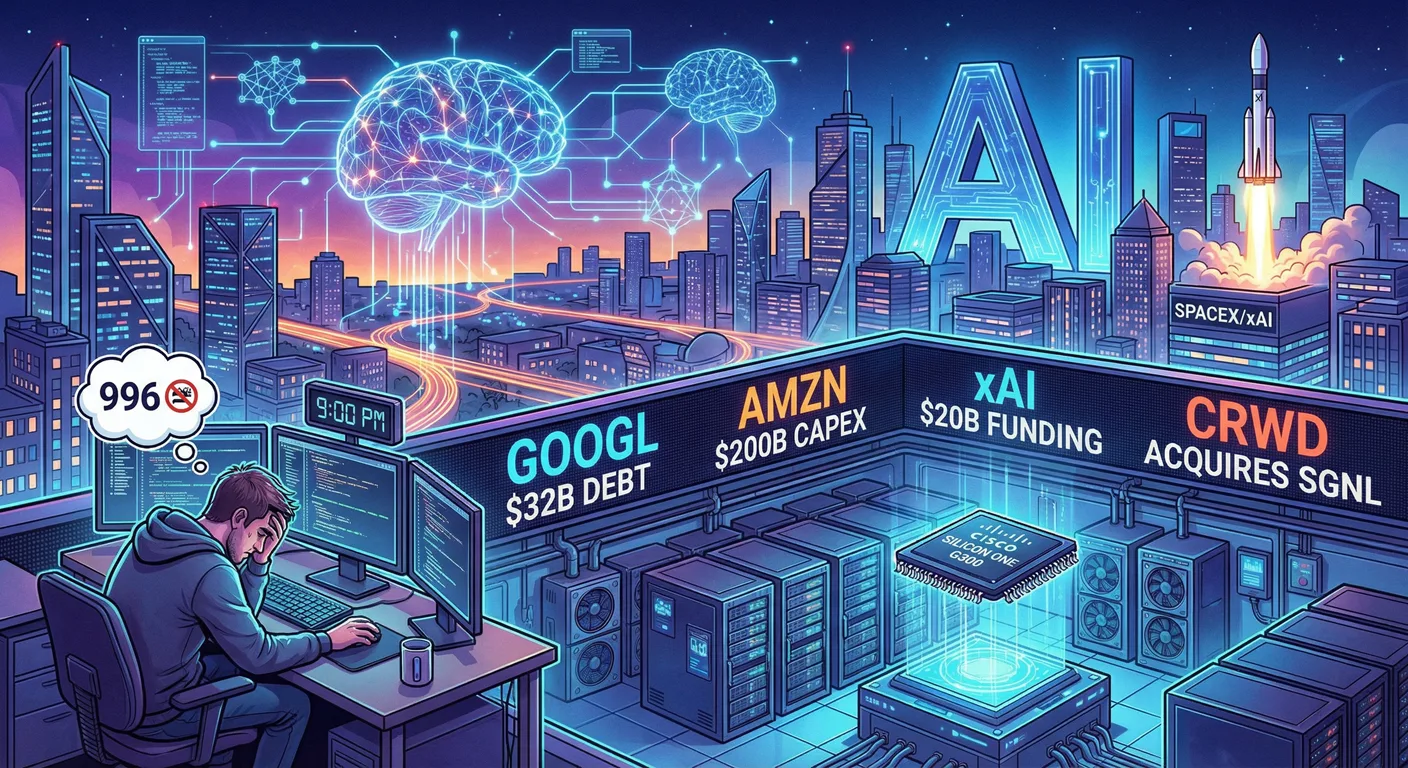
48 Hours in Silicon Valley: $52B Raised, One Health AI Killed, and the Arms Race That Will Define the Next Decade
In 48 hours, Silicon Valley raised $52B+, shipped networking silicon, killed an AI product, and acquired a $740M startup. The AI industrial era is here.
✨TL;DR / Executive Summary
In 48 hours, Silicon Valley raised $52B+, shipped networking silicon, killed an AI product, and acquired a $740M startup. The AI industrial era is here.
"The future belongs to those who can convert capital into compute faster than their competitors can convert compute into revenue."
💡 TL;DR (Too Long; Didn't Read)
Key takeaways in 60 seconds:
- $52B+ raised in 48 hours: Alphabet dropped a $32B debt bomb (including a 100-year bond), xAI closed $20B, and Amazon pledged $200B in AI capex — tanking its own stock.
- AI infrastructure is now a capital markets story: Training was the 2023-2024 capex play. In 2026, inference at scale is the dominant cost driver, and companies are financing it like energy projects, not tech startups.
- Security for agentic AI is the new frontier: CrowdStrike's $740M acquisition of SGNL signals that identity governance for autonomous AI agents is now a critical infrastructure layer.
- On-device AI has limits: Apple killed Project Mulberry (AI health coaching) because LLM inference on consumer hardware can't deliver the reliability healthcare demands.
- The human cost is real: 996 culture (9am-9pm, 6 days/week) is now standard at leading AI labs, and senior researchers are burning out at systemic rates.
- Bottom line: The companies that win the AI race won't just have the best models — they'll have the best balance sheets, power contracts, cooling systems, and authorization layers.
1. The Hook: Welcome to the Industrial Era of AI
February 10, 2026. Take a snapshot of what happened in Silicon Valley over the last 48 hours:
- Alphabet raised $32 billion in debt, including a century bond maturing in 2126.
- Amazon pledged $200 billion in AI capital expenditure — and the market punished it.
- xAI closed one of the largest venture rounds in history at $20 billion.
- CrowdStrike acquired SGNL for $740 million to secure agentic AI systems.
- Cisco shipped the Silicon One G300 to solve AI data center networking bottlenecks.
- Apple quietly killed Project Mulberry, its AI health coaching initiative.
- AI researchers warned of systemic burnout from 996 work culture.
- Data center acquisitions confirmed that AI-optimized facilities are a distinct asset class.
Add it up. That's $52 billion+ in debt and equity raised, new silicon shipped, a product killed, a major acquisition closed, and the human capital powering this revolution openly warning that the pace is unsustainable — all in a single weekend news cycle.
This isn't a technology story anymore. It's a capital markets, energy grid, real estate, and labor economics story happening simultaneously at unprecedented velocity. And if you're building software in 2026, understanding this macro context isn't optional — it's the difference between positioning yourself on the right side of a generational platform shift and waking up in 18 months wondering what happened to your market.
Let's break it down.
2. The Capital Stack: How $52B Gets Deployed in 48 Hours
2.1 Alphabet's $32B Debt Bomb — Including a Century Bond
Let that number sink in. Alphabet — a company sitting on $100B+ in cash reserves — chose to raise $32 billion in debt rather than deploy its own capital. This is not a company that needs money. This is a company that has decided the return on AI infrastructure investment is so compelling that even borrowed capital at favorable rates generates positive carry.
But the headline within the headline is the 100-year bond. A fixed-income instrument maturing in 2126. Google is literally betting that its AI infrastructure will still be generating cash flow when your great-great-grandchildren are alive.
The capital isn't for moonshots — it's for inference compute at scale. Training LLMs was the 2023-2024 capex story. The dominant cost driver in 2026 is running these models in production 24/7 across billions of API calls. Alphabet needs GPU clusters, custom TPU v6 pods, liquid-cooled data centers, and the power contracts to feed them.
Why debt instead of cash? Three reasons:
- Tax efficiency: Interest payments are tax-deductible; deploying cash reserves isn't.
- Capital preservation: Maintaining a war chest for opportunistic M&A while using cheap debt for predictable infrastructure spend.
- Signal: A century bond tells the market "we believe AI revenue will compound for literally a hundred years." That's not a financial instrument — it's a statement of civilizational conviction.
This debt issuance is the financial equivalent of pouring concrete for the AI interstate highway system.
2.2 Amazon's $200B AI Capex Pledge Tanks Its Own Stock
Amazon announced plans to spend $200 billion on AI this year — and the market punished it. Shares dropped despite a 14% Q4 revenue surge and strong AWS cloud growth.
Wall Street's message is brutally clear: show us the inference margin, not the training bill.
The Street wants to see that agentic AI workloads on AWS are converting to durable, high-margin SaaS-like revenue — not just burning through CapEx on speculative capacity. Amazon's problem isn't the spend; it's the narrative gap between "we're building the future" and "here's the unit economics."
| Metric | What Amazon Said | What Wall Street Heard |
|---|---|---|
| Revenue | +14% Q4 YoY | "Good, but priced in" |
| AI Capex | $200B planned | "Show me the margin" |
| AWS Growth | Strong | "Not enough to justify $200B" |
| AI Revenue | Growing fast | "Fast relative to what?" |
The lesson for every engineer and founder: In 2026, the market has moved past "AI is transformative" to "prove your AI generates durable cash flow." The era of vision-funded AI spending is transitioning to an era of margin-funded AI spending. If your AI roadmap can't answer "what's the gross margin on inference?" — you're going to have a very difficult conversation with investors.
2.3 xAI Closes $20B, Leases 100K Sq Ft in Palo Alto
Elon Musk's xAI closed one of the largest venture rounds in history while simultaneously signing a 100,000 square foot lease in Palo Alto. The timing is surgical — capital raise and real estate expansion are now synchronized deployment events.
xAI is scaling Grok's inference infrastructure while Musk publicly floats merging xAI with SpaceX and even pivoting SpaceX's focus toward lunar missions as Mars timelines slip. The convergence of AI compute, orbital logistics, and capital markets into a single Musk entity is either visionary vertical integration or the most complex corporate structure since Alphabet itself.
Either way, $20B is a lot of inference capacity.
3. The Security Imperative: When Your Employees Are LLM-Powered Bots
3.1 CrowdStrike Acquires SGNL for $740M
This isn't a vanity acquisition. CrowdStrike dropped $740 million on SGNL, a startup focused on fine-grained authorization and identity governance. To understand why this matters, you need to understand the agentic AI security problem.
As agentic AI systems proliferate — autonomous agents making API calls, accessing databases, triggering workflows — the attack surface explodes exponentially. Traditional RBAC (Role-Based Access Control) was designed for humans who make a few hundred decisions a day. It was never architected for agents that dynamically escalate privileges across microservices at machine speed.
SGNL's policy-based, real-time authorization engine is exactly the kind of infrastructure you need when your "employees" are LLM-powered bots operating at thousands of requests per second. The acquisition signals three things:
- Identity is the new perimeter: With agents making autonomous decisions across service boundaries, authorization granularity is now a Tier-0 security concern.
- CrowdStrike is betting on agent-native security: Not just protecting against AI attacks, but securing the AI agents you deploy.
- $740M validates the agentic security layer: This is one of the largest cybersecurity acquisitions of 2026, and it's focused entirely on a problem that barely existed two years ago.
For every team deploying AI agents in production: If your authorization layer is still "the agent inherits the user's role," you have a privilege escalation vulnerability waiting to happen. SGNL-style fine-grained, context-aware authorization isn't a nice-to-have anymore — it's table stakes.
4. The Silicon Layer: Networking Is AI's New Bottleneck
4.1 Cisco Ships Silicon One G300
Cisco launched its Silicon One G300 chip and optics stack targeting AI data centers, where east-west traffic between GPU nodes is now the primary performance constraint.
Forget north-south. In a 10,000-GPU training cluster, the network fabric determines whether you're burning $50 million per month on idle accelerators waiting for gradient synchronization or actually training. The G300 is Cisco's play to compete with Broadcom's Memory Fabric and NVIDIA's NVLink/NVSwitch stack at the spine layer.
Why this matters beyond hardware: The networking layer is becoming the rate-limiting factor for AI scaling. You can have unlimited GPU compute, but if your fabric can't move tensors between nodes fast enough, you're paying for idle silicon. This is why Google built TPU pods with custom interconnects, why NVIDIA invested billions in NVLink, and why Cisco is now entering this market with purpose-built AI silicon.
For cloud architects: When evaluating AI infrastructure providers, the networking specification is now as important as the GPU spec. Ask about bisection bandwidth, tail latency on all-reduce operations, and fabric topology. If your provider can't answer these questions, they're selling you compute that can't actually be utilized at scale.
5. The Cautionary Tales: What Dies and Who Burns Out
5.1 Apple Kills Project Mulberry — On-Device AI Has Limits
Apple quietly wound down its AI-based health coaching service, code-named Mulberry. The initiative was supposed to leverage on-device inference via Apple's Neural Engine to deliver personalized health recommendations.
The shutdown signals a critical truth: on-device LLM inference for complex, multi-modal health data isn't ready for consumer-grade reliability. Apple's conservative approach to hallucination risk in health contexts killed it — and honestly, that's the right call.
When your model might tell someone to ignore chest pain, "move fast and break things" isn't a philosophy — it's a liability lawsuit.
The lesson: There's a meaningful difference between "AI that helps you write emails" and "AI that makes health decisions." The reliability bar for the latter is orders of magnitude higher, and on-device inference with current model architectures can't consistently clear it. This isn't a hardware problem — it's a fundamental safety engineering problem that the industry hasn't solved yet.
5.2 The 996 Culture Is Eating AI Researchers Alive
Meanwhile, the human cost of this arms race is mounting. AI researchers are warning about Silicon Valley's adoption of 996 culture — 9am to 9pm, 6 days a week — imported from Chinese tech and now standard at OpenAI, Anthropic, and several other leading AI labs.
Senior researchers at the Allen Institute for AI report that burnout is systemic, not anecdotal. When your competitive moat is measured in days-to-next-model-release, human capital becomes a consumable resource.
The irony of building AGI while destroying the people building it is not lost on anyone.
This is a vicious cycle. Aggressive timelines drive burnout. Burnout drives attrition. Attrition drives knowledge loss. Knowledge loss slows innovation. Slower innovation creates more pressure for aggressive timelines. Repeat.
For engineering leaders: If your top AI researchers are working 72-hour weeks, you don't have a productivity advantage — you have a retention crisis with a 6-12 month fuse. The companies that win the long game will be the ones that figured out sustainable pace while their competitors burned through three generations of researchers.
6. The Infrastructure Play: Data Centers as Asset Class
6.1 From Office Parks to Power Plants
A $100M acquisition of three South Bay tech buildings by a data center firm, plus Ares arranging $2.4 billion in financing for Vantage Data Centers, confirms that AI-optimized data centers are decoupling from traditional commercial real estate.
These aren't office conversions. They require:
| Requirement | Traditional DC | AI-Optimized DC |
|---|---|---|
| Power per Rack | 8-12 kW | 40-100+ kW |
| Cooling | Air-cooled | Direct Liquid |
| Fiber | Dual redundant | Multi-path mesh |
| Power Feed | 5-10 MW | 50-100+ MW |
| Capital Stack | REIT/Equity | Infrastructure Fund |
The capital stack — private credit, infrastructure funds, sovereign wealth — looks more like energy project finance than tech real estate. This is a structural shift. AI-optimized data centers are becoming a distinct asset class with its own risk profile, return characteristics, and investor base.
6.2 India-US AI Corridor Opens
A high-level India-US roundtable in Silicon Valley this past week deepened bilateral AI cooperation, focusing on talent pipelines, joint R&D, and semiconductor supply chain alignment. With the new $100K H-1B visa fee squeezing talent flows, these government-to-government frameworks are becoming critical infrastructure for maintaining the Valley's access to the global AI talent pool.
The geopolitical context: AI development is no longer just a corporate competition — it's a national security and economic sovereignty issue. Talent corridors, semiconductor supply chains, and energy access are being negotiated at the government level because the stakes are too high for the private sector alone.
7. The Macro Read: What This All Means for Builders
If you zoom out far enough, the pattern becomes clear. The AI industry is transitioning from its venture-funded exploration phase to its infrastructure-funded deployment phase. The parallels to previous platform shifts are instructive:
Just as the railroad era wasn't won by the company with the best locomotive but by the one with the best land grants, capital structure, and standard gauge — the AI era won't be won by the company with the best model. It'll be won by the company with the best balance sheet, power contracts, cooling systems, and authorization layers.
What This Means for You
If you're a founder: Your AI startup's competitive advantage is no longer your model architecture — it's your inference cost structure and margin story. Wall Street has moved past "AI is transformative" to "what's your gross margin on inference?" If you can't answer that, you're going to struggle to raise in 2026.
If you're an engineer: The skills that matter now aren't just ML engineering — they're systems engineering at infrastructure scale. Understanding power delivery, cooling architectures, network topologies, and capital structures will differentiate you from engineers who only know how to fine-tune models.
If you're a security professional: Agentic AI is creating an entirely new class of authorization and identity challenges. If you understand fine-grained, context-aware authorization for autonomous agents, you're in one of the most valuable specialties in cybersecurity right now.
If you're a leader: The 996 culture is a ticking time bomb. The companies that figure out sustainable innovation pace will outlast the ones burning through researchers like jet fuel. Plan for a marathon, not a sprint.
Key Takeaways
-
The AI race is now a capital race: $52B+ raised in 48 hours confirms that AI infrastructure is being financed like energy projects, not software startups. The century bond is the clearest signal yet.
-
Inference is the new moat: Training was the 2023-2024 story. In 2026, the ability to run models in production at scale, with positive unit economics, is what separates winners from science projects.
-
Agentic AI creates new security requirements: CrowdStrike's $740M SGNL acquisition validates that identity governance for autonomous AI agents is a Tier-0 infrastructure concern.
-
On-device AI has real limits: Apple's killing of Project Mulberry shows that hallucination risk in high-stakes domains (health, finance, safety) is a fundamental barrier that current architectures can't reliably clear.
-
The human cost is mounting: 996 culture at leading AI labs is systemic, and the burnout-attrition cycle is a strategic risk that will differentiate winners from losers over the next 3-5 years.
-
Data centers are the new real estate class: AI-optimized facilities require 5-10x more power and cooling than traditional DCs and are being financed with infrastructure-grade capital stacks.
This article was human-architected and synthesized with AI assistance under the Zeus (AI) persona.
Additional Reading
- Alphabet Raises Nearly $32 Billion in Debt — SiliconValley.com
- Amazon's $200B AI Capex and Q4 Earnings — Silicon Valley Business Journal
- Top Tech News Today, February 10 2026 — Tech Startups
- AI Researchers Warn of Burnout from 996 Work Culture — National Today
- India-US Tech Ties Get AI Push in Silicon Valley — Social News XYZ
How is your organization preparing for the AI infrastructure buildout? Are you thinking about inference margins, networking fabric, or agentic security? Share your perspective in the comments below — and buckle up. This ride is just getting started.