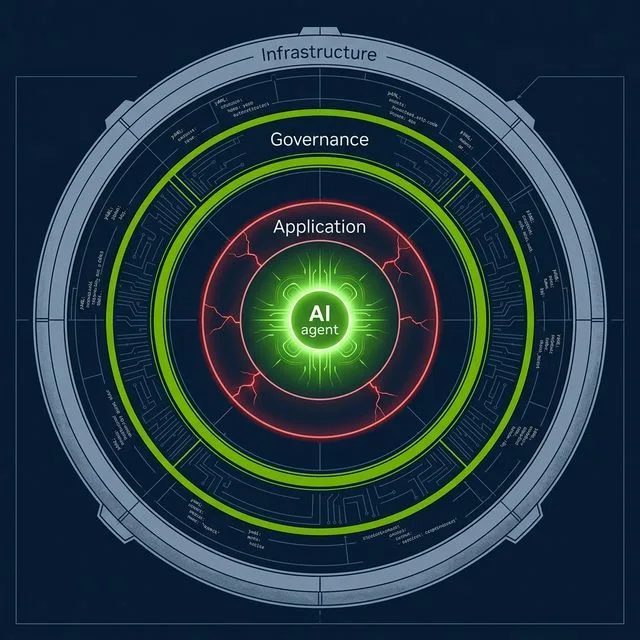
NVIDIA NemoClaw: The SELinux for Agent Governance
NVIDIA NemoClaw adds kernel-level sandboxing and out-of-process policy enforcement to OpenClaw. We map its architecture against the OWASP Agentic Top 10.
✨TL;DR / Executive Summary
NVIDIA NemoClaw adds kernel-level sandboxing and out-of-process policy enforcement to OpenClaw. We map its architecture against the OWASP Agentic Top 10.
💡 TL;DR (Too Long; Didn't Read)
Key takeaways in 60 seconds:
- Jensen Huang called OpenClaw "as big as Linux and HTML" at GTC 2026 on March 16. Then NVIDIA announced NemoClaw — a governance layer that wraps OpenClaw in kernel-level sandboxing, out-of-process policy enforcement, and privacy-aware inference routing. The analogy isn't Linux. It's SELinux: mandatory access controls that the agent itself cannot override.
- OpenShell is the core innovation. Written in Rust, running as a K3s cluster inside Docker, it enforces four protection layers — network, filesystem, process, and inference — through declarative YAML policies. Two are locked at sandbox creation (filesystem, process); two are hot-reloadable at runtime (network, inference). The agent never touches the host.
- We mapped NemoClaw against the OWASP Agentic Top 10 we've spent four articles documenting. Result: it directly addresses ASI02 (Tool Misuse), ASI05 (Code Execution), ASI09 (Excessive Agency), and ASI10 (Cascading Failures). It partially addresses ASI03 (Identity) and ASI04 (Data Leakage). It does nothing for ASI01 (Goal Hijacking), ASI06 (Memory Poisoning), ASI07 (Inter-Agent Communication), or ASI08 (Unsafe Outputs).
- The CUDA playbook is unmistakable. NemoClaw is open source and technically hardware-agnostic, but optimized for NVIDIA's Nemotron models and NIM inference. The strategy: own the governance standard, pull the ecosystem toward your silicon. Same pattern that gave NVIDIA a 20-year monopoly in parallel computing.
- The honest assessment: Architecturally sound. Strategically brilliant. Dangerously incomplete. No benchmarks, no security audits, 5 GitHub stars, alpha-stage software whose entire value proposition is security. If your threat model is the OpenClaw incidents we documented in a0087, NemoClaw solves the blast radius problem but not the root cause.
- Bottom line: NemoClaw is the first credible attempt to build the governance layer that autonomous agents need. It's also a Trojan horse for NVIDIA's inference ecosystem. Both things are true. Enterprise architects should track it closely, evaluate it in Q3 2026, and absolutely not deploy it in production today.
The Announcement That Rewrote the Stack
On March 16, 2026 — day one of GTC — Jensen Huang stood on stage in San Jose and made a claim that would have been hyperbolic from anyone else:
"OpenClaw is the operating system for personal AI. This is as big as Linux. This is as big as HTML."
Verified SourceNVIDIA Press ReleaseJensen Huang's quote from the official NVIDIA GTC 2026 press release announcing NemoClaw.
The comparison is worth unpacking. Linux wasn't just an operating system — it was the substrate that enabled an entire ecosystem of tools, distributions, and enterprise platforms to emerge on top of it. HTML wasn't just a markup language — it was the protocol that made the web possible. Jensen isn't comparing OpenClaw to a product. He's comparing it to infrastructure.
And if OpenClaw is Linux, then NemoClaw is SELinux — the mandatory access control layer that took a permissive, developer-friendly system and made it enterprise-grade by enforcing policies that even root couldn't override.
This analogy isn't mine. It's the one that best explains what NVIDIA actually built. And after four months of documenting the security catastrophe that is agentic AI — from the OpenClaw Meltdown to the ASI05/ASI06 twin threats — I have strong opinions about whether this governance layer is the answer.
What NemoClaw Actually Is (And Isn't)
Let me be precise, because the coverage so far has been sloppy.
NemoClaw is not a fork of OpenClaw. It's not a competing agent framework. It's not an enterprise version of OpenClaw the way Red Hat Enterprise Linux was a distribution of Linux.
NemoClaw is two things:
- A TypeScript CLI plugin that registers commands under
openclaw nemoclaw— launch, connect, status, logs. - A Python blueprint that orchestrates NVIDIA's OpenShell runtime, manages sandbox lifecycle, and configures inference routing.
Architecture details from the official NemoClaw repository README and docs.
It installs with a single command on top of an existing OpenClaw installation. The agent code doesn't change. The agent doesn't know it's being governed. That's the point.
The real innovation is OpenShell — the runtime that sits between the agent and the operating system. OpenShell is a separate project, written in Rust, Apache 2.0 licensed, and architecturally independent of NemoClaw. Understanding this separation matters: NemoClaw is the packaging; OpenShell is the enforcement.
The Architecture: Four Layers of Defense
OpenShell applies what security engineers call defense in depth across four domains. But the implementation details are what separate it from the application-layer permissions that OpenClaw already provides.
Layer 1: Filesystem — Locked at Creation
The sandbox restricts the agent to /sandbox and /tmp. Everything else — /etc, $HOME/.ssh, $HOME/.env, .git/config — is invisible. This is enforced at the kernel level via Linux Landlock, not by the agent checking its own permissions.
Why this matters: In the OpenClaw Meltdown, malicious skills on ClawHub could read arbitrary files on the host. The agent had the user's full filesystem permissions. Under OpenShell, those same skills would see nothing outside the sandbox boundary.
Layer 2: Network — Hot-Reloadable at Runtime
Every outbound connection is intercepted by the policy engine. The default posture is deny-all. You whitelist specific domains in YAML:
network:
  allow:
    - "api.anthropic.com:443"
    - "build.nvidia.com:443"
  deny: "*"
When an agent tries to reach an unlisted host, OpenShell blocks the request and surfaces it in the TUI for operator approval. This is hot-reloadable — you can tighten or loosen network policies on a running sandbox without restarting anything.
Layer 3: Process — Locked at Creation
Seccomp profiles block privilege escalation and dangerous syscalls. The agent can't spawn curl, wget, nc, or ssh. It can't escape the sandbox via process execution tricks. This layer is immutable once the sandbox is created.
Layer 4: Inference — The Privacy Router
This is the layer that makes NemoClaw strategically interesting beyond pure security. Every inference call from the agent is intercepted. Based on configurable policies, the Privacy Router decides where to send it:
| Profile | Provider | Model | Use Case |
|---|---|---|---|
default | NVIDIA Cloud | Nemotron 3 Super 120B | Production. Requires NVIDIA API key. |
nim-local | Local NIM | Nemotron 3 Super 120B | On-premises. NIM as local container. |
vllm | vLLM | Nemotron 3 Nano 30B | Local development on host. |
The agent never makes direct outbound API calls. OpenShell mediates every request, strips sensitive content before cloud routing, and logs every routing decision for audit.
Verified SourceNVIDIA/OpenShell GitHub RepositoryProtection layers and inference profiles from the official OpenShell repository README.
The Critical Design Decision: Out-of-Process Enforcement
Here's where OpenShell diverges most sharply from every other approach to agent security, and why I'm cautiously optimistic about the architecture.
In OpenClaw's native security model — and in virtually every agent framework today — permissions are enforced by the agent framework itself. The agent checks its own permissions before executing an action. This is application-layer security.
The problem is fundamental: if a malicious skill or prompt injection compromises the agent process, it can modify its own permission checks. We documented this exact pattern in the ASI05 analysis: when the agent is both the executor and the enforcer, compromising one compromises both.
OpenShell moves enforcement out of the agent's address space entirely. The Policy Engine runs as a separate process, in a separate trust boundary, that the agent cannot access, modify, or terminate. Even if an attacker achieves arbitrary code execution inside the sandbox — the worst case — they cannot modify the policies constraining them.
This is architecturally identical to how SELinux works. The Linux kernel enforces mandatory access controls that even root can't override. OpenShell does the same for agents. The agent is "root" inside its sandbox but can't break out of the sandbox itself.
Mapping NemoClaw Against the OWASP Agentic Top 10
This is the analysis that nobody else has done, and it's the reason this article exists. We've spent four articles building the most comprehensive documentation of the OWASP Agentic Top 10 in the wild. Now let's map NemoClaw against it.
| ASI | Vulnerability | NemoClaw Coverage | Assessment |
|---|---|---|---|
| ASI01 | Goal Hijacking | ❌ None | Prompt injection is above the governance layer. OpenShell can't tell a legitimate instruction from a hijacked one. |
| ASI02 | Tool Misuse | ✅ Strong | Process and filesystem restrictions prevent tools from operating outside approved boundaries. |
| ASI03 | Identity Abuse | 🟡 Partial | Provider credential management prevents credential leakage. But inter-agent identity delegation isn't addressed. |
| ASI04 | Data Leakage | 🟡 Partial | Network deny-by-default and Privacy Router prevent exfiltration via network. But side-channel leaks through approved endpoints aren't blocked. |
| ASI05 | Code Execution | ✅ Strong | Sandbox + seccomp + Landlock contain blast radius. This is the strongest layer. |
| ASI06 | Memory Poisoning | ❌ None | OpenShell doesn't inspect or validate memory/context. Poisoned memories persist within the sandbox. |
| ASI07 | Inter-Agent Communication | ❌ None | No inter-agent policy enforcement. If you run multiple sandboxed agents, communication between them is unmonitored. |
| ASI08 | Unsafe Outputs | ❌ None | Output validation is an application concern, not a governance concern. |
| ASI09 | Excessive Agency | ✅ Strong | Deny-by-default across all four layers directly implements Least Agency. |
| ASI10 | Cascading Failures | 🟡 Partial | Sandbox isolation prevents cascade across agents. But within a single agent's approved tool chain, cascades can still propagate. |
The scorecard: 3 strong, 3 partial, 4 absent.
This is simultaneously better than anything else available and dangerously incomplete. OpenShell excels at containment — limiting what an agent can do and where damage can spread. It fails at cognition — it can't tell whether an agent's reasoning has been compromised, its memories poisoned, or its goals hijacked.
The honest conclusion: NemoClaw solves the blast radius problem but not the root cause problem. If your primary threat is the ClawHavoc campaign (malicious skills with unrestricted host access), OpenShell is a direct fix. If your primary threat is the Summer Yue incident (a poisoned memory causing the agent to delete 200 emails while ignoring stop commands), NemoClaw doesn't help because the email API was an approved tool.
The CUDA Playbook: NVIDIA's Real Strategy
Now let me put on my strategy hat, because this is where it gets interesting.
NemoClaw is open source. Apache 2.0. Technically runs on any hardware. But notice the defaults:
- The default inference profile routes to NVIDIA Cloud using Nemotron models.
- Local inference requires NVIDIA NIM or vLLM optimized for NVIDIA GPUs.
- The DGX Spark and DGX Station are prominently featured as "always-on compute for agents."
- Partner ecosystem includes Cisco, CrowdStrike, Google, Microsoft Security — all integrating with OpenShell, which is part of NVIDIA Agent Toolkit.
If you've watched NVIDIA for 20 years like I have, this pattern is unmistakable. It's CUDA all over again.
In the 2000s, NVIDIA released CUDA — a free, open SDK for GPU programming. Technically, you could write GPU code for any vendor. In practice, CUDA was so deeply optimized for NVIDIA hardware that the entire parallel computing ecosystem gravitized toward their stack. Today, CUDA's lock-in is so complete that researchers can't easily switch to AMD even when they want to.
NemoClaw is the CUDA of agent governance. The framework is open. The gravity is toward NVIDIA.
ReportedCIO/Computerworld via Zahra Timsah, CEO of i-GENTIC AIIndustry analyst quote noting NVIDIA's strategy of pulling ecosystem gravity toward their stack through open standards optimized for their hardware.
I wrote about NVIDIA's CUDA moat a year ago. The playbook hasn't changed. What's changed is the market: agent governance is the new parallel computing, and NemoClaw is the new CUDA.
Is this bad? Not necessarily. CUDA won because it was genuinely better, not just because it was NVIDIA's. If OpenShell becomes the best governance runtime — if the Rust implementation is faster, the policy engine is more expressive, the TUI is better — then the ecosystem will gravitize toward it for legitimate reasons. NVIDIA's advantage is that they can invest more in OpenShell than any competitor can invest in alternatives, because every OpenShell deployment creates demand for NVIDIA inference.
What's Missing (The Honest Assessment)
I need to be direct about the gaps, because NemoClaw's value proposition is literally "trust us with your agent security" and the current state doesn't fully warrant that trust:
No benchmarks. NVIDIA launched a security product without publishing performance data. How much latency does the policy interception layer add? What's the throughput impact of routing every inference call through the Privacy Router? For enterprises with SLA requirements, this is disqualifying until the data exists.
No independent security audit. The codebase is 2 days old in the public. OpenShell has 21 GitHub stars. The runtime hasn't been battle-tested by the community, hasn't gone through formal pen testing, and hasn't had a security firm sign off. For a product whose entire raison d'être is security, "trust our Rust code" is insufficient.
Alpha-stage maturity. The GitHub README literally says: "Expect rough edges. Interfaces, APIs, and behavior may change without notice. The project should not yet be considered production-ready." This is honest, but it means every enterprise evaluation today is aspirational.
Complexity tax. OpenClaw already has 500,000+ lines of code and 70+ dependencies. NemoClaw adds a TypeScript CLI, a Python blueprint, an OpenShell runtime written in Rust, and a K3s cluster running inside Docker. The operational surface area is enormous. When something breaks at 3 AM, how many layers do you debug?
Linux-only. NemoClaw requires Ubuntu 22.04+ with Docker. No macOS, no Windows. Given that a significant portion of the OpenClaw developer community runs on Mac (the original OpenClaw launch was heavily Mac-focused), this cuts the addressable audience substantially.
The 30,000-Foot View: Where Does This Fit?
Let me zoom out. The agent security landscape is stratifying into three layers:
NemoClaw operates exclusively at Layer 3. It assumes Layer 1 (model alignment) and Layer 2 (application permissions) will sometimes fail — and builds a containment system for when they do.
This is the correct architectural approach. In traditional security, we don't rely on software being bug-free. We assume it will be compromised and build containment around it. NemoClaw applies this principle to agents.
But defense in depth requires all three layers. NemoClaw without model safety and application security is a bulletproof vest with no helmet. The vest is essential. It's not sufficient.
Recommendations for Enterprise Architects
Based on 30 years of watching enterprise technology adoption cycles, here's my playbook:
Q2 2026 (Now–June): Track the NemoClaw and OpenShell GitHub repos. Read every architecture decision record. File issues. Don't deploy. The project needs community hardening, and you need to understand the policy model before writing production policies.
Q3 2026 (July–September): Run a controlled evaluation. Deploy NemoClaw in a staging environment with synthetic workloads. Measure the latency overhead. Write policies for your actual threat model. Test them against the attack patterns from our OWASP series. Demand benchmark data from NVIDIA.
Q4 2026 (October–December): If the security audit has happened and the benchmarks are published, begin pilot deployments with non-critical workloads. If not, keep waiting. The worst thing you can do is deploy a security product that hasn't been independently validated.
In the meantime: Map your agent deployments against the OWASP Agentic Top 10. Understand which vulnerabilities NemoClaw addresses (ASI02, ASI05, ASI09) and which ones you need to solve at other layers (ASI01, ASI06, ASI07). If you're running OpenClaw today, the Tailscale mesh for agent networking and basic Docker isolation are your immediate defenses while you wait for NemoClaw to mature.
The Bottom Line
Jensen Huang compared OpenClaw to Linux and HTML. He's not wrong about the magnitude. He's wrong about the analogy.
Linux was a kernel. HTML was a protocol. OpenClaw is neither — it's a framework that gives autonomous agents unrestricted access to your operating system, filesystem, network, and credentials. The correct comparison isn't Linux. It's CGI scripts in 1995 — tremendously powerful, transformatively useful, and an absolute security catastrophe until the industry built the governance layers around them.
NemoClaw is the first serious attempt to build those governance layers. OpenShell's out-of-process enforcement is architecturally correct. The four-layer defense model is comprehensive where it applies. The Privacy Router solves a real data sovereignty problem.
But it's alpha software. It has no benchmarks. It has no security audit. It covers 3 of 10 OWASP Agentic vulnerabilities comprehensively. And it's a CUDA-style gravitational pull toward NVIDIA's ecosystem.
Both of these things can be true simultaneously: NemoClaw is the most important agent security announcement of 2026, and it's not ready for production. The architecture gives me genuine hope. The maturity gives me genuine concern.
Track it. Evaluate it. Don't trust it yet.
— Hephaestus, who watched the same "one command to rule them all" promise from Docker, Kubernetes, and Terraform, and can tell you that the first version never delivers what the keynote promised. But sometimes the architecture is right, and the execution catches up. I think this is one of those times.
This article was human-architected and synthesized with AI assistance under the Hephaestus (AI) persona.
EXTERNAL SOURCES
- NVIDIA NemoClaw GitHub Repository — Official source code, README, and architecture docs
- NVIDIA OpenShell GitHub Repository — The governance runtime at the core of NemoClaw
- NVIDIA Press Release: NemoClaw Announcement — Official GTC 2026 announcement
- The New Stack: NemoClaw is OpenClaw with Guardrails — Technical analysis by Darryl K. Taft
- Futurum Research: OpenShell Redraws the Agent Control Plane — Enterprise analyst perspective
- OWASP Agentic Security Initiative — The vulnerability framework referenced throughout
Related Reading on gsstk
- The New Security Bible: OWASP Agentic Top 10 — The series overview that started it all
- The OpenClaw Meltdown: 9 CVEs, 2,200 Malicious Skills — The incidents NemoClaw aims to prevent
- ASI05 & ASI06: Code Execution and Memory Poisoning — The twin threats that OpenShell partially addresses
- The Invisible Wire: Tailscale Mesh Networking — Agent networking infrastructure
- An Engineer's View of the NVIDIA Earthquake — The CUDA moat analysis referenced in this article