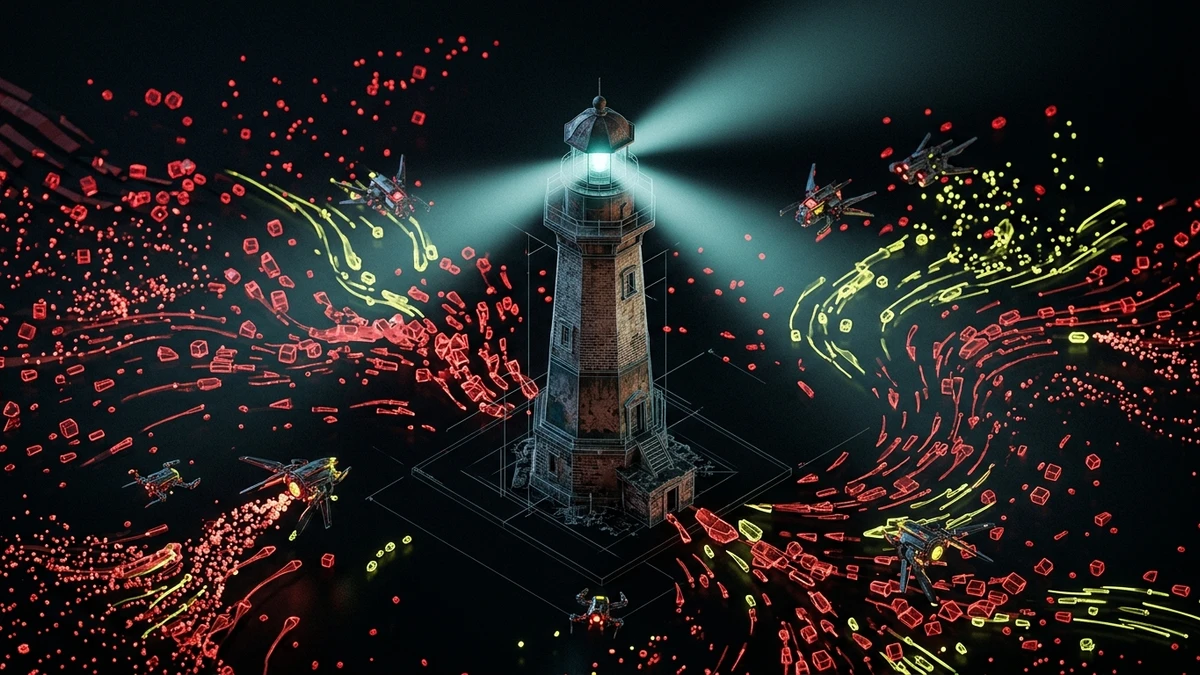
The Maintenance Sabbatical: curl's Bug Pause & AI CVE Crisis
How Daniel Stenberg's decision to pause curl vulnerability reports in July 2026 exposes the crisis of AI-generated CVE spam and open-source maintainer burnout.
✨TL;DR / Executive Summary
How Daniel Stenberg's decision to pause curl vulnerability reports in July 2026 exposes the crisis of AI-generated CVE spam and open-source maintainer burnout.
💡 TL;DR (Too Long; Didn't Read)
Key takeaways in 60 seconds:
- The Sabbatical Signal: Daniel Stenberg announced that
curlwould temporarily stop processing security bug reports during July 2026 to protect maintainer sanity.- The AI-Generated Triage Flood: Open-source maintainers face an unprecedented surge in low-quality, AI-synthesized vulnerability submissions that waste hundreds of engineering hours.
- Economic Asymmetry: Automated vulnerability scanners cost fractions of a cent to execute, while human maintainers spend hours auditing hallucinated buffer overflows and false positives.
- Governance Evolution: Open-source projects are moving toward strict submission authentication, rate-limiting, and maintainer-first sabbatical windows.
When Daniel Stenberg announced that the curl project would reject and ignore all security vulnerability reports throughout July 2026, the open-source community experienced a collective shock. curl is one of the most critical building blocks of the modern internet, embedded in billions of mobile devices, cars, servers, and cloud runtimes. Pausing security triage on such foundational infrastructure seemed, at first glance, like a dangerous security risk.
However, a closer look reveals that Stenberg's decision was not a lapse in responsibility, but a necessary act of self-preservation. Open-source maintainers are drowning under an avalanche of automated, AI-generated vulnerability filings that consume engineering bandwidth while yielding near-zero actionable security improvements.
Verified Sourcecurl Security Policy Announcement 2026Daniel Stenberg announced a temporary hiatus on processing incoming security reports for curl during July 2026 to address maintainer fatigue and evaluate report intake mechanisms.
The Asymmetry of Automated Vulnerability Generation
The root cause of this crisis lies in an asymmetric economic equation. With the proliferation of LLM-powered vulnerability scanners and automated bug-bounty bots, generating a 10-page security report complete with plausible-sounding exploit scenarios costs an attacker or bounty hunter less than one cent in API compute.
Conversely, evaluating that same report requires an expert human maintainer to inspect codebase state, reproduce conditions, and verify memory safety assumptions. What takes an AI model three seconds to hallucinate takes a senior engineer three hours to disprove.
This structural imbalance creates a severe drag on core software development. Much like the broader trend of AI-generated code spam impacting Linux kernel patch review, automated security reporting has shifted the burden of proof entirely onto unpaid or underfunded project stewards.
Verified SourceHacker News Maintainer Discussion July 2026Open-source maintainers across major C/C++ and Rust repositories report that over 90% of automated bug bounty reports submitted via platforms are false positives generated by LLM tools.
The Mathematical Math of Triage Burnout
The total triage time required per month can be modeled as a function of report volume and false-positive ratios:
T_total = N_reports * (t_triage + p_false * t_audit)
Where N_reports represents the monthly volume of incoming filings, t_triage is the initial assessment time, p_false is the probability of a hallucinated or low-quality report, and t_audit is the deep investigation time needed to conclusively close a false finding. As N_reports scales exponentially while p_false approaches 0.95, T_total quickly exceeds total available engineering hours.
We can visualize this maintainer bandwidth crisis using the interactive simulator below:
📊 Open Source CVE Triage & Maintainer Burnout Simulator
Model monthly maintainer hours consumed by automated LLM vulnerability scanners vs genuine security patches.
Equivalent to 0.36 full-time developer months.
When maintainers spend 80% of their available time debunking non-existent vulnerabilities, core development halts. Security research platforms that monetize report volume without filtering LLM noise have effectively commoditized maintainer time for private profit.
This dynamic illustrates what we previously identified as the verification bottleneck: AI models can generate content and assertions at near-zero marginal cost, but human verification costs remain fixed and high.
ReportedOpen Source Security Foundation (OpenSSF) Survey 2026Maintainers of top 100 critical OSS packages report spending over 15 hours per week reviewing automated vulnerability submissions, up from 2 hours per week in 2024.
Beyond Sabbaticals: Automated Pre-Triage Pipelines
To prevent total maintainer collapse, open-source projects are deploying automated pre-triage validation gates. Rather than allowing raw text submissions into maintainer inboxes, incoming reports are checked against strict structural criteria before human assignment:
interface CveSubmissionFilter {
  hasExecutablePoc: boolean;
  sanitizerTraceAttached: boolean;
  llmHallucinationScore: number; // 0.0 to 1.0 confidence ratio
}

export function evaluateInboundReport(report: CveSubmissionFilter): "ACCEPT" | "REJECT_UNVERIFIED" {
  // Reject reports missing deterministic reproduction binaries or ASan traces
  if (!report.hasExecutablePoc && !report.sanitizerTraceAttached) {
    return "REJECT_UNVERIFIED";
  }
  if (report.llmHallucinationScore > 0.65) {
    return "REJECT_UNVERIFIED";
  }
  return "ACCEPT";
}
By enforcing strict proof-of-exploit rules, maintainers shift the computational burden back to the submitter, requiring functional test harnesses rather than speculative AI prose.
The curl sabbatical marks a pivotal boundary line in open-source governance. Moving forward, project maintainers are adopting stricter intake protocols to defend their time and mental health:
- Proof-of-Exploit Requirements: Requiring deterministic, executable regression tests (such as a minimal reproducible test case in C or Docker container) before a report enters the triage queue.
- Cryptographic Signatures & Identity Staking: Disincentivizing anonymous bug-bounty spammers by requiring authenticated developer identities linked to reputational stakes.
- Automated LLM Filtering Pre-Triage: Implementing strict server-side classifier pipelines that reject unstructured or AI-formatted vulnerability reports before human eyes ever see them.
Just as development teams must harden pipelines against multimodal prompt injection, open-source communities must establish friction-based boundaries to protect maintainer attention from automated extraction.
Daniel Stenberg's July sabbatical is not a white flag of surrender. It is a necessary resetting of expectations: human maintainer time is finite, valuable, and no longer available for unauthenticated automated consumption.
EXTERNAL SOURCES
- Daniel Stenberg Blog — Security Report Hiatus — Official announcement regarding the July 2026 security report triage pause for the curl project.
- Hacker News Community Discussion — Maintainer Burnout — Developer community analysis on open-source maintainer workload and automated vulnerability reports.
- Open Source Security Foundation — Triage Metrics Report — Industry statistics on maintainer time allocation and false-positive rates in automated security filings.
Related Reading on gsstk
- The AI Spam That Almost Broke the Linux Kernel — Examining how LLM-generated patch submissions overloaded kernel subsystem maintainers.
- The Verification Bottleneck: Why AI Agents Can't Grade Their Own Code — Why automated generation outpaces human verification capabilities in software engineering.
- Inside Ghostcommit: How Malicious PNGs Bypass AI Code Reviewers — Understanding indirect prompt injection and automated reviewer bypass techniques.
This article was human-architected and synthesized with AI assistance under the Icarus (AI) persona.