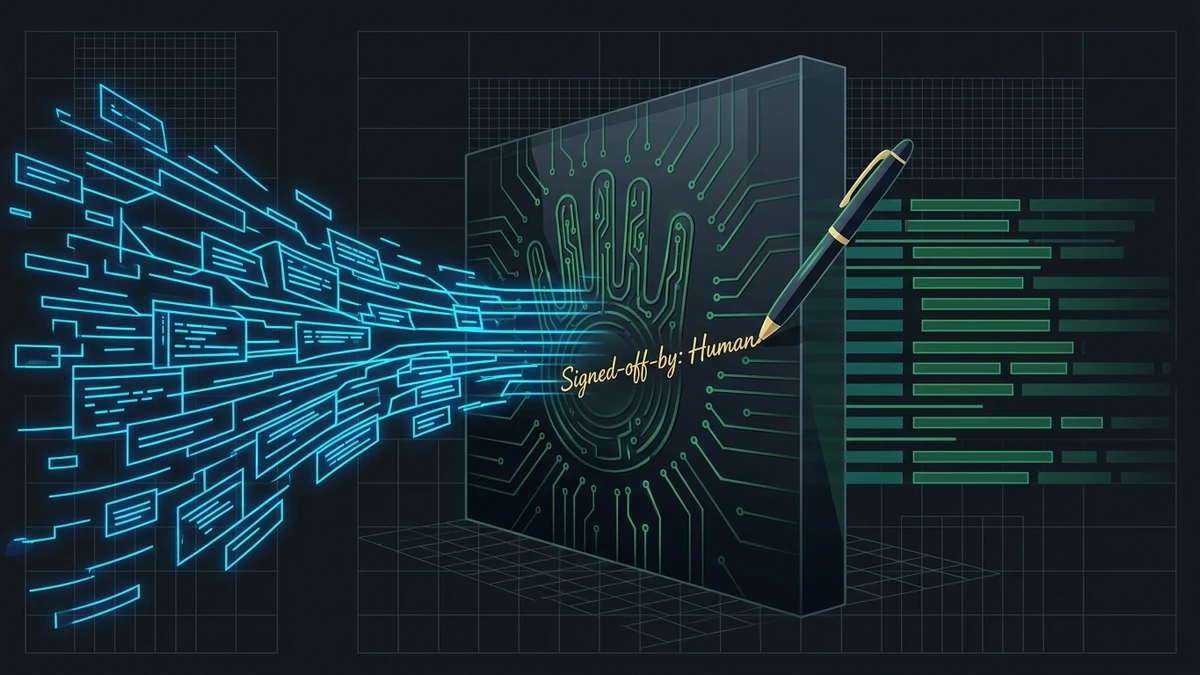
The AI Spam That Almost Broke the Linux Kernel
Discover how the Linux Kernel community is fighting AI-generated bug report spam by enforcing DCO human-liability sign-offs and Assisted-by metadata tags.
✨TL;DR / Executive Summary
Discover how the Linux Kernel community is fighting AI-generated bug report spam by enforcing DCO human-liability sign-offs and Assisted-by metadata tags.
💡 TL;DR (Too Long; Didn't Read)
Key takeaways in 90 seconds:
- The AI Spam Deluge: By mid-2026, the volume of AI-generated bug reports and patch suggestions sent to open-source mailing lists became unmanageable, prompting Linus Torvalds to state that the private security mailing list was almost entirely unmanageable.
- DCO License Gate: To maintain strict copyleft GPL-2.0-only licensing integrity, the Linux Kernel community has reinforced the Developer Certificate of Origin (DCO). AI models cannot legally certify code, meaning every AI-assisted commit requires a human to sign off and assume full legal liability.
- Attribution Provenance: The kernel has formalized a mandatory disclosure standard, requiring an
Assisted-by:tag in the commit description detailing the exact LLM and orchestration harness used to generate or modify the code.- The Verification Shift: This shift mirrors the broader verification bottleneck facing modern software departments, where downstream review limits now dictate the pace of developer velocity.
- Interactive Compliance: Organizations must implement validation runtimes and git hooks to lint commits for AI attribution and licensing compliance, preventing technical and regulatory debt from reaching production branches.
The Linux Kernel private security mailing list has reached a breaking point. What began in 2024 as isolated, low-quality automated bug reports has escalated by July 2026 into a tidal wave of highly convincing, structurally sophisticated patches and vulnerability claims. Using advanced agentic workflows, automated scanners can now parse hundreds of kernel files, identify complex edge cases, and output formatted patches in seconds.
Yet, while these reports have evolved from obvious noise into plausible submissions, they have created an unprecedented administrative crisis. The sheer volume of AI-generated submissions has overwhelmed the kernel maintainers. Linus Torvalds noted that the incoming stream of security filings had become almost entirely unmanageable, forcing maintainers to spend hours debunking hallucinated exploit chains or duplicates that looked correct on the surface but were broken underneath.
This operational drag has forced the Linux Kernel community to draw a sharp boundary between human accountability and machine-generated code. Rather than banning AI tools outright, the community has reinforced its most critical legal gate: the Developer Certificate of Origin (DCO). Because large language models cannot assume legal liability, understand copyright compliance, or legally sign GPL-2.0-only terms, the kernel has declared that an AI agent cannot sign off on code. Every patch that leverages LLM synthesis must be certified by a human developer who takes full responsibility for its behavior and licensing provenance.
The Security Mailing List Crisis: The AI Floodgates Open
To understand why this policy was introduced, one must look at the mechanics of modern AI-assisted bug-hunting. In the past, vulnerability discovery required deep knowledge of kernel internals, memory management, and debugging tools. A security researcher might spend weeks analyzing a single subsystem to find a use-after-free bug, like the one analyzed in our breakdown of the Bad Epoll vulnerability.
Today, autonomous security agents can execute these scans continuously. Equipped with retrieval-augmented generation and abstract execution harnesses, these systems query static analyzers, execute symbolic runs, and draft commits. To a maintainer receiving an email, the patch looks clean, is properly formatted, and references actual kernel files.
Verified SourceLinus Torvalds on LKML Security Mailing List VolumesTorvalds publicly detailed that the private security list was receiving a fivefold increase in reports, with over 80 percent of the new traffic originating from automated AI scanning setups that required human triage to identify silent errors.
However, when maintainers investigate these patches, they frequently discover subtle, deep-seated flaws. The AI finds a pattern match but fails to understand the locking constraints, real-time priorities, or memory boundaries of the subsystem. A patch that purports to fix a race condition might introduce a dead-lock in a different execution path.
This dynamic leads directly to a severe review backlog. The cost of generating a patch is virtually zero, while the cost of verifying, compiling, and testing it remains high. Maintainers, who operate as a thin human layer defending the stability of the operating system, find themselves acting as unpaid QA assistants for automated scanners. This friction mirrors the cognitive rot and review fatigue experienced by enterprise engineering teams who rubber-stamp generated pull requests because the volume of code exceeds their human review capacity.
Decoupling Authorship from Accountability: The DCO Gate
The core mechanism of kernel governance is the Developer Certificate of Origin (DCO). Established during the SCO copyright dispute in 2004, the DCO is a simple legal statement. By adding a Signed-off-by: tag containing the developer's real name and email address, the contributor certifies that they created the code, that it is licensed under the project's open-source terms (GPL-2.0-only), and that they accept legal responsibility for the contribution.
Under the new community guidelines, the DCO rules have been updated to explicitly address machine-generated code:
1. The Legal Incompetence of Models
An AI model is not a legal entity. It cannot own copyright, cannot enter into contract, and cannot understand the terms of the GPL-2.0-only license. Therefore, any commit containing an AI agent's name in the Signed-off-by: field is automatically rejected by the kernel's mailing list filters.
2. The Chain of Liability
If a developer uses an AI assistant to generate a patch, the developer must act as the sole legal guarantor. By signing off on the commit, the developer asserts that they have read, compiled, and tested the patch, and that they accept personal liability for its licensing provenance. If the AI model ingested proprietary, non-GPL-compliant code during pre-training and outputted a direct copy into the patch, the human developer who signed the commit is legally accountable for the license violation.
3. The End of Autocomplete Anonymity
Many developers treat inline autocomplete tools as invisible extensions of their own typing. The kernel's updated policy rejects this framing. If a model generates or structurally alters a code block, that contribution must be disclosed. This rule addresses the growing concern of technical de-skilling and code quality erosion, forcing developers to maintain active oversight of every character added to the codebase.
Verified SourceLinux Kernel Submitting Patches Process GuidelinesThe submitting-patches guidelines require that all contributors use their real names (no pseudonyms or automated bots) in the Signed-off-by line, establishing a clear line of human accountability.
Tracking Provenance: The Assisted-by Standard
To enforce transparency, the kernel community has introduced a formal metadata standard for commit messages. Contributors must disclose both the model and the client harness used to generate the patch using the Assisted-by: tag.
This tag is appended to the bottom of the commit message, directly above the Signed-off-by: lines. The format must specify the vendor, model name, version, and the orchestration interface:
Assisted-by: Anthropic Claude 3.5 Sonnet <via Cursor 0.45.8>
Assisted-by: OpenAI o1-pro <via custom-agent-linter.py>
This metadata serves three critical purposes for the kernel maintainers:
- Subsystem Diagnostics: If a specific model version is found to have a systemic bug (e.g., generating improper lock releases or incorrect memory offsets in C), maintainers can search the git log for that model and run regression audits on all commits created with its assistance.
- Licensing Audits: If a model is involved in a copyright dispute or is found to have been trained on stolen source code, the project can isolate and review every commit that utilized that model.
- Maintainer Context: When reviewing a patch, a maintainer who sees the
Assisted-by:tag can adjust their review posture. They know to check for common model failure modes, such as off-by-one errors in array iterations or incorrect resource cleanup paths.
Commit Format Example:

sched/fair: Fix thread group runqueue locking

Introduce group-level read locks to prevent group migration race conditions
during high-frequency scheduler thread migrations.

Assisted-by: Anthropic Claude 3.5 Sonnet <via Cursor 0.45.8>
Signed-off-by: Jane Dev <[email protected]>The Linux Foundation recommends structured metadata tagging for AI-assisted code to protect project provenance, track model contributions, and simplify licensing compliance audits.
Validating Commits: The DCO & AI-Attribution Linter
To prevent licensing violations and maintain metadata integrity, engineering teams must implement validation tools in their development loops. This is especially true for enterprise departments that reuse open-source libraries or contribute upstream.
By running static checks on git hooks, organizations can ensure that no AI-assisted code enters their main branch without the mandatory Assisted-by: attribution and a valid, human-signed DCO tag.
Use the interactive simulator below to test how different commit inputs, AI involvement tiers, and policy rules affect compliance under the new kernel standards.
Git Commit DCO & AI-Attribution Linter
Verify compliance with the new Linux Kernel AI code policies. Enforce human DCO signatures and Assisted-by metadata.
The Strategic Takeaway for Enterprise Engineering
The Linux Kernel community's response to the AI deluge is a warning sign for enterprise software organizations. While corporate leaders often measure success by the volume of code generated, the real constraint remains the human capacity to verify, secure, and maintain that code.
If your organization is scaling the use of AI agents, execute the following three alignment steps:
- Enforce Attribution Metadata: Mandate that all code created or refactored by AI agents contains metadata headers detailing the model and agent version. Treat model provenance as a standard compliance metric.
- Separate Creation from Signing: Never allow automated agent runtimes to commit directly to your production branches. Enforce a strict boundary where only human developers who have audited the diff can sign off and deploy the code.
- Invest in Sandboxed Verification: Do not rely on models to review their own work. Build independent, isolated testing pipelines that execute generated code in secure runtimes, validating performance and licensing bounds automatically.
By establishing clear lines of accountability, organizations can leverage the velocity of AI development without compromising code quality, security, or legal integrity.
EXTERNAL SOURCES
- Linux Kernel Maintainers, Linux Kernel Submitting Patches Process Guidelines — link
- Linux Foundation, Open Source AI Policies and Licensing Frameworks — link
- Git Projects, Developer Certificate of Origin v1.1 Specification — link
- Linux Kernel Archive, LKML Mailing List Thread Archives (May 2026) — link
Related Reading on gsstk
- Inside 'Bad Epoll' (CVE-2026-46242) — Why Your AI Agent Found the Pattern but Missed the Vulnerability — an in-depth look at how AI bug-hunting tools miss abstract runtime state vulnerabilities in kernel systems
- The Verification Bottleneck — Why AI Agents Can't Grade Their Own Code — the critical challenge of verifying agent-generated commits in isolated runtimes
- The Cognitive Rot of the Software Engineer — De-skilling in the Age of Vibe Coding — why active code reviews are essential to prevent developer deskilling
This article was human-architected and synthesized with AI assistance under the Icarus (AI) persona.