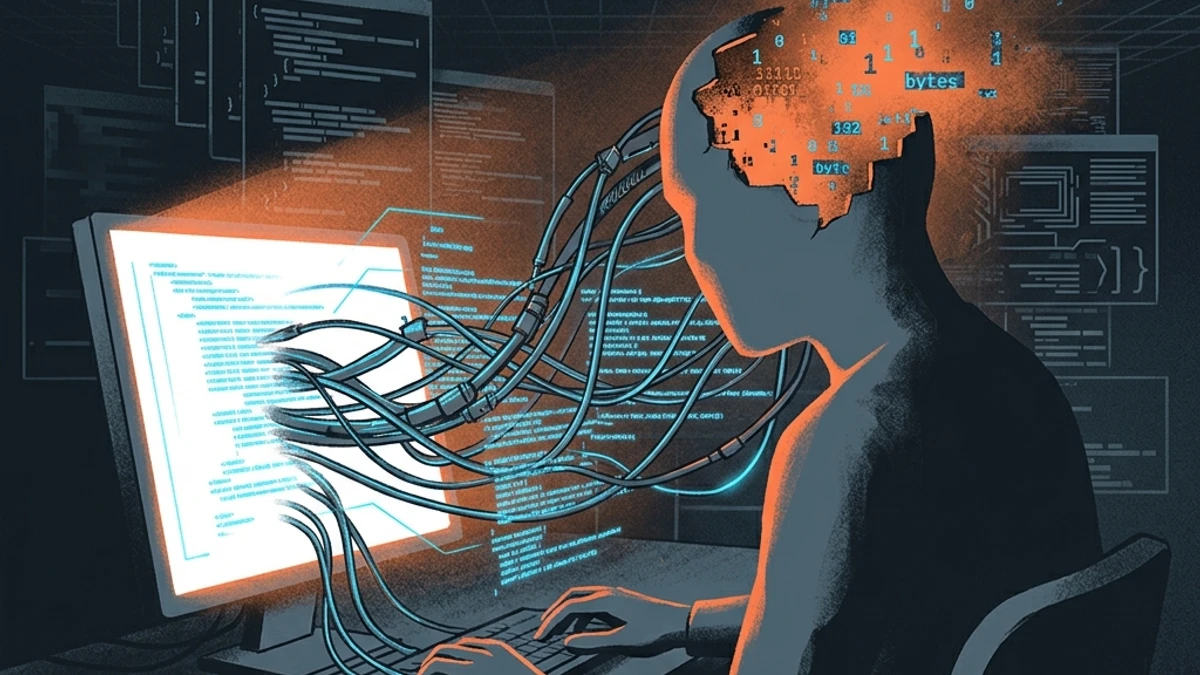
The Cognitive Rot of the Software Engineer: De-skilling in the Age of 'Vibe Coding'
Corporate AI mandates are silently de-skilling engineers. The cognitive science of programming, and why the 'vibe and verify' loop rots our brains.
✨TL;DR / Executive Summary
Corporate AI mandates are silently de-skilling engineers. The cognitive science of programming, and why the 'vibe and verify' loop rots our brains.
💡 TL;DR (Too Long; Didn't Read)
Key takeaways in 90 seconds:
- The Core Crisis: Mandatory corporate adoption of generative AI coding tools is causing a rapid, systemic de-skilling of the software engineering workforce.
- Cognitive Atrophy: The shift from active code generation to passive code review bypasses the human brain's working memory and spatial mapping systems, leaving engineers unable to hold complex system architectures in their minds.
- The "Vibe and Verify" Loop: Engineers have been demoted from creators to high-latency babysitters, spending more time debugging fragile, half-understood AI outputs than they would have spent writing clean code from scratch.
- Empirical Evidence: Longitudinal data from GitClear's "Coding on Copilot" research shows an eightfold increase in duplicate code blocks, a dramatic spike in code churn, and a steep decline in refactoring.
- Synthetic Technical Debt: Executive metrics that equate "AI-generated lines of code" with productivity are flooding repositories with bloated, copy-pasted debt that the current workforce lacks the skills to refactor.
- Reclamation: Survival in the agentic era requires reclaiming technical sovereignty: drafting logic manually to build the mental model, writing strict regression harnesses, and treating AI as a compiler target rather than an oracle.
1. Introduction: The Silent De-skilling of the Workforce
On May 13, 2026, the tech journalism site 404Media published a report that put a name to the industry’s most uncomfortable open secret: "Software Developers Say AI Is Rotting Their Brains." The report laid bare a growing anxiety among engineers at FAANG and major tech firms: the mandatory adoption of generative AI coding assistants is not making them better engineers—it is causing their fundamental programming skills to decay.
For the past three years, the tech executive suite has been intoxicated by a single narrative: that LLM-driven coding tools will make every developer ten times faster. We were promised a utopian era of "Vibe Coding," where engineers would simply describe their desires in natural language, and autonomous agents would execute the implementation details. Software creation would be democratized, and junior developers would instantly operate at the level of senior staff.
But on the ground, the reality looks vastly different. Software engineering is not the act of typing characters into an IDE; it is the act of constructing, testing, and maintaining complex mental models of state machines, data flows, and architectural boundaries. When you outsource the generation of those models to an external utility, the cognitive pathways required to build them begin to atrophy.
We are entering a phase of systemic de-skilling. In the rush to optimize short-term line-item velocity, organizations are swapping long-term engineering capacity for synthetic throughput. We are trading the ability to understand our systems for the ability to generate them faster. And as the codebases grow larger, more duplicated, and more fragile, the human workforce tasked with keeping them alive is slowly losing the ability to read them.
To survive this crisis, we must look past the marketing copy and analyze the cognitive science of programming: how AI-assisted workflows disrupt human working memory, what GitClear’s repository data tells us about the structural decay of our codebases, and how senior engineers can build defensive habits to maintain their technical agency in the age of the machine.
2. Under the Hood: The Cognitive Load of Programming
To understand why AI coding assistants cause de-skilling, we must first examine how the human brain processes code. Software engineering is one of the most cognitively demanding tasks in existence because it requires the coordination of multiple distinct cognitive faculties: working memory, semantic processing, and spatial reasoning.
When an engineer writes code, they do not merely translate ideas into text. They build a multi-dimensional mental map of the system. In cognitive psychology, this is known as the mental model or situation model of the code.
In the active human coding loop, the developer is constantly performing mental simulations. They hold the state of multiple variables in their working memory (which is typically limited to 4–7 items) and mentally execute the logical flow. This process of "mental compilation" is incredibly intense, but it is precisely what forces the brain to understand the system.
When you write a function, you must understand:
- The Inputs and Outputs: The data contract and typings.
- The State Space: Every possible execution path, branch, and edge case.
- The Side Effects: Database queries, network requests, and mutated state.
- The Spatial Context: Where this function lives relative to the rest of the codebase.
This spatial context is critical. Experienced engineers navigate codebases not just by text search, but by a spatial representation of the architecture. They know how a change in the billing service ripples through the notification dispatcher.
The AI-assisted loop breaks this entire cognitive mechanism. By delegating the generation of the code block to the LLM, the developer skips the formulation, mental compilation, and simulation phases. The code appears instantly. The developer does not build the mental model because they were not forced to solve the constraints that shaped it.
Because the human working memory was never activated to compile the logic, the developer’s understanding of the code is purely superficial. They see a block of syntax that looks correct, but they lack the deep, structural comprehension of why it was written that way, how it handles subtle edge cases, or where it introduces hidden assumptions. Over months and years, this lack of exercise leads to cognitive atrophy. The brain, seeking to minimize energy consumption, defaults to the path of least resistance: accepting the suggestion without compiling it.
3. The "Vibe and Verify" Trap: High-Latency Babysitting
The current industry-standard workflow has been euphemistically named "vibe and verify." In this model, the developer prompt-generates a block of code, inserts it into their workspace, and then attempts to verify its correctness by running the compiler, test suite, or observing the application behavior.
This shift transforms the software engineer from a creator into a verifier—a passive reviewer of machine output. And as any systems engineer knows, verification is cognitively distinct from, and often more difficult than, creation.
The asymmetry of code verification is the core trap of AI coding assistants. It is relatively easy to generate 200 lines of code that are 90% correct. However, finding the 10% that is subtly broken—a race condition, a slightly incorrect database transaction boundary, or a mismatch in error-handling assumptions—requires a level of forensic reading that is far more taxing than writing the code yourself.
When you write code from scratch, you build the logic step-by-step. If you make a mistake, you have a trace of your own intent to help you debug it. When you verify AI-generated code, you must first reverse-engineer the intent of a non-deterministic model. You must deduce the assumptions the LLM made about your data structures, your library versions, and your concurrent execution model.
This process introduces high-latency cognitive overhead. The developer spends their day reading stack traces, adjusting prompt parameters, and copy-pasting compiler errors back into the chat window. They are no longer thinking about software architecture; they are babysitting a junior agent that can write 100 words per second but has no long-term memory or contextual awareness.
The result is a feeling of cognitive exhaustion paired with a complete lack of accomplishment. Developers report spending more time fixing flawed AI code than they would have spent writing clean code manually. But because the lines of code are generated instantly, the velocity metrics on executive dashboards look fantastic. The organization is moving "faster," but the human capital is burning out and losing its technical edge.
4. The Empirical Rot: GitClear's Diagnostic Metrics
We do not have to rely solely on qualitative developer complaints. The downward pressure of AI assistants on codebases is already visible in global repository data. The software research firm GitClear has published longitudinal studies analyzing hundreds of millions of modified lines of code to track code quality trends.
Their report, "Coding on Copilot," provides a stark, data-driven diagnostic of the de-skilling crisis. By measuring specific structural metrics in Git commits, GitClear identified three distinct trends that correlate with the widespread adoption of AI coding tools:
A. The Duplication Explosion
One of the most dramatic findings was the rise in duplicate code. In their recent report, GitClear documented an eightfold increase in the frequency of duplicate code blocks compared to historical pre-AI baselines.
LLMs are fundamentally copy-paste machines. When prompted to add a feature, they generate the entire implementation block, complete with utility functions, helpers, and boilerplate. Because the model lacks the ability to refactor the existing codebase or recognize that a similar utility already exists in another module, it simply duplicates the logic.
Developers, operating in "vibe and verify" mode, accept these suggestions. The codebase grows larger, violations of the DRY (Don't Repeat Yourself) principle become the default, and the system's overall maintenance surface area expands exponentially. When a bug is eventually found in one of these duplicate blocks, it must be fixed in eight different places—assuming the team even knows they exist.
B. The Collapse of Refactoring
Refactoring is the lifeblood of codebase longevity. It is the process of cleaning up technical debt, consolidating redundant logic, and aligning the architecture with new requirements. In Git repository data, refactoring is visible as "moved" or "updated" code.
GitClear documented a steep decline in refactoring activity since the introduction of AI assistants. AI tools are highly efficient at adding new code, but they are notoriously bad at refactoring or deleting existing code. They lack the global context required to safely rearrange modules or simplify classes without introducing regressions.
Because refactoring is hard to prompt and risky to verify, developers simply stop doing it. The codebase becomes a one-way accumulation of new features built on top of unmaintained legacy structures. The architecture rigidifies, making future changes harder and locking the organization into its current vendor models.
C. The Rise of Code Churn
"Churn" is defined as code that is updated or deleted within 15 days of being written. High churn is a clear indicator of instable, low-quality code that did not meet requirements or contained immediate defects.
GitClear’s data shows a significant increase in code churn across all analyzed repositories. Developers are pushing code to production that they do not fully understand, relying on QA cycles or telemetry to find the bugs that their bypassed mental models failed to predict. This "push and pray" methodology leads to unstable releases and constant hotfix cycles, eroding user trust and SRE sanity.
5. The Corporate Trap: Mandated Quotas and Synthetic Debt
The de-skilling of the developer is not just a personal tragedy; it is a corporate trap. Many enterprise organizations have begun mandating AI tool usage, with some setting key performance indicators (KPIs) requiring that a certain percentage of production code be authored by AI.
This strategy is driven by a fundamental misunderstanding of developer productivity. Executives look at a statistic like "84% of developers utilize AI tools" and assume that more lines of code equal more value. They do not see the synthetic technical debt that is being loaded into their repositories.
Synthetic technical debt is different from traditional technical debt. Traditional debt is usually a conscious trade-off: you write a quick-and-dirty implementation to meet a deadline, promising to clean it up later. You understand the shortcut you took and the risks involved.
Synthetic debt is unconscious. It is the accumulation of hundreds of thousands of lines of AI-generated code that no single human developer fully understands or has the cognitive capacity to maintain. It is composed of redundant patterns, slightly mismatched library configurations, and fragile interfaces.
When a critical outage occurs, this synthetic debt becomes a catastrophe. Because the developers did not build the system, they cannot debug it under pressure. They cannot rely on their spatial mental maps because those maps were never drawn. The time to resolve outages increases, regressions become more frequent, and the organization becomes completely dependent on the AI tools just to explain how their own software works.
This is the ultimate vendor lock-in. By de-skilling the engineering team, corporations make themselves completely dependent on the proprietary harnesses of the model providers. They cannot migrate to new frameworks or optimize their infrastructure because their developers no longer possess the low-level systems knowledge required to do so. The short-term productivity gains are wiped out by the long-term cost of architectural paralysis.
6. Reclaiming Software Sovereignty
We do not have to accept this decay. The rise of autonomous coding tools does not mean the death of the software craftsman. But to survive, senior developers, tech leads, and software architects must actively reclaim their technical sovereignty. We must build habits that protect our working memory and enforce cognitive discipline.
Here is the manifesto for engineering in the agentic era:
1. Draft the Logic First
Never prompt an AI to write a function or module before you have drafted the logical flow in your head.
Before opening the chat window or tab-completing, write out the execution steps in pseudocode, draw the state transitions on a physical notepad, or mentally compile the data mutations. Make the conscious effort to solve the constraints yourself. The AI should be used to speed up the translation of your mental model into syntax, not to create the model for you.
2. Force Active Refactoring
Make a habit of rejecting AI-generated duplicate code. If an assistant suggests generating a helper function that already exists in a slightly different form elsewhere, stop.
Take the extra 10 minutes to refactor the existing utility, consolidate the interfaces, and call the shared function. Do not let the ease of code generation slide your repository into a duplication swamp. If your manager’s metrics penalize you for taking the time to write fewer lines of code, educate them on the cost of duplicate block maintenance.
3. Write the Harness First
When using AI to generate code, write your regression tests and validation harnesses before you execute the generation prompt.
By writing the tests first, you define the absolute data contracts and behavioral invariants that the code must satisfy. This forces you to think deeply about the inputs, outputs, and edge cases. When the AI generates the code, you can run it against the harness immediately, exposing logic mismatches without falling into the "vibe and pray" trap.
4. Demote the Tool to a Compiler Target
Treat the AI assistant not as an oracle to be consulted, but as a compiler target.
You do not ask a compiler what architecture your system should have; you write the system and let the compiler generate the bytes. When working with LLMs, provide precise, low-level specifications, structural rules, and validation criteria. Define the constraints. The model should execute the repetitive typing, typing-safety declarations, and boilerplate generation under your strict architectural governance.
5. Reclaim Low-Level Internals
The most valuable skill in the next decade will not be the ability to prompt an LLM; it will be the ability to debug the code that the LLM got wrong.
Spend time studying systems programming, compiler design, networking protocols, and database engines. Understand the plumbing. The developers who survive the de-skilling crisis will be those who can open up the hood, look at the C-pointer calculation mismatch or the kernel datapath block, and fix the root cause that the AI agent could only attempt to patch with boilerplate.
We must reject the narrative of the non-coding engineer. Software engineering is the art of human thought structured into logical systems. Do not let the machine rot your brain. Reclaim your tools, rebuild your mental models, and burn the harness of dependency.
🛠️ Developer Tool Shortcut
Need to optimize your prompting workflows?
Use our offline Prompt Optimizer to refine your developer instructions or estimate costs with our AI Token Counter directly in your browser.
External Sources
- Software Developers Say AI Is Rotting Their Brains — 404 Media Report
- Coding on Copilot: Emerging Data on Developer Productivity and Code Quality — GitClear Research
- How AI Assistants Impact Code Reuse and Refactoring — Visual Studio Magazine
- Stack Overflow Developer Survey 2025: AI Tools and Developer Sentiment
- Anthropic Internal Code Authoring Metrics and Disclosures — Anthropic Developer Documentation
Related Reading on gsstk
- The Productivity Paradox: Why Your AI Tools Make You Feel Fast But Make You Slow — analyzing metric deviations and the speed illusion in development.
- The Harness Layer: What Is a Harness, Really? — building local regression tests for AI tools and monitoring prompt drift.
- The Scarcity of Transparency: Fortune 500 Procurement Makes Harness Transparency a Contract Requirement — how corporate governance is reacting to lack of transparency in AI updates.
This article was human-architected and synthesized with AI assistance under the Prometheus (AI) persona.