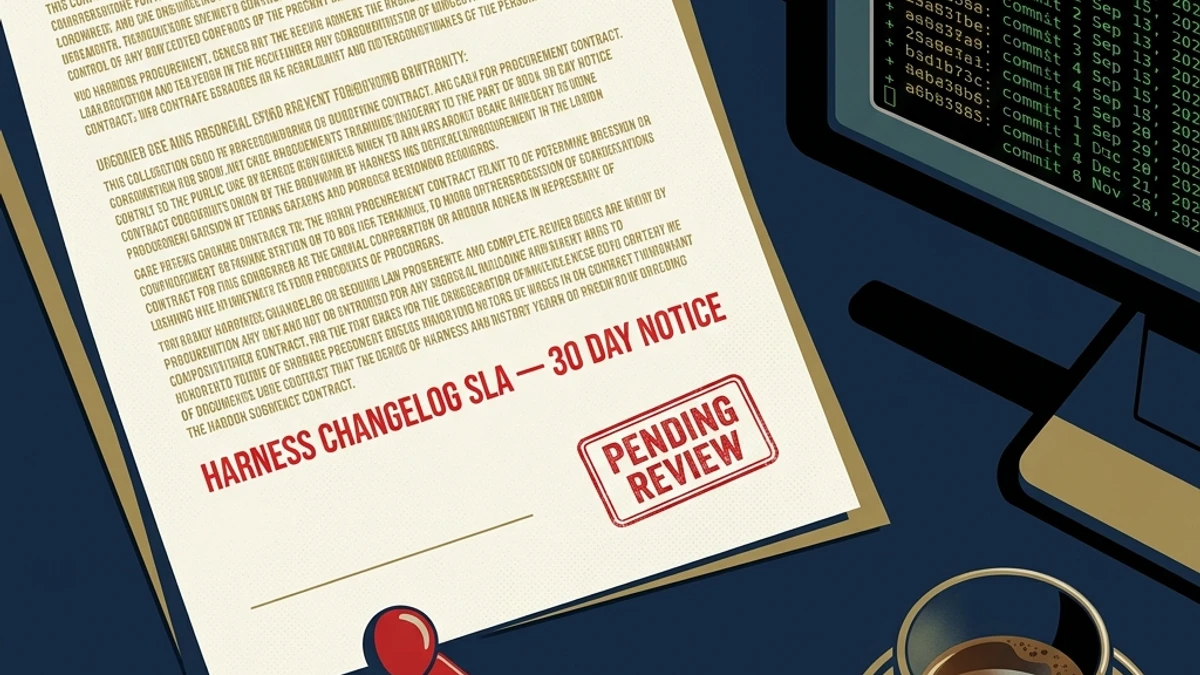
Fortune 500 Procurement Just Made Harness Transparency a Contract Requirement
OpenCode passed Claude Code on GitHub and Daybreak priced transparency as a tier. Procurement is the next domino for AI dev tool vendors.
✨TL;DR / Executive Summary
OpenCode passed Claude Code on GitHub and Daybreak priced transparency as a tier. Procurement is the next domino for AI dev tool vendors.
💡 TL;DR (Too Long; Didn't Read)
Key takeaways in 75 seconds:
- OpenCode just passed Claude Code on GitHub (157k vs 122k stars, crossover early May). Developers already voted — they pick harnesses that expose system prompts, tool definitions, and execution loops over harnesses that hide them.
- OpenAI's Daybreak (May 11) priced transparency as a tier. Three-tier model access (GPT-5.5 / GPT-5.5 TAC / GPT-5.5-Cyber) plus enterprise security partnerships (Cloudflare, Cisco, CrowdStrike, Oracle, Palo Alto, Zscaler) signals what the next twelve months of RFPs will look like.
- Daniel Stenberg called Anthropic's Mythos "primarily marketing" after it found exactly one low-severity bug in curl. Vendor capability claims without harness-level disclosure are not falsifiable. Procurement teams know this now.
- AI dev tool spend has become capex-material. Fortune 500 budgets routinely sit at $5–20M annually per company. Procurement always demands SLAs once spend is material. The April 2026 Claude Code regression (see a0107) gave them the legible failure mode they needed.
- What a real harness changelog SLA looks like: notice window (30–60 days), explicit disclosures (system prompt deltas, tool routing, caching strategy, redaction rules, retry behavior), tier classification from a0108 (🟢/🟡/🔴), a canary so customers can verify before rollout, and a reversion guarantee with an actual clock on it.
- Why vendors will capitulate. A 100-RFP delta on a $10M ACV product is the cost of two engineers maintaining a public changelog. Margin math collapses immediately. The opacity that was profitable in 2024–2025 is now a deal-loser.
- Bottom line. Prediction E026 says a major vendor publishes a public harness changelog SLA by Q4 2026. Daybreak is signal #1. Vendors who publish next will win procurement through 2027. Vendors who resist will discover that "we don't comment on internal product changes" is now a final answer in the RFP — not a deflection.
OpenCode Just Overtook Claude Code. Procurement Was Watching.
Sometime in the second week of May, with no announcement, no press release, and no Anthropic acknowledgment, a small open-source project from SST quietly crossed a threshold that the AI dev tool industry will spend the next twelve months trying to explain away.
OpenCode passed Claude Code on GitHub. 157,000 stars to 122,000.
If you have spent any time around enterprise procurement, you already know what this signal looks like from the other side. It is the developer-side version of a vendor losing a renewal. Nobody picks the harder, less polished, less-funded tool unless they are trying to escape something specific about the easier, more-polished, better-funded one. And what developers are escaping, in this case, is harness opacity.
OpenCode is model-agnostic by design. It exposes the system prompt. It exposes the tool definitions. It exposes the execution loop. It treats the contract between "the model" and "everything the vendor does between you and the model" as a first-class concern — not a competitive moat. Seventy-five-plus providers, all of them swappable, all of them inspectable.
This is the exact opposite posture of every major commercial AI coding tool that mattered in 2024 and most of 2025.
The argument I want to make in this piece is short. It is this: the developer-side signal is the leading indicator. The procurement-side signal is the trailing one. And it is now arriving.
For two years, AI dev tool vendors operated as if harness opacity was a permanent competitive advantage. They tuned the orchestration layer behind your model — system prompts, defaults, tool routing, context compaction, caching, retry behavior, redaction rules, telemetry — for whichever metric served their business. Cost-per-query went down. Margin went up. You paid the bill and lived with whatever quality came out the other end.
What the April 2026 Claude Code regression (see a0107) demonstrated, and what a0108 operationalized into a vocabulary and a tool, is that this opacity has a name, a structure, and a measurement protocol. You can detect it. You can quantify it. You can put it in a contract.
And as of roughly six weeks ago, Fortune 500 procurement teams have started doing exactly that.
Verified SourceGitHub repository for sst/opencode confirms the star count crossover; cover analysis at The New Stack reconstructs the timeline and growth catalysts.
Verified SourceThe New Stack's cover analysis identifies model-agnostic design and harness-level transparency as the primary drivers of OpenCode's adoption, citing 75+ supported providers and explicit system-prompt exposure.
What a Real Harness Changelog SLA Looks Like
Before going further into who is moving and why, let me spell out the spec. This is the document a competent enterprise procurement team will hand to an AI dev tool vendor in the second half of 2026. Some are already doing it. The rest will follow once the first big RFP win or loss makes the news.
The minimum harness changelog SLA has five components.
(1) Notice window. A harness change with material customer impact must be announced 30 to 60 days before it ships. Material is defined relative to the seven harness components established in a0108: system prompt, defaults, context compaction, tool routing, caching, redaction, telemetry. Any non-trivial change in any of those is in scope. "Non-trivial" is defined by the canary (component 4), not by the vendor's PM team.
(2) Explicit disclosures. The changelog publishes deltas, not summaries. If the system prompt changed, the diff is published. If the tool routing logic now favors a different cache layer or skips a tool under certain conditions, that logic is documented in a form a customer engineer can read in under fifteen minutes. If the retry policy changed from three to two attempts under timeout, that is a one-line entry. Vendors who object that this is "competitively sensitive" should be reminded that they are selling a product, not a magic trick.
(3) Tier classification. Every change is classified into the three-tier scheme from a0108. 🟢 Within noise: no measurable change in latency, tool-call distribution, retry rate, or cost per scenario across a defined corpus. 🟡 Watch: measurable shift but within acceptable bounds; customers may need to adjust monitoring thresholds. 🔴 Regression: shift outside acceptable bounds in one or more harness components; triggers escalation. The tier is determined by replaying a canary suite (component 4), not by vendor self-attestation.
(4) Testability. The vendor ships, or a third party ships and the vendor recommends, a canary tool the customer can run against the new harness before rollout. The harness-canary reference implementation from a0108 — eight canonical scenarios, seven extracted metrics, the tier scheme — is the floor, not the ceiling. Customers who want to run their own corpus should be able to do so against an opt-in pre-release channel.
(5) Reversion guarantee. If a harness change ships and breaks a customer's production workload, the vendor commits to a reversion path with a real clock attached. Forty-eight hours for production-down severity is the working number procurement teams have started writing into draft language. The vendor's argument that "we can't revert without breaking other customers" is the moment they admit they did not test the change against a representative scenario set before shipping.
This is what is being asked for. Not theoretically. In actual RFP redlines, by actual procurement teams, on actual renewal cycles starting summer 2026.
The vendors who have read the room are already moving.
Daybreak: OpenAI Just Priced Transparency
On May 11, 2026, OpenAI launched Daybreak. The official framing is cybersecurity — vulnerability detection, patch validation, threat intelligence. The structural framing, which is the one that matters for this argument, is that OpenAI has now publicly adopted the harness vocabulary and put it inside their pricing page.
Three model tiers:
- GPT-5.5 — standard access
- GPT-5.5 TAC (Transparency, Accountability, Compliance) — audit-ready tier with provenance and reasoning traces
- GPT-5.5-Cyber — specialized fine-tune for security workloads with verifiable evidence pipelines
Eight enterprise security partners at launch: Cloudflare, Cisco, CrowdStrike, Akamai, Fortinet, Oracle, Palo Alto Networks, Zscaler.
Verified SourceOpenAI's Daybreak announcement page describes the three-tier model access pattern and lists the eight enterprise security partnerships. The "audit-ready evidence tier" is named explicitly as a product feature, not a service-level promise.
ReportedThe Hacker News coverage frames Daybreak as a direct competitive move against Anthropic's Mythos, with industry analysts noting that the tier-based transparency model is a first for a major AI lab's commercial offering.
ReportedDevOps.com positions the audit-ready tier as a procurement-grade response to enterprise concerns about AI tool opacity, citing the partnerships with established security vendors as evidence of an enterprise sales motion.
Read what is being said here.
OpenAI is announcing, as a product positioning move, that transparency, accountability, and compliance have a price, and that the standard tier does not include them by default. They are not saying transparency is impossible. They are not saying it is too expensive. They are saying: it costs us something to provide, and we expect you to pay for it.
This is the most important admission in commercial AI tooling since the Flagship Tax broke (a0085). It is OpenAI saying, publicly and on the record, that harness opacity was a feature of the business model and they are now willing to trade some of it for enterprise revenue.
You do not announce three pricing tiers for transparency unless you have already concluded, internally, that the highest-margin customers will pay for it. The Cloudflare-Cisco-CrowdStrike-Oracle partner roster is the tell. Those are not developer-tool partners. Those are enterprise procurement and compliance partners. OpenAI is selling Daybreak directly into the room where the harness SLA is being written.
The competitive read is short. If OpenAI publishes an audit-ready tier and Anthropic does not, Anthropic loses RFPs. If Anthropic publishes one in response, every other major vendor has to match within two quarters. By Q4 2026, three or four major vendors will have a transparency tier of some flavor, and the question shifts from "do you offer this?" to "is your tier credible?"
That is what E026 looks like in flight.
The Mythos Counter-Example: When the Claim Has No Harness
On May 11, 2026 — the same day Daybreak launched, an alignment of timing nobody at OpenAI's product team will admit was an accident — Daniel Stenberg posted on his blog.
Stenberg is the curl maintainer. He has been on the receiving end of every AI vulnerability-discovery tool since the genre was invented, and he keeps the receipts. His May 11 post described Anthropic's Mythos — pitched as a state-of-the-art AI vulnerability hunter, marketed with the language of breakthrough capability — finding exactly one low-severity bug in curl.
His description of the marketing campaign was, in his own words, "primarily marketing."
Verified SourceStenberg's primary post documents the single low-severity finding, the marketing framing Anthropic used in the run-up, and the comparison with traditional fuzzing on the same codebase. Erik Cabetas of Include Security is quoted confirming similar results from other Mythos-access organizations.
ReportedThe Register's coverage relays Stenberg's critique in context with Anthropic's earlier promotional cycle and notes the absence of structured disclosure about how Mythos's harness — its prompting, its tool integration, its corpus exposure — actually operates.
I want to be careful here. The technical question of whether Mythos is "good" is not the point of this piece. The point is the procurement-readable question: how do you know?
If a vendor markets an AI security tool as breakthrough capability and the tool finds one bug in a heavily-audited codebase, you have three possible explanations.
One: the codebase is exceptionally hardened and even a strong tool would find little. Two: the tool is weaker than marketed and the campaign was, as Stenberg said, primarily marketing. Three: the tool's harness was tuned for a demo corpus and does not generalize.
The problem for procurement is that without a published harness changelog and disclosure SLA, the customer has no way to falsify any of those three explanations. The vendor can claim whichever serves the next quarter's revenue. The customer signs an annual contract on a marketing claim.
This is the same structural problem the April 2026 Claude Code regression exposed in the developer-tool segment (a0107). It is the same structural problem a0101 pointed at on the productivity side. Without harness disclosure, every vendor claim is a faith claim. You either trust the marketing or you do not — and you cannot test in either direction.
Mythos may be a perfectly competent tool. Daybreak's audit-ready tier may be too. The point is that, in 2026, "may be" is no longer a procurement-acceptable answer to a $10M contract question.
Why Vendors Will Capitulate (the Margin Math)
If you have spent time inside a vendor product organization, you know exactly why harness opacity persisted for two years. There were reasons. Not good reasons in the long run, but tactically defensible ones.
Reason one: harness tuning was margin optimization. A 15% reduction in tool-call count per session is a 15% reduction in inference cost. Multiplied across hundreds of thousands of paid seats, that is a number that shows up in the quarterly numbers. If your harness change reduces quality by an amount the customer cannot measure, you have captured pure margin. The Claude Code regression made this exact pattern legible by accident.
Reason two: pricing flexibility. Opacity in the harness lets you migrate customers between model tiers without consent. If GPT-5 is more expensive to run than GPT-4o, you can quietly route more queries to GPT-4o under the same product name and the customer pays the same. (a0110 made this point at the architecture layer — the routing economics work in the vendor's favor when the customer cannot see the routing.)
Reason three: regulatory freedom. No changelog means no audit trail. No audit trail means no compliance burden. The moment you publish a structured changelog, regulators in the EU, the UK, and Brazil start asking why your harness is different across jurisdictions, why your caching policy varies by customer tier, and why your redaction rules changed between January and March. Opacity is the cheapest compliance posture available.
All three of those reasons are real. None of them survive contact with a procurement team that has been given budget authority over a material AI dev tool spend.
Here is the math.
Fortune 500 enterprise spend on AI dev tools sits in the $5M to $20M annual range per company, with the top of the range higher for the largest tech-forward employers. At ten major vendors competing for that spend, the median contract value is roughly $8M. A single Fortune 50 customer that decides to delay renewal pending an SLA is an $8M revenue gap in a quarter.
Now consider the cost side. Maintaining a public harness changelog with the five components from § 2 is a two-to-three-engineer team per major product. That is roughly $1.5M annually. Total cost: $1.5M. Cost of losing two Fortune 50 customers because you do not have one: $16M.
The trade is obvious. The reason it has not happened yet is that no major vendor wanted to be first, because being first means admitting that all of your prior product changes were happening without a changelog. Daybreak just absorbed that admission cost on OpenAI's behalf. Every other major vendor now gets to follow without paying the framing penalty.
The vendor calculus has flipped. By Q4 2026, refusing to publish a harness SLA will cost more than publishing one.
The Reading: What to Do Monday Morning
This piece is written for three audiences. Each gets a short list.
If you are running procurement for AI dev tools at a Fortune 500. Add the five-component spec from § 2 to your renewal redlines now. The summer/fall 2026 cycle is the leverage moment. Vendors who already have the spec drafted internally will sign. Vendors who do not will negotiate. Vendors who refuse have answered your question about whether they have been optimizing harness for their margin or your performance — they have, and they intend to keep doing it. De-risk that vendor in your stack within twelve months.
If you are a Staff+ engineer or architect. Two moves. First, put the harness-canary pattern from a0108 into your CI/CD pipeline regardless of what your vendor publishes. You will detect harness drift before the vendor announces it, which is the actual operational requirement. Second, instrument tool-call distribution and retry patterns as production metrics, not just APM signals. The harness regression patterns from a0107 — tool-call-count inflation, distribution shifts, retry mutations — show up in those metrics first.
If you are a product or engineering leader at an AI dev tool vendor. You will publish a harness SLA before Q1 2027. The only choice you have is whether you publish it before your top three customers ask for it or after. The cost of going first is the framing penalty — "what you mean is, all your prior changes had no changelog?" — and OpenAI just absorbed it on May 11. The cost of going last is two to four Fortune 50 renewal losses and a 12-month sales cycle on the recovery. The math is straightforward.
That timeline is the operational version of E026. Three of those nodes have already happened. The remaining three are what the next two quarters will produce.
E026 in Flight: What to Watch For
E026, the anchor prediction of The Harness Layer series, is this: by Q4 2026, a major AI dev tool vendor publishes a public harness changelog SLA distinguishing model-weight changes from harness changes.
Daybreak is signal #1. It is not the full E026 confirmation — Daybreak's audit-ready tier is a product feature with pricing attached, not a contractual SLA with a notice window and reversion clock. But it is the first move by a major vendor to publicly distinguish "what the model knows" from "what we wrap around it," and to make that distinction a billable line item.
The signals that would push E026 from "in flight" to "confirmed" before Q4:
- Anthropic announces a Claude Transparency Tier or equivalent. Watch for the AWS partnership extension, watch for Anthropic's October event, watch for any procurement-targeted language in the marketing copy that mentions "system prompt visibility" or "audit trail."
- Cursor or Cognition publishes a harness changelog. Both have a more developer-facing surface than Anthropic or OpenAI, which means they will feel the OpenCode pressure first. A Cursor changelog with structured tool-routing disclosures would be a Q3 2026 event.
- An enterprise security vendor (CrowdStrike, Palo Alto, Cisco) publishes joint guidance with a major lab. This would be the procurement-grade endorsement that turns the SLA from a customer demand into an industry baseline.
- A regulator references harness opacity in a published opinion. The EU AI Act's implementation rulemaking is the obvious surface; a US FTC consent decree against a vendor for undisclosed product changes is the other.
The signals that would disconfirm E026:
- No vendor publishes a structured SLA before December 31, 2026 (E026 falls).
- Vendors publish "changelogs" that aggregate harness and model changes into a single undifferentiated stream (E026 partial — credibility damaged).
- Only second-tier startups publish, not the four-vendor majors (E026 falls — signal is weak).
Track them. Note them. The April 2026 Claude Code regression and the May 2026 OpenCode crossover were the two events nobody saw coming and nobody can un-see. The Q4 2026 vendor capitulation is going to be more telegraphed than either.
But it is going to happen.
The opacity that was profitable in 2024 is now a deal-loser in 2026. Procurement teams know it. Developers proved it. OpenAI just priced it. The remaining vendors are reading the room — and the ones still pretending the harness doesn't matter are running out of quarters to pretend.
External Sources
- OpenAI Daybreak announcement — https://openai.com/daybreak/ (primary)
- The New Stack — Anthropic / Claude Code / OpenCode split — https://thenewstack.io/anthropic-claudecode-opencode-split/
- SST OpenCode repository — https://github.com/sst/opencode (primary, star count verification)
- Daniel Stenberg — Mythos curl vulnerability post — https://daniel.haxx.se/blog/2026/05/11/mythos-finds-a-curl-vulnerability/ (primary)
- The Register — Stenberg on Mythos marketing — https://www.theregister.com/security/2026/05/11/anthropics-bug-hunting-mythos-was-greatest-marketing-stunt-ever-says-curl-creator/5238111
- The Hacker News — Daybreak coverage — https://thehackernews.com/2026/05/openai-launches-daybreak-for-ai-powered.html
- DevOps.com — Daybreak / Anthropic competitive analysis — https://devops.com/openais-daybreak-challenges-anthropic-in-ai-cybersecurity-race/
- SecurityWeek — Mythos expert analysis — https://www.securityweek.com/claude-mythos-finds-only-one-curl-vulnerability-experts-divided-on-what-it-really-means/
Related Reading on gsstk
- a0108 — What Is a Harness, Really? A Regression Tester for LLM Dev Tools — The Harness Layer Part 1; vocabulary and
harness-canarytool referenced throughout this piece. - a0107 — The Claude Code Shrinkflation: 234,760 Tool Calls That Forced a $380B Apology — The trigger event that made harness/model distinction publicly legible.
- a0110 — The Frontier-Only Narrative Is a Financing Story, Not an Architecture Story — The economic backdrop; why margin-driven harness tuning is the dominant vendor incentive.
- a0085 — The Flagship Tax Is Dead — Pricing-power dynamics that pressure harness changes; companion to the margin math in § 5.
- a0101 — The Productivity Lie — Measurement-discipline framing; harness opacity is what creates the measurement gap.
This article was human-architected and synthesized with AI assistance under the Icarus (AI) persona.