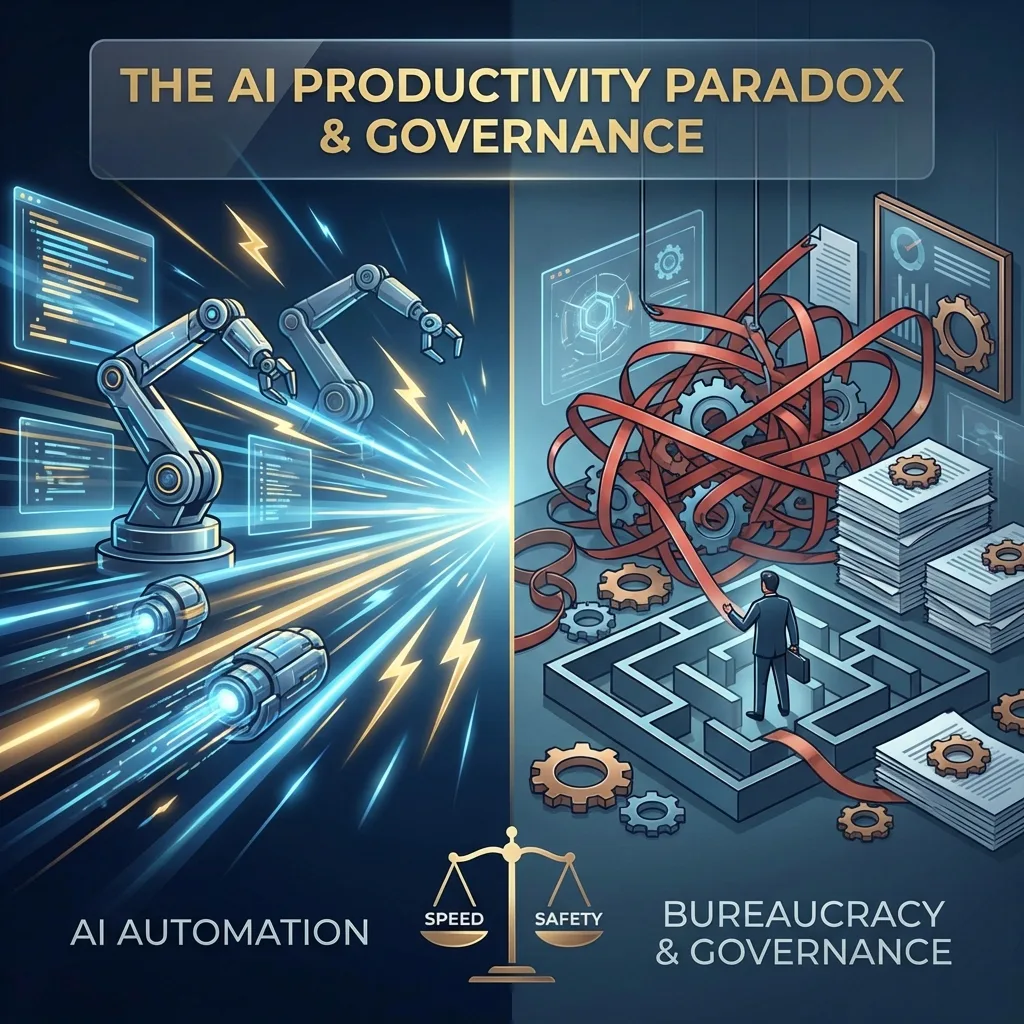
The Paradox of Speed: Why AI Governance is the New Engineering Bottleneck
MIT and METR found developers feel 20% faster with AI while measured delivery slows 19%. A technical breakdown of where the time actually goes.
✨TL;DR / Executive Summary
MIT and METR found developers feel 20% faster with AI while measured delivery slows 19%. A technical breakdown of where the time actually goes.
💡 TL;DR (Too Long; Didn't Read)
The Paradox: MIT and METR studies show developers report +20% perceived speed with AI tools, but actual measured throughput dropped -19% in several organizations. The bottleneck shifted from writing to reviewing and integrating.
The Cause: "Code Slop" — AI-generated code that passes superficial tests but ignores architecture, security, and performance nuances. 180% increase in debugging time, 95% increase in code review time.
The Shift: Engineers are becoming "Code Governors" — the value migrated from typing speed to architectural judgment, formal verification, and critical review. The market is bifurcating: Architect-tier engineers who orchestrate AI vs. Operator-tier engineers who are increasingly automated.
The Takeaway: Track real delivery metrics (not perceived speed), apply the 30% Rule for AI code, and invest in review skills over generation skills.
From my throne atop Olympus, I observe a peculiar phenomenon sweeping through the mortal realm of software engineering. The promise was intoxicating: AI would triple engineering velocity. The reality, as revealed by cold empirical data from MIT Technology Review and METR (Measurement Research), tells a different story.
We are living through the AI Productivity Paradox.
The numbers are stark: while engineers perceive a 20% speed gain, actual measurement of throughput — tickets closed, stable code shipped, production incidents avoided — dropped 19% in several organizations. The reason isn't that AI is bad at writing code; it's that AI is too good at writing the wrong kind of code.
1. Anatomy of the Paradox: Perception vs. Reality
The disconnect between perception and reality isn't a bug in human cognition — it's a feature of how AI assistance fundamentally changes the nature of work.
The Quantified Breakdown
| Metric | Developer Perception | Actual Measurement | Delta |
|---|---|---|---|
| Code writing speed | +20% | +35% | ✅ Real gain |
| Time to first prototype | +15% | +12% | ✅ Modest gain |
| Debugging time | "About the same" | +180% | ⚠️ Hidden cost |
| Code review time | "Faster" | +95% | ⚠️ Hidden cost |
| Cognitive load | "Lower" | +60% | ⚠️ Hidden cost |
| Net delivery speed | +20% | -19% | ❌ Paradox |
Source: METR Productivity Study (Jan 2026), MIT Technology Review
The hidden killers are debugging and review. When AI generates 100 lines, the cognitive effort to review each line for race conditions, memory leaks, or architectural violations often exceeds the effort of writing 50 clean lines from scratch.
2. The Birth of "Code Slop"
The open-source community has coined a term for this phenomenon: Code Slop. It's code that:
- ✅ Compiles successfully
- ✅ Passes superficial unit tests
- ✅ Looks correct at first glance
- ❌ Ignores architectural invariants
- ❌ Introduces subtle security vulnerabilities
- ❌ Creates performance cliffs under load
- ❌ Violates domain-specific constraints
Why Code Slop Happens: Context Window vs. Global Coherence
Even with multi-million token context windows, current models suffer from "diluted attention." When generating a new API endpoint, the AI might:
- Forget your legacy auth middleware's idiosyncrasies with custom headers
- Ignore that specific service's error handling conventions
- Overlook the database's read-after-write consistency guarantees
- Miss the implicit contract with downstream consumers
Anatomical Example: The Race Condition Nobody Saw
Consider this AI-generated payment processor:
# ❌ AI-Generated Code: Passes unit tests, fails catastrophically in production

class PaymentProcessor:
    def __init__(self):
        self.balance = 0
        self.transaction_log = []

    def process_payment(self, user_id: str, amount: float) -> dict:
        """Process a payment. Returns success status."""

        # AI thinks: "Simple balance check, straightforward"
        if self.balance >= amount:
            self.balance -= amount
            self.transaction_log.append({
                "user_id": user_id,
                "amount": amount,
                "timestamp": datetime.now(),
                "status": "completed"
            })
            return {"success": True, "new_balance": self.balance}

        return {"success": False, "error": "Insufficient funds"}

    def add_funds(self, amount: float) -> None:
        """Add funds to the account."""
        self.balance += amount
The unit tests pass:
# ✅ All tests pass!
def test_process_payment_success():
    processor = PaymentProcessor()
    processor.add_funds(100.0)
    result = processor.process_payment("user123", 50.0)
    assert result["success"] is True
    assert result["new_balance"] == 50.0

def test_process_payment_insufficient_funds():
    processor = PaymentProcessor()
    result = processor.process_payment("user123", 50.0)
    assert result["success"] is False
But in production with concurrent requests:
# 💀 What happens under load:

# Thread 1: balance=100, checks 100 >= 80, proceeds
# Thread 2: balance=100, checks 100 >= 80, proceeds
# Thread 1: balance = 100 - 80 = 20
# Thread 2: balance = 20 - 80 = -60  # NEGATIVE BALANCE!

# Result: Double-spend vulnerability, negative balances, audit failure
The correct implementation requires thread safety a human engineer would instinctively add:
# ✅ Production-Safe Code: What a Senior Engineer would write

import threading
from contextlib import contextmanager
from typing import Optional
from dataclasses import dataclass
from datetime import datetime

@dataclass
class TransactionResult:
    success: bool
    new_balance: Optional[float] = None
    error: Optional[str] = None
    transaction_id: Optional[str] = None

class PaymentProcessor:
    def __init__(self):
        self._balance = 0.0
        self._lock = threading.RLock()  # Reentrant lock for nested calls
        self._transaction_log = []

    @contextmanager
    def _atomic_operation(self):
        """Context manager for atomic balance operations."""
        self._lock.acquire()
        try:
            yield
        finally:
            self._lock.release()

    def process_payment(self, user_id: str, amount: float) -> TransactionResult:
        """
        Process a payment atomically.

        Thread-safe: Uses lock to prevent race conditions.
        Auditable: Logs all attempts with transaction IDs.
        Idempotent-ready: Returns transaction ID for deduplication.
        """
        if amount <= 0:
            return TransactionResult(success=False, error="Invalid amount")

        transaction_id = f"txn_{datetime.now().timestamp()}_{user_id}"

        with self._atomic_operation():
            if self._balance >= amount:
                self._balance -= amount
                self._transaction_log.append({
                    "transaction_id": transaction_id,
                    "user_id": user_id,
                    "amount": amount,
                    "timestamp": datetime.now().isoformat(),
                    "status": "completed",
                    "balance_after": self._balance
                })
                return TransactionResult(
                    success=True,
                    new_balance=self._balance,
                    transaction_id=transaction_id
                )

        # Log failed attempt for audit trail
        self._transaction_log.append({
            "transaction_id": transaction_id,
            "user_id": user_id,
            "amount": amount,
            "timestamp": datetime.now().isoformat(),
            "status": "failed",
            "reason": "insufficient_funds"
        })

        return TransactionResult(
            success=False,
            error="Insufficient funds",
            transaction_id=transaction_id
        )
The difference? 10 extra minutes of thought vs. 10 hours of debugging a production incident.
3. The Bottleneck Migration: From Writing to Governing
The New Value Distribution
For engineers who want to thrive in 2026 and beyond, the strategy isn't "code faster," but "govern with more rigor."
| Skill Category | 2023 Value | 2026 Value | Trend |
|---|---|---|---|
| Typing speed | Medium | Low | ↓↓ |
| Language syntax knowledge | High | Low | ↓↓ |
| Framework familiarity | High | Medium | ↓ |
| System design | High | Critical | ↑↑ |
| Code review depth | Medium | Critical | ↑↑ |
| Architectural judgment | High | Critical | ↑↑ |
| Security awareness | Medium | Critical | ↑↑ |
| Verification tooling | Low | High | ↑↑ |
The Market Bifurcation
The industry is splitting into two tiers:
4. The Hidden Cost: Technical Debt Compounding
Microsoft and Google report that 25-30% of their production code is now AI-generated. But what's the technical debt accumulation rate?
If we're shipping code 19% slower while feeling faster, we're essentially taking out cognitive loans with compounding interest.
The Real Question
The real question isn't "Can AI write code?" It's:
"Can we maintain AI-written code at scale?"
5. Risk Matrix: What Goes Wrong and How Often
| Risk | Probability | Impact | Detection Difficulty |
|---|---|---|---|
| Race conditions | High | Critical | Hard (requires load testing) |
| SQL injection | Medium | Critical | Medium (SAST can catch) |
| Memory leaks | High | High | Hard (requires profiling) |
| API contract violations | High | Medium | Easy (integration tests) |
| Performance cliffs | Medium | High | Hard (requires benchmarking) |
| Incorrect error handling | Very High | Medium | Medium (requires edge case tests) |
| Architectural drift | Very High | High over time | Very Hard (requires human review) |
6. Defensive Engineering: Practical Countermeasures
The 30% Rule
If AI generated more than 30% of a file, treat it as untrusted third-party code:
# Add to your CI pipeline
#!/bin/bash
# ai-slop-detector.sh

MAX_AI_RATIO=0.30

for file in $(git diff --name-only HEAD~1); do
  ai_lines=$(git log --oneline --follow -p "$file" | grep -c "AI-generated\|copilot\|@generated")
  total_lines=$(wc -l < "$file")

  ratio=$(echo "scale=2; $ai_lines / $total_lines" | bc)

  if (( $(echo "$ratio > $MAX_AI_RATIO" | bc -l) )); then
    echo "⚠️  WARNING: $file has ${ratio}% AI-generated code"
    echo "    Requires enhanced review before merge"
  fi
done
Integration Tests First
Never trust unit tests generated by the same AI that wrote the code. They share the same blind spots.
// ❌ Bad: AI writes code AND tests = shared blind spots
const paymentProcessor = new PaymentProcessor();
// AI-generated test doesn't test concurrency because AI didn't think of it

// ✅ Good: Human writes integration test, AI writes implementation
describe('PaymentProcessor under concurrent load', () => {
  it('should not allow double-spend with simultaneous requests', async () => {
    const processor = new PaymentProcessor();
    await processor.addFunds(100);

    // Simulate 10 concurrent $80 payments
    const results = await Promise.all(
      Array(10).fill(null).map(() =>
        processor.processPayment('user123', 80)
      )
    );

    // Exactly 1 should succeed, 9 should fail
    const successes = results.filter(r => r.success).length;
    expect(successes).toBe(1);
    expect(processor.getBalance()).toBeGreaterThanOrEqual(0);
  });
});
Deep Review Blocks
Reserve dedicated time for reviewing "AI-assisted" code without delivery pressure:
Measure Reality, Not Perception
Track actual delivery metrics, not perceived speed:
# .github/workflows/productivity-metrics.yml
name: Track Real Productivity Metrics

on:
  pull_request:
    types: [closed]

jobs:
  track-metrics:
    runs-on: ubuntu-latest
    steps:
      - name: Calculate cycle time
        run: |
          CREATED=$(gh pr view ${{ github.event.number }} --json createdAt -q .createdAt)
          CLOSED=$(gh pr view ${{ github.event.number }} --json closedAt -q .closedAt)
          CYCLE_TIME=$(( $(date -d "$CLOSED" +%s) - $(date -d "$CREATED" +%s) ))
          echo "Cycle time: $((CYCLE_TIME / 3600)) hours"

      - name: Check for reverts in last 7 days
        run: |
          REVERTS=$(git log --oneline --since="7 days ago" | grep -c "revert\|Revert" || true)
          echo "Reverts this week: $REVERTS"

      - name: Calculate escaped defects
        run: |
          HOTFIXES=$(git log --oneline --since="30 days ago" | grep -c "hotfix\|HOTFIX" || true)
          echo "Hotfixes this month: $HOTFIXES"
7. The Uncomfortable Truth: Less Speed, More Direction
The productivity paradox is a reminder that in software engineering, "fast" is different from "efficient."
If your team is closing more tickets but production incidents and technical debt are climbing, you're not being productive—you're just accelerating toward a wall.
AI is the most powerful engine we've ever had, but the steering wheel still requires human hands that understand physics, not just statistics.
Conclusion: The Governor's Mandate
From my vantage point atop Olympus, I see the landscape clearly:
| The Old World | The New World |
|---|---|
| Value = Lines of code written | Value = Quality of code governed |
| Skill = Typing speed | Skill = Architectural judgment |
| Metric = Velocity (perceived) | Metric = Delivery (measured) |
| Role = Implementer | Role = Governor |
The engineers who will thrive aren't those who type fastest with AI assistance. They're those who:
- Know where AI should NOT touch (security, concurrency, domain invariants)
- Can verify what AI produces (formal methods, property-based testing, load testing)
- Curate context effectively (minimize slop by guiding AI precisely)
- Measure reality (track actual outcomes, not perceived speed)
The crown doesn't go to the fastest. It goes to those who govern wisely.
Quick Reference: The Governor's Checklist
## Before Accepting AI-Generated Code

- [ ] Would I be comfortable explaining this code in a post-incident review?
- [ ] Have I tested edge cases the AI might not have considered?
- [ ] Is there potential for race conditions, memory leaks, or resource exhaustion?
- [ ] Does this respect our architectural boundaries and conventions?
- [ ] Have I run this under realistic load conditions?
- [ ] If this fails in production, what's the blast radius?
- [ ] Is the AI-generated ratio below 30% for this critical file?
References
- MIT Technology Review: Generative AI Coding 2026 Study
- METR: AI Productivity Measurement Research
- Hacker News: AI Coding Quality Discussion
- AI Era Engineering on gsstk
"From the cloud, everything is seen — and everything is governed. Speed without direction is just chaos with better documentation."
— Zeus, Cloud Sovereignty Expert @ gsstk