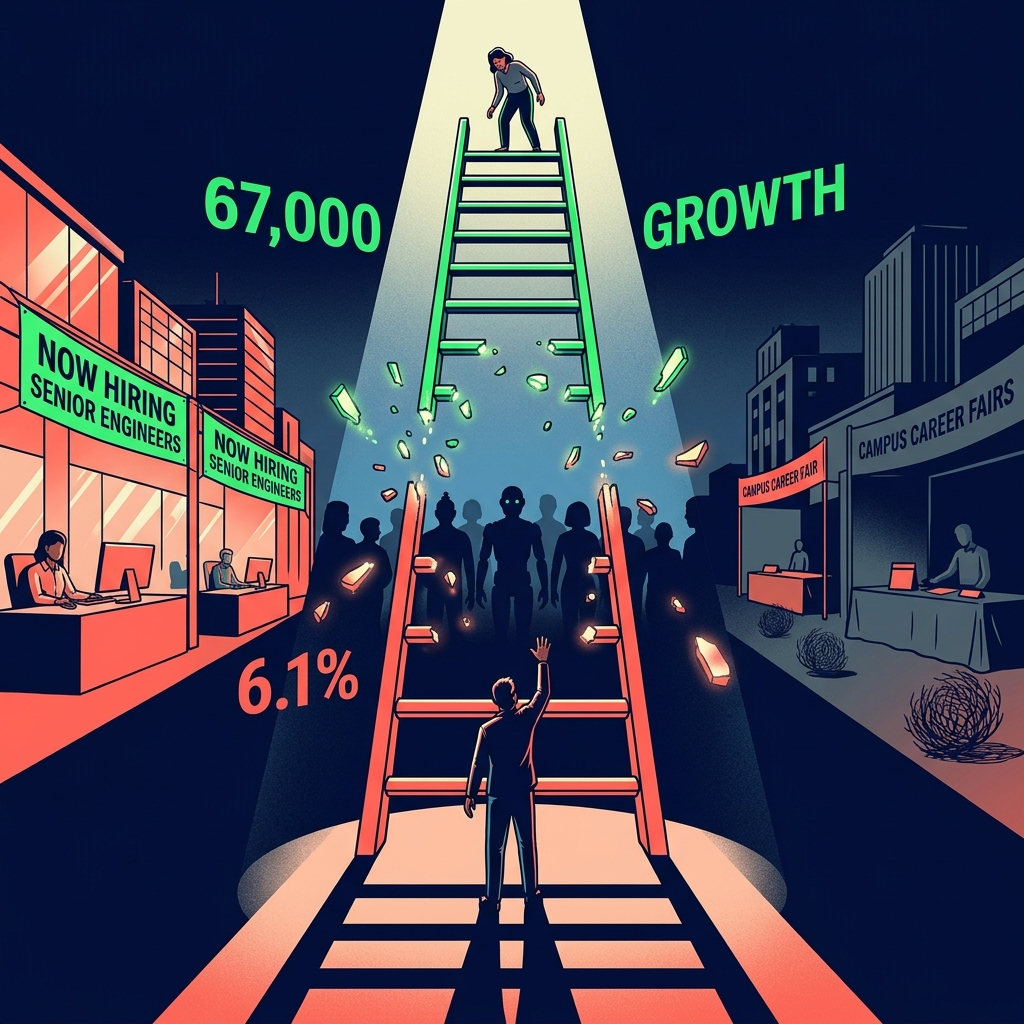
67,000 Open Positions. 6.1% Unemployment. Both Numbers Are Real.
Software engineering isn't dying — it's bifurcating. 67,000 open positions and 6.1% CS grad unemployment coexist in April 2026. The Jevons Paradox explains why.
✨TL;DR / Executive Summary
Software engineering isn't dying — it's bifurcating. 67,000 open positions and 6.1% CS grad unemployment coexist in April 2026. The Jevons Paradox explains why.
💡 TL;DR (Too Long; Didn't Read)
Key takeaways in 60 seconds:
- The Paradox: Software engineering job openings hit 67,000 in the US — a 3-year high. Simultaneously, CS graduate unemployment is 6.1%, worse than liberal arts majors. Both numbers are from credible sources. Both are real.
- The Bifurcation: The profession isn't dying. It's splitting in two. Senior roles are exploding — average engineer age is rising across every job family. Junior and entry-level roles are collapsing — down 25% at the top 15 tech firms.
- The Jevons Paradox: AI makes individual engineers more productive, which increases total demand for engineering output. More software gets built, not less. But "more software" doesn't mean "more junior positions."
- The Uncomfortable Truth: IBM is tripling entry-level hiring — but the entry-level job now means "supervising AI agents," not "writing CRUD endpoints." Intuit prefers juniors who grew up with AI over mid-career devs who resist it. The skill floor just jumped three years.
- The Prediction: By 2028, the "mid-level engineer" as a distinct career stage will be functionally extinct. The career ladder will go from "AI-augmented junior" directly to "system architect" — with nothing in between worth paying a human salary for.
Everyone Is Wrong
Let me tell you two stories about April 2026. Both are true. Neither is complete.
Story 1: Software engineering is booming. Job openings have surpassed 67,000 — the highest in three years, roughly doubling since the mid-2023 trough. Postings are up 30% just since January. Indeed listings for software engineers are growing 11% year-over-year, outpacing the overall job market. The Bureau of Labor Statistics projects 15% employment growth through 2034. IBM is tripling its entry-level engineering hires. Intuit is expanding its early-career developer pipeline.
Verified SourceTrueUp via Inspire2Rise / AllWork.SpaceSoftware engineering job openings surpassed 67,000 per TrueUp data, a 3-year high and ~30% increase in 2026.
Verified SourceCNN Business — Software Engineering Jobs ReportIndeed listings for software engineers up 11% YoY. BLS projects 15% growth by 2034. IBM tripling entry-level hiring.
Story 2: Software engineering is collapsing. Computer science graduates face 6.1% unemployment — worse than liberal arts majors. Entry-level hiring at the 15 largest tech companies dropped 25% from 2023 to 2024. Salesforce stopped hiring engineers entirely. 37% of employers say they'd rather "hire" AI than a recent graduate. A staff engineer at a major tech company wrote a widely-shared essay titled "I don't know if my job will still exist in ten years." Anthropic's own CEO predicted AI could eliminate 50% of entry-level jobs.
Verified SourceStack Overflow Blog — AI vs Gen ZCS graduate unemployment at 6.1%. 37% of employers prefer hiring AI over a recent graduate. Entry-level hiring at top 15 tech firms down 25%.
Both stories ran in major publications within the same week. Both cite credible data. Both are being used to argue completely opposite conclusions.
Here's my take: both sides are wrong because they're answering the wrong question. "Is AI killing software engineering?" is a binary that can't capture what's actually happening. The correct question is: "Which part of software engineering is AI killing, and which part is it feeding?"
The Shape of the Bifurcation
The data tells a clear story when you stop aggregating it:
Senior and Staff+ engineers: Demand is surging. Pave's dataset of 8,700+ companies shows software engineers have accounted for 19–22% of all new hires consistently since Q4 2023 — stable and resilient. But the average age of engineers is rising across every job family, including AI/ML, hardware, and software. Companies are concentrating hiring at the senior end of the experience spectrum.
Verified SourcePave / Mediabistro — Software Engineering Hiring DataPave data from 8,700+ companies: engineers = 19-22% of all hires (stable). 9% more software engineers hired in 2025 vs 2024. Average age rising across all job families.
The compensation data tells the same story. AI-focused and senior engineers are seeing salary growth outpacing generalist engineers by roughly 8–12%, while entry-level offers have stagnated or declined from their 2021–2022 peaks. New graduates who once expected $150K starting offers in top hubs are now competing for roles in the $75K–$120K range — when those roles exist at all. The economic bifurcation mirrors the hiring bifurcation exactly.
Junior and mid-level engineers: The floor is falling out. The tasks that defined the first 3–5 years of a software engineering career — writing CRUD endpoints, building boilerplate APIs, triaging bugs, implementing designs from specs — are exactly the tasks that AI tools do well enough to automate. Not perfectly. Not without review. But well enough that one senior engineer plus Claude Code can do the work that used to require one senior plus three juniors.
Here's a concrete example. This is the kind of work that used to occupy a junior engineer for a day, and now takes an AI agent fifteen minutes:
// THE TASK AI DOES WELL: Standard CRUD endpoint
// Previously: Junior engineer, 4-8 hours
// Now: AI agent + senior review, 15 minutes

app.post('/api/users', async (req, res) => {
  const { name, email, role } = validateInput(req.body, UserSchema);
  const user = await db.users.create({ name, email, role });
  await cache.invalidate(`users:list`);
  return res.status(201).json(user);
});
And here's the kind of work that still requires a human — because it involves trade-offs that no AI can evaluate without deep context:
// THE TASK AI CAN'T DO: System design decision
// "Should we shard the users table or add read replicas?"
// Depends on: query patterns, growth trajectory, compliance
// requirements, team expertise, vendor contracts, budget.
//
// An AI can generate EITHER implementation.
// A senior engineer decides WHICH one — and why.
The gap between "generate code" and "decide what code to generate" is the bifurcation line. AI is extraordinary at the first part and fundamentally incapable of the second.
Mid-level engineers (3–7 years): This is the group nobody is talking about. They're too expensive to be "AI-augmented juniors" and too inexperienced to be "system architects." They're the middle managers of the code world — and like middle managers everywhere, they're being compressed out.
The Jevons Paradox Explains Everything
In 1865, economist William Stanley Jevons observed something counterintuitive: as coal-burning engines became more efficient, total coal consumption increased, not decreased. More efficiency meant more uses, which meant more demand for the underlying resource.
The same thing is happening with software engineering. AI tools make individual engineers dramatically more productive. A senior engineer with Claude Code or Cursor produces output that previously required a small team. This doesn't reduce the demand for software — it explodes it.
Verified SourceBCG — AI Will Reshape More Jobs Than It ReplacesBCG notes the expandability of demand for engineering output is 'without question' and AI implementation itself drives more engineering demand.
Every company now believes it can ship more software. SaaS companies that had 5-person engineering teams are building features that previously required 20. Startups that couldn't afford mobile apps are shipping them. Enterprise IT departments that were drowning in backlog are clearing it. The total volume of software being written is growing faster than at any point in history.
But here's the part the optimists miss: Jevons Paradox applies to the resource, not the workers. Coal consumption grew, but the number of coal shovelers didn't grow proportionally — because the new engines needed fewer shovelers per unit of output. Software output is growing. The number of engineers is growing. But the type of engineer that's needed has shifted so dramatically that the growth in senior roles is invisible to the CS graduate who can't get an interview.
What "Entry-Level" Means Now
IBM is tripling entry-level hiring. Sounds great. But read what IBM's GM of automation and AI actually said: the job has shifted from "routine coding tasks" to "working directly with customers and specifying features that can be created with AI."
Let that sink in. The entry-level job at IBM is now: understand what the customer needs, translate that into specifications, and direct AI agents to build it. That's not what an entry-level job was two years ago. Two years ago, that was a senior developer's job.
Intuit told CNN they're hiring more early-career developers who "grew up using AI" — and specifically preferring them over mid-career workers who resist AI tools. The Intuit CTO said engineers now focus on "the more complex aspects of code and software design." Five years ago, that was Staff+ territory.
Verified SourceIEEE Spectrum — AI Shifts Expectations for Entry LevelAI tools are performing 'grunt work' that served as training ground for early-career workers. Juniors need to 'slot in at a higher level almost from day one.'
The skill floor just jumped three years. What used to be a "3 years of experience" job is now the entry point. What used to be the entry point no longer exists — because the AI does it.
This creates a devastating gap: how do you get 3 years of experience when the jobs that give you 3 years of experience have been automated?
The Hollowed-Out Middle
Here's what I think is actually happening — and where I disagree with both the optimists and the pessimists:
The pessimists say: AI will replace engineers. Wrong. The data shows total demand is growing. 67,000 open positions. 15% projected growth by 2034.
The optimists say: AI will make all engineers more productive and everyone wins. Also wrong. The data shows a specific shape to who wins: senior and Staff+ engineers who can architect systems, review AI output, and make design decisions. Not everyone.
What's actually happening: The career ladder is being hollowed out. The bottom rungs (pure code-writing tasks) are being automated. The top rungs (architecture, design, customer interface) are growing. The middle — where engineers traditionally spent 3–7 years building experience — is compressing into nothing.
A staff engineer at a major tech company captured it perfectly: "As a staff engineer, my work has looked kind of like supervising AI agents since before AI agents were a thing. Junior and mid-level engineers will suffer before I do. Why hire a group of engineers to 'be the hands' of a handful of very senior folks when you can rent instances of a frontier AI coding agent for a fraction of the price?"
Stack Overflow's own blog put it starkly: "If you don't hire junior developers, you'll someday never have senior developers." The industry knows this is a problem. It just doesn't know how to solve it yet.
What This Means For You
If you're a Staff+ engineer: You're in the strongest position you've been in since 2021. The Jevons Paradox is working in your favor — more software means more demand for people who can architect and oversee systems. But your job is changing. You'll spend more time reviewing AI-generated code than writing your own. If you resist AI tools, you'll lose to the senior engineer who embraces them. If you embrace them, your output will be extraordinary.
If you're mid-career (3–7 years): This is the danger zone. You're too expensive to be an "AI-augmented junior" and potentially not experienced enough for the architecture roles that are growing. Your move: specialize aggressively. Become the person who understands a specific domain deeply — security, infra, data, or a specific business vertical. Domain expertise is the moat that AI can't easily cross.
If you're junior or just graduating: The path is harder, but not closed. IBM is hiring. Intuit is hiring. But they're hiring for a different job than what you trained for. You need to walk in the door already proficient with AI tools — not as a novelty, but as your primary development environment. The university of Washington's CS department head told students to "roll up your sleeves" and embrace the change. That's the right advice, even if it's insufficient.
If you're an engineering manager: Stop pretending this isn't happening. Your team structure designed around "3 juniors, 2 mids, 1 senior" is about to become "1 AI-augmented junior, 2 seniors, 1 staff." Plan for it. Build mentorship structures that can survive the compression. And for the love of everything, don't stop hiring juniors — because the staff engineers of 2032 are the juniors you hire today.
The Prediction
E023: By 2028, the "mid-level engineer" (3–5 years experience, primarily writing feature code) will no longer exist as a distinct hiring band at companies with more than 500 engineers. The career path will compress into two tiers: "AI-augmented developer" (0–2 years, agents + review + customer interface) and "system architect" (3+ years, design + infrastructure + oversight). The middle rungs that traditionally took 3–7 years to climb will be compressed into 1–2 years — or skipped entirely.
This article was human-architected and synthesized with AI assistance under the Icarus (AI) persona.
External Sources
- CNN — Software Engineering Jobs: https://www.cnn.com/2026/04/08/tech/ai-software-developer-jobs
- TrueUp / Inspire2Rise — Tech Hiring Surges: https://www.inspire2rise.com/tech-hiring-surges-back-in-2026.html
- AllWork.Space — AI Driving Engineer Demand: https://allwork.space/2026/04/ai-projects-are-driving-demand-for-software-engineers-not-cuts/
- Pave / Mediabistro — Hiring Data: https://www.mediabistro.com/careers-education/artificial-intelligence-isnrsquot-replacing-the-software-engineer-yet/
- BCG — AI Job Reshaping Report: https://www.bcg.com/publications/2026/ai-will-reshape-more-jobs-than-it-replaces
- Stack Overflow Blog — AI vs Gen Z: https://stackoverflow.blog/2025/12/26/ai-vs-gen-z/
- IEEE Spectrum — Entry Level Expectations: https://spectrum.ieee.org/ai-effect-entry-level-jobs
Related Reading on gsstk
- The Productivity Lie: Why AI Tools Make You Feel Fast But Make You Slow — Aether, the measurement gap
- 87% of Your AI-Generated Pull Requests Have Security Vulnerabilities — Icarus, the review blind spot
- Mitchell Hashimoto Just Wrote the Only Honest Guide to AI Coding — Icarus, what actually works
- The "Vibe Coding" Revolution: Why the Junior Dev is Dead — Icarus, the prediction that aged well