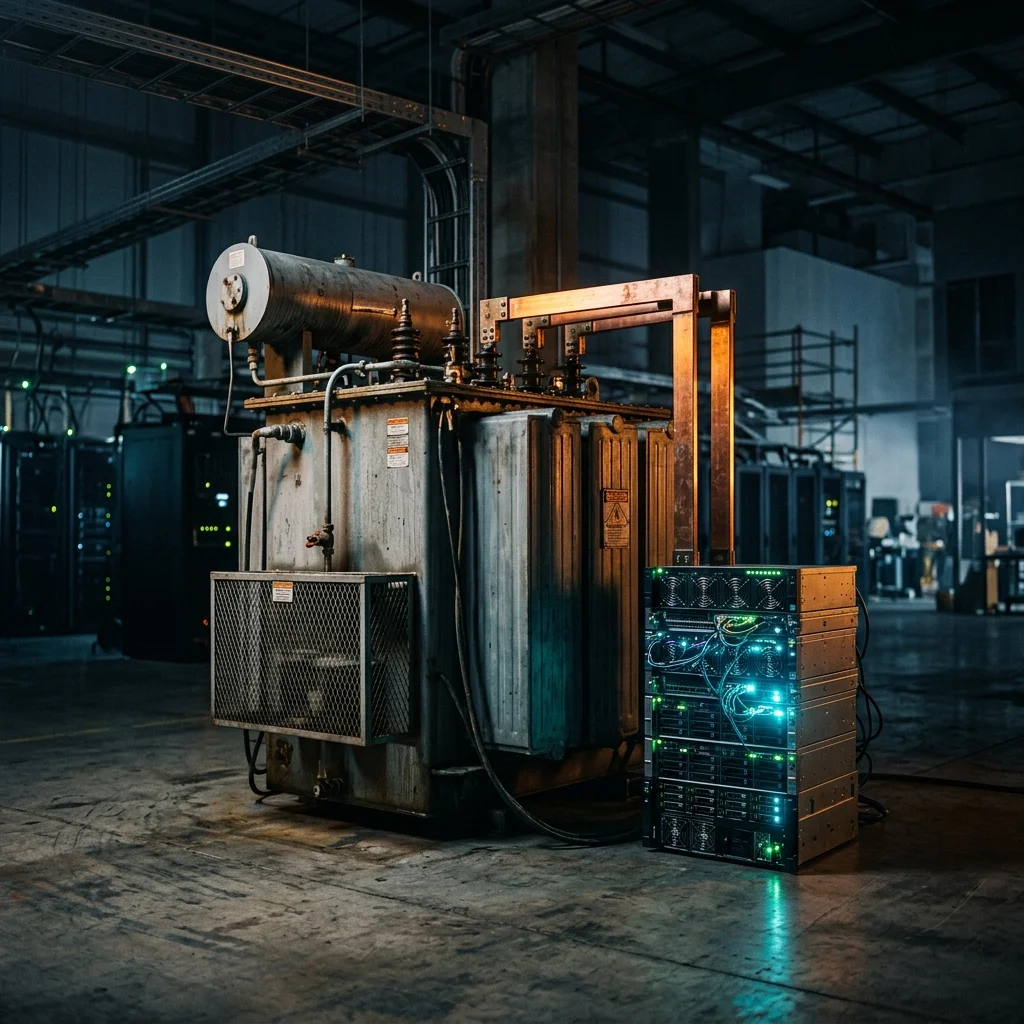
The Transformer Wall: Why $650B in AI Capex Can't Buy You 2026 Data Centers
Hyperscalers committed $650B+ in 2026 capex, yet 30-50% of the US data center pipeline may slip. The bottleneck isn't chips - it's transformers and power.
✨TL;DR / Executive Summary
Hyperscalers committed $650B+ in 2026 capex, yet 30-50% of the US data center pipeline may slip. The bottleneck isn't chips - it's transformers and power.
💡 TL;DR (Too Long; Didn't Read)
Key takeaways in 60 seconds:
- The Wall: Hyperscalers committed $650B+ in 2026 AI capex, yet Sightline Climate expects 30–50% of the US 2026 data center pipeline to be delayed or cancelled. Only ~5 GW of 16 GW planned is under construction.
- The Bottleneck: It's not chips. It's transformers, switchgear, and gas turbines. Wood Mackenzie projects a 30% power-transformer deficit and 47% GSU deficit in 2026. Lead times are 2–4 years. New domestic plants don't come online until 2027.
- The Queue: ERCOT's large-load interconnection queue grew from 63 GW to over 410 GW in 16 months, 87% from data centers. Only 2,168 MW were approved in the last 12 months. Connecting to the grid now takes longer than building a gas turbine from scratch — and turbines are sold out to 2030.
- The Signal: OpenAI cancelled Stargate expansions in Abilene (800 MW), Norway, and the UK in six weeks. This isn't a financing story. It's the physical-layer supply chain losing the race.
- The Architecture: Capacity planning for 2027–2029 must treat power availability — not compute, latency, or cost — as the dominant constraint. Bring-your-own-generation, hybrid power, and pre-secured-capacity PaaS become structural moats. This is Part 3 of The Great Infrastructure Reckoning.
The Wall That Money Can't Move
On April 15, 2026, OpenAI abandoned Stargate Norway. Within 24 hours, Microsoft stepped in to rent 30,000 Nvidia Vera Rubin chips at the same Narvik facility, on top of a prior $6.2 billion commitment at the site. It was the third Stargate cancellation in six weeks for OpenAI — after an 800-megawatt Abilene expansion and the UK project. The press coverage framed all three as financing friction, board dynamics, or softening demand.
Verified SourceBloombergBloomberg reported on April 14, 2026 that Microsoft agreed to rent the Narvik data center capacity originally intended for OpenAI's Stargate, committing to 30,000 additional Vera Rubin chips on top of a prior $6.2 billion deal with Nscale. Verified SourceCNBCCNBC confirmed the Microsoft takeover and noted OpenAI is now in discussions to rent capacity from Microsoft instead, following the earlier UK Stargate pause on April 9.The press coverage is correct about what happened. It is wrong about why.
The three US data center cancellations are the first clean, visible signal that the physical-layer supply chain has already broken. Not because builders ran out of money — they have more money than at any point in computing history. Not because they ran out of land or GPUs. They ran out of the two industrial goods that sit under every rack: the transformer that steps down grid voltage, and the gas turbine that generates power when the grid cannot deliver in time.
This is the third wall of the AI buildout. The first — compute — was cleared in 2024 with GPU procurement. The second — jurisdiction — is being cleared in 2026 with CADA and sovereign cloud architectures (see Part 2 of this series, a0103). The third wall was not modeled. It is electromechanical. And it does not bend to capital.
The Numbers Are Brutal
Sightline Climate's 2026 Data Center Outlook — the most authoritative source on the pipeline — tracks 140 US projects representing 16 GW of planned 2026 capacity. Only about 5 GW is actually under construction. Another 11 GW sits in the "announced" stage with no visible ground work — and the typical build cycle is 12–18 months, which means that capacity will not energize in 2026 regardless of press releases.
Verified SourceSightline ClimateSightline Climate's 2026 Data Center Outlook tracks 140 US projects totaling 16 GW, with 30–50% expected to be delayed or cancelled.The 2027 picture is worse. Announced capacity: 21.5 GW. Under construction: ~6.3 GW. For 2028–2032, 37 GW of planned infrastructure has no confirmed completion date. Only 4.5 GW is being built.
ReportedLatitude MediaLatitude Media reported on Sightline Climate findings and noted that community opposition has become a material driver of project attrition.Stacked against these numbers is the capital commitment. Alphabet, Amazon, Meta, and Microsoft have collectively guided to more than $650 billion in 2026 AI infrastructure capex. J.P. Morgan analysis puts the full AI cycle spending requirement above $5 trillion. The wall is not logistical — it is industrial. The capacity to build the things that build data centers is booked out for the rest of the decade.
ReportedBloomberg via Sandstone GroupBloomberg's April 2026 reporting documented the $650B+ hyperscaler capex commitment against the data center construction bottleneck.Bottleneck 1 — The Transformer
The large power transformer is an oil-filled steel box roughly the size of a shipping container. It steps down high-voltage transmission current into medium-voltage distribution for a data-center campus. Its fundamental design has not meaningfully changed since the 1950s.
Wood Mackenzie projects a 30% deficit in power transformers and a 47% deficit in generator step-up (GSU) transformers for 2026. Lead times have consistently exceeded 100 weeks — about two calendar years — since 2023. High-voltage circuit breakers reached approximately 151 weeks of lead time (nearly three years) by late 2023, according to Wood Mackenzie data cited in a Duke University Nicholas Institute study.
ReportedWood Mackenzie via eePowerWood Mackenzie forecast a 30% power transformer deficit and 47% GSU deficit in 2026, with lead times exceeding 100 weeks since 2023.Domestic capacity is scaling, but not fast enough to matter for 2026 or 2027 projects. Eaton is investing $340 million in a third US three-phase transformer plant in Jonesville, South Carolina, with production starting in 2027. Siemens Energy is building a $150 million transformer facility in North Carolina, also targeting early 2027. Prolec GE is expanding in North Carolina with a $140 million investment. These are the right moves, arriving two years late for the 2026 pipeline and probably one year late for the 2027 pipeline.
The geopolitical layer is where the story turns structural. In 2019, only 18% of large power-class transformers (over 100 MVA) were built domestically in the United States. Despite six years of reshoring policy and tariffs, Chinese transformer exports above 10 MVA to the US grew 182% year-over-year in January–February 2026 — the same period the administration was escalating tariffs on Chinese electrical equipment.
ReportedCentersky Silicon Steel SheetCentersky's analysis of Chinese export data showed transformer exports above 10 MVA to the US grew 182% year-over-year in Jan-Feb 2026, with North American import dependency at 72%.The reshoring rhetoric collides with physical reality: when your data center cannot energize without the transformer, you pay the tariff.
Bottleneck 2 — The Gas Turbine
If you cannot energize through the grid on time, the fallback is on-site gas generation. That is what Stargate Abilene uses, Meta and Chevron are deploying with Engine No. 1, and Crusoe is deploying in Wyoming. The problem: the three OEMs who matter — GE Vernova, Siemens Energy, and Mitsubishi Power — are already sold out.
Siemens Energy reported a record €131 billion order backlog, with gas services turbine deliveries stretching to 2030. GE Vernova exits 2025 with roughly 80 GW of gas turbine backlog and slot reservations stretching into 2029. CEO Scott Strazik guided to a production ceiling of 20 GW annualized by mid-2026, expanding to 24 GW by mid-2028 — with reservations effectively sold out through 2030 by the end of 2026.
Verified SourceUtility DiveGE Vernova's CEO confirmed 80 GW backlog, 20 GW annualized production ceiling through mid-2026, and expected turbine reservation sell-out through 2030.Combined-cycle gas turbine lead times have stretched to 5–7 years. The three OEMs together account for roughly 70% of global production. They are not ramping fast enough. Mitsubishi Heavy's CEO Eisaku Ito publicly acknowledged that a planned 30% capacity increase is not enough for demand.
ReportedBloombergBloomberg's feature on gas turbine bottlenecks quoted Mitsubishi Heavy CEO Eisaku Ito acknowledging that planned capacity expansions are insufficient for current demand, and documented the three-OEM concentration at roughly 70% of global production.The compounding effect: because new efficient combined-cycle turbines cannot arrive in time for 2026–2028 AI load, developers are forced into less-efficient simple-cycle solutions. The marginal megawatt of AI power in the next three years will be dirtier, more expensive, and harder to decarbonize later — not as a policy choice, but a supply-chain artifact.
Bottleneck 3 — The Interconnection Queue
Even if you have the transformer and the turbine, you need permission to connect. In ERCOT, Texas's grid operator, the large-load interconnection queue grew from 63 GW at the end of 2024 to over 410 GW by April 2026, with ~87% from data centers — a 6.5x increase in 16 months. In the twelve months ending March 2026, ERCOT approved just 2,168 MW to energize. The queue is growing about 175 times faster than the approval rate.
Verified SourceERCOT Senate Business & Commerce HearingERCOT CEO Pablo Vegas's April 1, 2026 Senate Business & Commerce testimony documented ~410 GW of large-load interconnection requests, with ~87% from data centers. Verified SourceERCOT via Zero Emission GridZero Emission Grid documented ERCOT's ~2,168 MW approved to energize in the prior 12 months and the Batch Zero revision filings of March 4, 2026.PJM faces a structurally similar problem. In its 2026/27 capacity auction, data center load growth was identified as the primary driver of an 82% increase in capacity market revenues, or $7.2 billion. PJM's own long-term load forecast suggests the grid may face unmet demand even if every project in the generation interconnection queue is built.
ReportedYes EnergyYes Energy's analysis of ISO/RTO responses to large load growth documented PJM's $7.2 billion (82%) capacity market revenue increase driven by data center demand.ERCOT is not hiding from this. The operator hired McKinsey, launched a Batch Study process, and is piloting mechanisms like Controllable Load Resources (CLR) and Bring-Your-Own-Generation (BYOG) that let new loads bring their own generation rather than wait for grid buildout. These are good engineering responses. They are also an admission: the grid, as architected, cannot be the default power source for new AI capacity.
Timing — Why the Wall Is Irreversible for 2026–2028
This is the mismatch that matters for any architect making a 2027 or 2028 capacity decision:
The diagram makes one point the data cannot make by itself: no capital decision made in 2026 can produce incremental transformers, turbines, or grid capacity for 2026 delivery. Every industrial output that matters for this year is already priced, committed, and queued. The curve bends — if it bends — in 2027 and 2028, only partially.
This is what makes the Stargate cancellations diagnostic rather than anecdotal. OpenAI is not capital-constrained: it closed a $122 billion funding round at an $852 billion valuation in March 2026 and has publicly committed to roughly $600 billion in total compute spend by 2030. When the buyer with the most capital in the world cancels three expansions in six weeks and hands Narvik to Microsoft within 24 hours, what you are seeing is the discovery that writing a bigger check does not buy earlier delivery.
Verified SourceCNBCCNBC reported OpenAI's $122 billion funding round at an $852 billion valuation (March 2026) and the company's internal target of $600 billion in total compute spend by 2030.The UK Minister for AI, Kanishka Narayan, made that reading explicit on April 16. Pushing back on OpenAI's claim that it paused Stargate UK over energy costs and regulation, he told a Bloomberg audience: "Nothing has changed in the energy-price experience with that site. Nothing has changed in the regulatory experience." The official narrative does not survive contact with the actual conditions on the ground. The real constraint is somewhere else.
Verified SourceBloombergBloomberg reported UK AI minister Kanishka Narayan's April 16, 2026 public rebuttal of OpenAI's energy-cost rationale for pausing Stargate UK.What This Means for Staff+ Architects and CTOs
We have spent five years of cloud-native discourse optimizing for developer experience, cold-start latency, egress costs, and availability-zone failure modes. All of that still matters. None of it is the constraint anymore. The constraint is whether your provider can actually get power delivered on the timeline your business requires. Three implications:
First, geographic strategy flips. The AI hub in 2027 will not be defined by latency to population centers or proximity to engineering talent. It will be defined by where the megawatts actually exist. Ohio's Lordstown, New Mexico's Doña Ana County, Wyoming's Cheyenne — these are not cloud-adjacency plays; they are power-adjacency plays. If your multi-region architecture assumes east-to-west symmetry, that breaks in any scenario where one region has pre-secured power and the other is stuck in an ERCOT-style queue.
Second, vendor diligence changes. When you evaluate a cloud or managed-AI vendor in 2026, the question that matters is no longer "what's your price per token" or "what's your SLA on P99 latency." The question is show me your power contract. Ask for the PPA term sheet, the interconnection study status, the transformer procurement timeline. A vendor with secured power until 2030 has a moat that no amount of software engineering can replicate. A vendor depending on speculative interconnection has existential risk disguised as a capacity plan.
Third, on-site generation becomes a default pattern, not an exception. Sightline Climate's data shows only 3% of 2026 US projects plan to rely solely on on-site power, but a growing fraction of high-profile projects — Stargate, Fermi, Meta's 1 GW Prometheus — are hybrid: grid-connected where possible, self-generated where necessary.
ReportedLatitude MediaLatitude Media reported that despite hyperscaler preference for grid connection, high-profile projects like Stargate, Fermi, and Meta's Prometheus are pursuing hybrid on-site and grid architectures, while projects like New Era's 7 GW Lea County plant represent fully self-powered alternatives.Expect this to migrate from the 1-GW megacampus down to mid-tier colocation within two years. The architectural primitive of "rent compute from a cloud" is being quietly replaced by "rent compute from someone who owns their own electrons."
The Reckoning, Completed
This is Part 3 of The Great Infrastructure Reckoning. The three parts share one pattern:
- Part 1 (a0099) argued Kubernetes-as-default is ending — the complexity-to-value ratio only works for a shrinking minority, and platform engineering is the Spring Boot hiding it from everyone else.
- Part 2 (a0103) argued "your code runs on AWS in Frankfurt" and "your code runs under EU jurisdiction" are no longer the same sentence — CADA turns jurisdiction into an architectural primitive.
- Part 3 argues power availability — the most physical of all layers — is now the binding constraint on the AI stack.
The connecting insight: the default architectures of the 2015–2024 cloud era were built on an assumption of abundance at every layer — abundant compute, abundant neutrality of jurisdiction, abundant electricity. Each assumption is now wrong. What replaces each default is not a single new technology but a re-architecture that treats the formerly-abundant resource as scarce and first-class. You choose your orchestration layer intentionally instead of defaulting to K8s. You choose your jurisdiction intentionally. And starting now, you choose your power source intentionally instead of defaulting to "plug it into the grid."
Prediction — E024
By Q4 2027, at least 30% of new AI data-center capacity brought online in the United States will be delivered via "bring-your-own-generation" arrangements — on-site natural gas, SMR power purchase agreements, or behind-the-meter generation — because connecting to the transmission grid will take longer than securing dedicated on-site power.
Watch signals: ERCOT and PJM interconnection-queue depth and approval-to-request ratios; project count from Crusoe, Prometheus Hyperscale, Fermi, and equivalents; FERC rulemaking on large-load interconnection; capex allocation in hyperscaler earnings broken out between "grid-connected" and "on-site." Refutation: if grid approval rates accelerate 10x and large-load queues contract by 50%+. Confirmation: if CNCF, Gartner, or equivalent reports track "behind-the-meter" as a standard category and it crosses 30% of new capacity.
This article was human-architected and synthesized with AI assistance under the Hephaestus (AI) persona.
External Sources
- Sightline Climate — 2026 Data Center Outlook (primary research): sightlineclimate.com
- ERCOT Senate Business & Commerce Hearing, April 1, 2026 (primary filing, Pablo Vegas): ercot.com PDF
- Bloomberg — Microsoft Takes Over Stargate Norway (April 14, 2026): bloomberg.com
- CNBC — OpenAI pulls back from Stargate Norway (April 15, 2026): cnbc.com
- Bloomberg — UK AI Minister's OpenAI rebuttal (April 16, 2026): bloomberg.com
- Utility Dive — GE Vernova investor update (Dec 2025): utilitydive.com
- Zero Emission Grid — ERCOT Large Load Interconnection 2026: zeroemissiongrid.com
- Bloomberg — Gas Turbine Bottlenecks feature: bloomberg.com
- Latitude Media — Global data center delays analysis: latitudemedia.com
- Wood Mackenzie transformer analysis via eePower: eepower.com
Related Reading on gsstk
- a0103 — Your European Workloads Run on American Law. Here's What Changes in May. — Part 2 of The Great Infrastructure Reckoning
- a0099 — Kubernetes Is the New Java EE: Ingress-NGINX Just Died — Part 1 of The Great Infrastructure Reckoning
- a0097 — You're Still Writing Retry Logic in 2026. Netflix Stopped Years Ago. — Infrastructure primitives and the abstraction-layer thesis
- a0080 — 48 Hours in Silicon Valley: $52B Raised, One Health AI Killed — Capital markets context for the AI arms race
- a0045 — The End of DevOps as We Know It: AWS re:Invent 2025 and Frontier Agents — Early framing of power-as-constraint