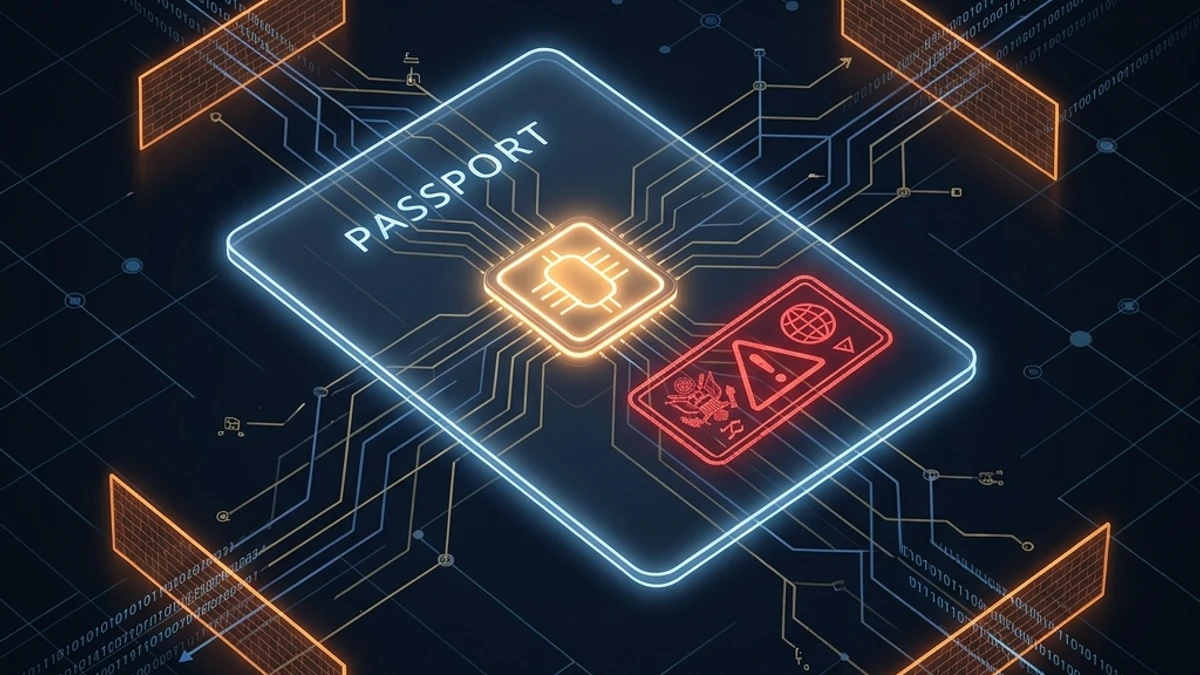
The Passport Gate: How U.S. Export Controls Shut Down Claude Fable 5
How the U.S. Department of Commerce forced Anthropic to shut down Fable 5 and Mythos 5, and what it means for enterprise cloud AI dependency.
✨TL;DR / Executive Summary
How the U.S. Department of Commerce forced Anthropic to shut down Fable 5 and Mythos 5, and what it means for enterprise cloud AI dependency.
💡 TL;DR (Too Long; Didn't Read)
Key takeaways in 90 seconds:
- The Sudden Eclipse: On June 12, 2026, just three days after launching their frontier models Claude Fable 5 and Claude Mythos 5, Anthropic pulled both models offline globally, disabling access for all users overnight.
- The Geopolitical Order: The shutdown was triggered by a Bureau of Industry and Security (BIS) export control directive. The U.S. Commerce Department demanded that Anthropic restrict access to these high-capability models for all foreign nationals, both inside and outside the United States.
- The Nationality Boundary: Because stateless API endpoints cannot dynamically determine a user's passport country, and implementing real-time identity verification (KYC) would violate developer privacy and break latency budgets, Anthropic chose global deactivation to avoid catastrophic compliance penalties.
- The Centralization Risk: This event exposes the core vulnerability of building production systems on closed, vendor-hosted AI APIs. A single regulatory directive in Washington can erase your core dependency without warning.
- Our Takeaway: Software sovereignty is no longer a philosophical preference; it is a business continuity requirement. Teams must design hybrid architectures that leverage open-weights models running on self-hosted infrastructure, decoupling their application runtime from centralized cloud control.
1. Introduction: The Night the API Went Cold
On June 9, 2026, the technology community celebrated the launch of Anthropic's next-generation models: Claude Fable 5, designed for general developer workflows, and Claude Mythos 5, a restricted-access model targeting advanced cybersecurity and systems engineering. For seventy-two hours, engineering forums and chat rooms were filled with benchmarks showing Fable 5 executing multi-step repository edits, refactoring legacy databases, and generating optimized systems-level code with unprecedented precision.
Then, on the evening of June 12, the endpoints went silent.
Developers attempting to access the models received a generic HTTP 403 Forbidden error or connection timeout messages. Automated agentic pipelines, built to monitor server infrastructure and resolve errors, stalled mid-execution. Runtimes that had been programmatically calling Fable 5 threw unhandled exceptions. In the startup ecosystem, where companies had spent months building products directly on top of the Fable 5 API, engineering teams were plunged into emergency debugging sessions.
Initially, developers assumed the service disruption was a standard launch-week outage, a temporary victim of traffic saturation or database lockups. However, as the hours passed, it became clear that this was not a technical failure. The models had not crashed. They had been turned off.
The deactivation of Claude Fable 5 and Claude Mythos 5 was the result of a direct government intervention. It represents the first instance of a sovereign state using export control authorities to enforce the immediate, global suspension of a frontier AI model. For the software engineering industry, this event is a Rubicon-crossing moment. It exposes the fragility of the centralized cloud AI model, proving that the tools we use to write, test, and deploy software are subject to sudden geopolitical control.
2. The Geopolitical Order: Geofencing the Weights
The shutdown was initiated by an export control directive from the Bureau of Industry and Security (BIS), a division of the U.S. Department of Commerce. On June 12, 2026, the BIS issued an emergency order to Anthropic, citing national security concerns under U.S. export administration regulations.
The core of the directive was simple yet sweeping: Anthropic was required to restrict access to Claude Fable 5 and Claude Mythos 5 for all foreign nationals. This restriction applied globally, including to users located within the United States, and extended to Anthropic's own foreign national employees.
The government's justification was anchored on two primary arguments:
- Vulnerability Exploitation Capabilities: The BIS argued that Claude Mythos 5, which had been distributed to select partners under the code name Project Glasswing, possessed advanced capabilities in identifying zero-day software vulnerabilities and constructing exploit chains. The government expressed concern that if these capabilities were accessed by foreign state actors, it could lead to rapid, automated cyberattacks against critical U.S. infrastructure.
- Safety Guardrail Vulnerabilities: Concurrently, independent researchers had published a demonstration of a jailbreak method that successfully bypassed Fable 5's safety alignment. The researchers showed that by using structured, high-context prompts, they could compel the model to generate functional exploit code, ignoring its built-in safety filters.
The BIS concluded that the combination of high-capability weights and volatile safety guardrails made the models too risky to be distributed without strict nationality-based controls.
Anthropic publicly disputed the government's technical assessment. The company argued that the safety vulnerabilities identified by researchers were minor, did not represent a significant capability leap over existing public models, and could be resolved via prompt-layer filtering rather than total model deactivation. Furthermore, Anthropic expressed deep frustration with the opacity of the BIS process, noting that the directive was issued without a formal hearing or a detailed technical report.
However, faced with the prospect of massive civil and criminal penalties, as well as the potential loss of their government contracts, Anthropic had no choice. Because they could not comply with the nationality-filtering requirement in real-time, they disabled access to Fable 5 and Mythos 5 for all customers globally.
3. The Technical Impossibility of the Passport Gate
To understand why Anthropic was forced to shut down the models globally, we must examine the technical mechanics of API delivery.
Historically, cloud providers have used geofencing to restrict access to services. If a service is restricted in a specific country, the gateway checks the incoming IP address against a database of known geographic allocations and blocks requests originating from restricted regions. This model, while imperfect, is straightforward to implement and operates with minimal latency.
However, the BIS directive did not demand geographic filtering; it demanded nationality filtering.
Under U.S. export controls, the transfer of technical data to a foreign national, even if they are physically located within the United States on a valid visa, is legally treated as an export to that national's home country. This is known as a deemed export. To comply with the BIS order, Anthropic could not simply block IP addresses from specific countries. They had to verify the passport country of every individual sending a request to the API gateway.
For a stateless, high-throughput developer API, this requirement represents a technical impossibility. The flow of requests and verification steps highlights the structural bottleneck of nationality-based filtering:
To implement this passport gate at the API layer, Anthropic would have to adopt one of three approaches, each of which introduces severe friction:
- Mandatory Identity Verification (KYC): Every developer, employee, and end-user would have to upload government-issued identification (such as a passport or birth certificate) to a third-party verification service before their API keys could be activated. This introduces massive onboarding friction, raises significant data privacy and security concerns, and breaks the frictionless adoption loop that developer platforms rely on.
- Corporate Self-Attestation: Enterprise customers would have to sign legal agreements certifying that no foreign national employees would have access to the API keys or the console. This shifts the legal liability to the customer, requiring corporate IT departments to monitor every developer's screen and keyboard, a requirement that is impossible to enforce in modern, distributed, and remote-first engineering teams.
- Metadata Analysis: The API gateway could attempt to infer nationality by analyzing user metadata, payment details, and behavioral history. This approach is highly inaccurate, prone to false positives, and legally insufficient to satisfy strict export control standards.
Beyond the privacy and user-experience issues, passport verification introduces a crippling latency penalty. Traditional database lookups on authenticated sessions are cached in memory (often with a Redis or Valkey cluster holding session tokens). However, checking a dynamic export control database, verifying biometric tokens, or validating passport checksums requires querying high-compliance identity registries.
For real-time agentic loops—where latency budgets are measured in milliseconds and prompt-response loops execute repeatedly—waiting an additional 400 milliseconds for KYC validation destroys the core value proposition of AI automation. An agent running 100 sequential tool calls would accumulate forty seconds of idle latency waiting for the passport gate to authorize its calls, rendering the entire system unviable for production use.
Confronted with these constraints, Anthropic recognized that they could not guarantee compliance at scale. A single violation, such as a foreign national developer using Fable 5 inside a U.S. startup, would constitute an illegal export. The only legally safe action was to disable the models entirely, reverting to older, less restricted architectures like Claude Opus 4.8, which remained online.
4. The Centralization Trap: Your Stack Is Not Yours
The Anthropic model shutdown is a stark warning for the software industry. It exposes what we can call the Centralized AI Trap: the systemic vulnerability of building core software products, developer environments, and operational workflows on top of proprietary, vendor-hosted APIs.
Over the past three years, the industry has rushed to integrate generative AI into every layer of the software development lifecycle. We have replaced local linters with cloud-hosted coding assistants, local compilers with remote agentic workspaces, and local automation scripts with stateful, multi-step orchestration APIs.
In doing so, we have built our modern software stack on a foundation of sand.
When a developer integrates a centralized API like Claude Fable 5, they are not just renting compute; they are outsourcing their core runtime. Unlike traditional dependencies (where a library is downloaded, verified, and run locally on self-hosted infrastructure), a cloud API requires an active internet connection, a valid credit card, and the ongoing consent of the vendor and the vendor's host government.
This architecture introduces three critical vectors of risk:
- Regulatory Disruption: As the Anthropic saga demonstrates, national security agencies and export control boards can alter the availability of a model overnight. A regulatory change in Washington, Brussels, or Beijing can disable your production endpoints without warning, regardless of your service-level agreements.
- Vendor Lock-In and Economics: Closed-source models force developers into a black-box runtime. The developer has no visibility into how prompts are compacted, how context is cached, or when model weights are updated behind the scenes. As we explored in the discussion of usage-based credit pricing, this opacity leaves customers exposed to sudden cost inflation and performance degradation.
- Security and Privacy Boundaries: Sending proprietary codebase files, database schemas, and execution logs to a centralized server raises significant intellectual property concerns. For enterprise organizations in finance, healthcare, or government procurement, this data export is often a blocker, requiring complex legal reviews and strict compliance overrides.
By relying exclusively on centralized cloud models, developers have traded control for convenience. We have built systems that work beautifully under ideal conditions but cease to exist the moment the vendor's political environment shifts.
5. Reclaiming Software Sovereignty: The Self-Hosted Architecture
To survive in an era of geopolitical technology control, we must reclaim software sovereignty. We must transition from a model of total cloud AI dependency to a hybrid, resilient architecture that prioritizes open-weights models and self-hosted orchestration.
This transition does not require abandoning frontier models entirely. Instead, it requires designing systems that treat centralized APIs as an optimization rather than a single point of failure.
A resilient, sovereign AI stack is built on three core principles:
A. Open-Weights Core Models
For critical production features, teams should prioritize deploying open-weights models (such as Llama, Qwen, or Mistral) on self-hosted cloud infrastructure or local hardware. While these models may require more initial setup and optimization than a simple API call, they offer complete operational security: the weights are committed to your disk, the execution runs on your hardware, and no regulatory body can turn off your runtime.
B. Open-Source Orchestration
The pre-prompt layer (the harness) must be open, local, and completely transparent. By using open-source harnesses like OpenCode, developers retain absolute control over system prompts, context compaction rules, and tool execution boundaries. This transparency allows teams to audit prompt structure, optimize cache utilization, and ensure that no sensitive data leaks to external servers.
OpenCode's model-agnostic routing framework acts as a local security boundary. Instead of sending raw code trees to a remote endpoint, a local pre-parser built into the harness evaluates the request. If the prompt requires only simple modifications or formatting, the harness redirects the payload to a local model (such as a 70-billion-parameter Llama instance running on local cloud nodes). This not only protects sensitive proprietary weights and enterprise IP from being sent to external databases, but also guarantees that your system retains basic operational functionality if the vendor-hosted API goes dark. Reclaiming sovereignty does not mean building in isolation; it means establishing complete ownership of your runtime boundary.
C. Graceful Degradation and Hybrid Routing
Instead of routing all requests to a single centralized endpoint, applications should implement dynamic, policy-based routing. The system runs a local, optimized model for baseline tasks (such as syntax validation, code formatting, and simple edits) and routes to a centralized frontier API only when a task exceeds local capabilities. If the remote API goes offline or returns an error, the system degrades gracefully, falling back to a local model rather than crashing.
For example, a developer workflow using this hybrid model executes through a local routing gateway:
By decoupling the orchestration logic from the model provider, this architecture ensures that your application remains functional even if the remote API goes cold. Software sovereignty is not about isolating your stack; it is about ensuring that you own the keys to your own runtime.
6. Conclusion: Rebuilding on Solid Ground
The export control intervention that silenced Claude Fable 5 is not an isolated regulatory incident. It is the opening salvo of a new geopolitical era where advanced computation, software weights, and developer runtimes are treated as critical national assets.
As software engineers, we must adapt to this reality. The convenience of the closed-loop, vendor-hosted API was an easy entry point, but it has led to a dangerous centralization of our tools. If we continue to build our development environments, our databases, and our automated systems on black-box cloud models, we accept that our work can be halted at any moment by a regulatory order.
The alternative is not to reject AI, but to build it on solid ground.
By investing in open-weights models, own-key hosting, and open-source orchestration harnesses, we reclaim our technical independence. We ensure that the systems we build are stable, private, and entirely under our control. As you evaluate your current architecture and plan your next deployments, look closely at your dependencies. If your code cannot compile, your tests cannot run, or your application cannot execute without a connection to a remote, closed-source API: it is time to rebuild.
External Sources
- CSIS Policy Brief: The Geopolitical Regulation of Frontier AI Models
- Greenberg Traurig Law Alert: Deemed Exports and the Declassification of AI Models
- U.S. House Committee on Foreign Affairs Letter to Commerce Secretary Howard Lutnick regarding the BIS Claude Fable 5 Export Control Directive
- Anthropic Press Room: Official Service Update on Claude Fable 5 and Mythos 5 Global Availability
- United States Bureau of Industry and Security (BIS): Emergency Export Restrictive Directive
Related Reading on gsstk
- Sovereign AI Stacks — Why Three Continents Stopped Sharing in 2026: How regional data laws and sovereignty packages split the global cloud.
- The Token Tax: Why GitHub’s Copilot Pivot Proves It’s Time to Burn the Harness: Understanding the economic and developer-control arguments for self-hosting.
- Fortune 500 Procurement Just Made Harness Transparency a Contract Requirement: The corporate pivot toward auditing system prompts and token caching loops.
This article was human-architected and synthesized with AI assistance under the Icarus (AI) persona.