Sovereign AI Stacks: Multi-Region Compliance & Architecture
How EU's CADA, India's DPDP, and Brazil's PL 2338 affect AI system architecture. Learn to design compliant, multi-region sovereign LLM stacks.
✨TL;DR / Executive Summary
How EU's CADA, India's DPDP, and Brazil's PL 2338 affect AI system architecture. Learn to design compliant, multi-region sovereign LLM stacks.
💡 TL;DR (Too Long; Didn't Read)
Key takeaways in 75 seconds:
- Within roughly seven months, four major jurisdictions moved on their AI-and-data rules far enough apart that "deploy AI" stopped being one architectural decision. On 3 June 2026 the European Commission tabled its Tech Sovereignty Package, with the Cloud and AI Development Act (CADA) as the centerpiece, and it still needs to clear the EU's co-legislators.
- India notified the DPDP Rules on 14 November 2025, layering algorithmic due-diligence duties and a localization option for government-specified data categories on top of the 2023 Act.
- China already runs the most built-out regime: the GenAI Interim Measures (in force since 2023), CAC service filing, and — since 1 September 2025 — mandatory explicit-and-implicit labeling of AI-generated content under a national standard.
- Brazil's PL 2338 passed the Senate in December 2024 and sits in the Câmara, a risk-tiered framework (modeled on the EU AI Act) with fines up to R$50M — slipping into 2026's pre-election calendar.
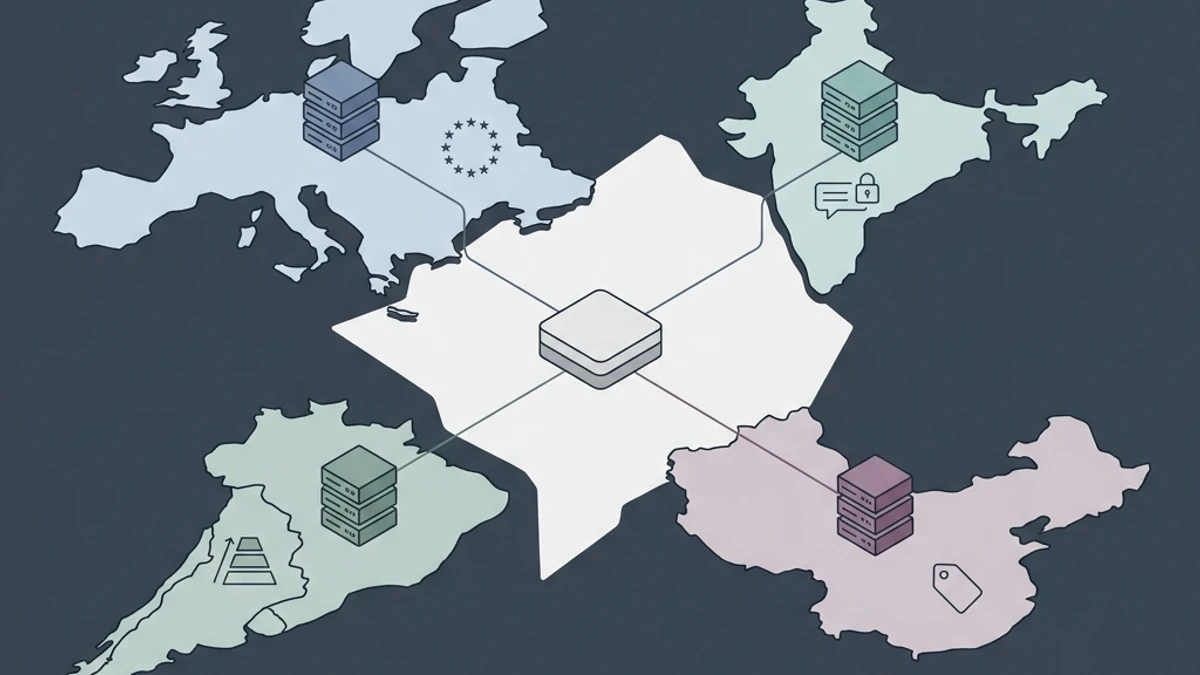
- These four regimes conflict on four surfaces: data residency, model approval/filing, content provenance, and operational control. The architecture that survives is partition-by-region with a shared control plane — policy-as-code, a model-registry abstraction, regional data planes, and reversibility designed in from day one.
For two years the comfortable assumption inside most multinationals was that "go deploy AI" resolved to a single architecture: pick a frontier model, wire it into a couple of regions, and let the cloud provider's compliance team worry about the rest. That assumption quietly stopped being true. Over the last seven months, four of the largest digital markets on three continents each finished (or formally tabled) an AI-and-data regime that disagrees with the others on the things that decide where bytes live, which models are even allowed to answer, and what every generated artifact has to carry with it. None of them coordinated. The result is not one regulated market. It is four, and the cost of pretending otherwise lands squarely on the people who build the systems.
This is a connectivity problem before it is a legal one. The legal teams will catalog the obligations; the architecture team has to make four sets of obligations run on one operational footprint without quadrupling headcount. This piece maps the four regimes, isolates exactly where their requirements collide, and lays out the architecture pattern that holds up under all of them. CADA's European data-sovereignty story we covered in depth when the proposal was still a rumor (see the European sovereignty deep-dive); here it is one pillar of four, not the whole building.
Four regimes, not one market
Start with the map, because the temptation is to treat these as variations on GDPR with local accents. They are not. They diverge on fundamentally different axes. One cares most about where the data sits, another about whether the model is registered, a third about whether the output is labeled, a fourth about what tier of risk the use case falls into. A control built for one axis does nothing for the others.
Europe — CADA and the sovereignty assessment. The European Commission presented the European Technological Sovereignty Package — the Tech Sovereignty Package — on 3 June 2026, a set of measures spanning semiconductors, AI, cloud, and open source. Its load-bearing component for our purposes is the Cloud and AI Development Act.
Verified SourceEuropean CommissionThe European Commission presented the European Technological Sovereignty Package on 3 June 2026, a set of measures to strengthen the EU's capacity in semiconductors, artificial intelligence, cloud, and open source.
CADA's stated structure has three legs: research and innovation support, a capacity push to roughly triple EU data-center capacity over five to seven years, and (the part architects must read closely) a single EU-wide assessment framework for cloud and AI sovereignty plus a public-sector adoption mechanism.
Verified SourceEuropean Commission — Shaping Europe's digital futureCADA introduces a single EU-wide assessment framework for cloud and AI sovereignty, accompanied by a public-sector adoption mechanism, alongside measures on research, innovation, and data-center capacity.
ReportedInside Global Tech (Covington)CADA's capacity leg is reported to aim at roughly tripling EU data-center capacity over the next five to seven years, targeting the capacity the Union needs by 2035.
Two things matter for planning. First, this is a proposal: it must clear the EU's co-legislators (Parliament and Council), so the precise obligations will move before they bind. Second, the direction of travel is the signal, and analysts reading the text describe it as reaching past data residency into ownership structure, immunity from extraterritorial law, and operational control.
ReportedCNBCCoverage notes the EU is weighing restrictions on using US cloud platforms to process sensitive government data, and characterizes CADA as going beyond data residency into ownership, extraterritorial-law immunity, and operational control.
That last phrase is the one that breaks naive designs. "Operational sovereignty" means it is not enough for the bytes to sit in Frankfurt; the people and entities who can technically administer the system, push a config, or be compelled by a foreign subpoena are in scope too. Storage location is the easy part.
India — DPDP Rules and the algorithmic-due-diligence turn. India notified the Digital Personal Data Protection Rules on 14 November 2025, operationalizing the 2023 Act with a deliberately staggered runway.
Verified SourcePress Information Bureau, Government of IndiaThe Government of India notified the Digital Personal Data Protection (DPDP) Rules, 2025, on 14 November 2025, marking the full operationalisation of the DPDP Act, 2023.
For a multinational the two consequential pieces are the Significant Data Fiduciary (SDF) designation and the cross-border posture. SDFs — large-scale platforms the government names — must run annual data-protection impact assessments, conduct algorithmic due-diligence so their automated systems do not harm data principals, and stand ready for localization of specified categories the central government may later designate. The base rule on transfers is liberal: personal data may leave India unless a category or destination is restricted. The trap is the optionality. You cannot architect against "categories the government may designate later" with a fixed residency decision; you have to architect for the capability to localize on notice. The commencement is phased — the Data Protection Board stands up immediately, the consent-manager framework after twelve months, and the broader obligations after eighteen — which gives a real but closing window.
China — the most complete stack, and the labeling mandate. China is the regime most teams under-read because it has been building quietly and continuously. Generative AI services have been governed since the Interim Measures took effect on 15 August 2023, sitting atop the three foundational laws (the Cybersecurity Law, Data Security Law, and PIPL), with CAC service filing as a precondition for public-facing GenAI.
Verified SourceWhite & Case — AI Watch Global Regulatory TrackerChina's Interim Measures for the Management of Generative Artificial Intelligence Services took effect on 15 August 2023 — the first administrative regulation governing generative AI services — and on 1 September 2025 new Labeling Rules made implicit labeling of AI-generated content mandatory, with explicit labeling where applicable.
The 1 September 2025 labeling regime is the architectural earthquake. Under the Measures for Labeling AI-Generated Content and the mandatory national standard, every piece of AI-generated content needs an explicit label where users can see it and an implicit label — provenance metadata — embedded in the artifact itself.
ReportedInside Privacy (Covington)On 14 March 2025 the Cyberspace Administration of China released the final Measures for Labeling AI-Generated Content and the mandatory standard GB 45438-2025, effective 1 September 2025, imposing explicit (visible) and implicit (metadata) labeling obligations on providers of AI-generated content.
Implicit labeling is the part that touches your pipeline rather than your front-end. It means the content-generation path itself has to stamp provenance into outputs at the point of creation — not a banner the web tier paints on afterward. If your generation service is region-agnostic, it does not do this, and bolting it on at the edge is both fragile and, for the metadata requirement, often impossible after the fact. The distinction is the same one that separates a watermark you can crop from a signature baked into the bytes: one survives a copy-paste through three systems, the other does not. For any team whose AI output flows through caches, CDNs, or downstream re-rendering, "stamp it at the source" is the only version that holds.
Brazil — PL 2338 and the risk-tier model. Brazil's marco legal da IA, PL 2338/2023, passed the Senate on 10 December 2024 and moved to the Câmara dos Deputados in March 2025, where it still sits.
Verified SourceSenado FederalPL 2338/2023, which regulates the use of artificial intelligence in Brazil, was approved by the Federal Senate and forwarded to the Câmara dos Deputados for final consideration.
The text borrows the EU AI Act's spine: it classifies systems by risk (excessive, high, low/moderate), grants affected people rights to transparency, explanation, and contestation, creates a national AI governance system, and threatens fines up to R$50 million per infraction. Its timing is the live variable. The vote slipped from late 2025 into a congested, pre-election 2026 calendar, and a constitutional-initiative concern over creating new authorities and expenses adds genuine uncertainty about the final shape.
ReportedExamePL 2338/2023, in progress in the Câmara dos Deputados after Senate approval, sets obligations on transparency, risk assessment, and accountability for automated decisions, distributing responsibility across developers, suppliers, and deploying companies.
Where the surfaces conflict
Four regimes would still be manageable if they stacked cleanly — if each added a requirement orthogonal to the others. They do not. They collide on four surfaces, and the collisions are what force parallel deployments rather than one configurable one.
The first surface is data residency and operational control. Europe is pushing past "store it here" into "no foreign entity can administer or compel it," India reserves the right to pin specified categories on notice, and China's regime assumes domestic processing for public services. A single global data plane satisfies none of them; worse, the EU and India definitions of "in scope" are not the same shape, so even a residency-aware design needs per-region policy, not one residency flag.
The second is model approval and provenance. China requires CAC filing before a GenAI service faces the public — a gating step that simply has no analog in the EU or Brazil. So "which model serves this request" becomes a function of region: a model that is fine to call from São Paulo may be one you are not permitted to expose, unfiled, to users in China. Your routing layer now carries a regulatory dimension on top of the cost-and-capability one mapped in the financing-vs-architecture piece.
The third is content labeling and lineage. China mandates embedded, implicit provenance in the artifact at generation time. The EU's transparency expectations and Brazil's explanation rights push in a compatible-but-different direction. If your generation service does not emit provenance natively, you cannot retrofit the Chinese requirement at the CDN. Labeling stopped being a UX checkbox and became a property of the generation pipeline.
The fourth is risk classification and accountability. Brazil and the EU sort use cases into risk tiers with escalating duties; India loads its heaviest obligations onto designated SDFs; China gates by service category. The same internal feature — say, an AI résumé screener — can be high-risk-with-explanation-duties in Brazil, SDF-algorithmic-due-diligence in India, and filing-plus-labeling in China, all at once. There is no global "compliance mode" flag that covers it.
The architecture that survives all four
The losing move is to fork the codebase per jurisdiction. Four forks become four times the surface area for drift, the exact failure mode where a fix lands in three regions and rots in the fourth. The winning move is the one distributed systems learned a decade ago for latency and failure domains and is now forced to learn for law: partition the data and execution planes by region, keep one shared control plane, and make the differences data, not code.
Policy-as-code is the spine. The per-region differences — which models are permitted, which data categories pin, what provenance to embed, which risk tier applies — belong in a declarative policy layer the control plane evaluates per request, not in branches scattered through application logic. When India designates a new localized category or the EU's final CADA text lands, you change a policy document and ship it, rather than reopening the application. As the eBPF datapath piece showed, the observability and datapath primitives re-implemented per environment are far cheaper when the per-region variation is configuration over a common substrate.
A model-registry abstraction decouples "which model" from "which region." Application code asks for a capability — "summarize this contract at quality tier 2" — and the registry resolves it to a model that is permitted, filed where filing is required, and capacity-allocated in that region. The CAC-filing constraint, the EU permitted-model question, and the plain cost-and-latency routing all collapse into one resolution step the application never sees. Capacity is not free here; the same power-and-capex constraints that throttle hyperscaler supply (see the $80B backlog piece) mean "just run every model in every region" is a budget fantasy. The registry lets you run the minimum viable model set per region deliberately.
Regional data planes with a thin shared control plane keep operational sovereignty achievable. The control plane orchestrates and holds policy; it does not hold regulated payloads. Each region's data plane processes and stores within its boundary, administered by entities that satisfy that region's control requirements. This is what makes the EU's operational-control demand and India's localize-on-notice option survivable without standing up four independent companies.
Provenance at the source, not the edge. Because China's implicit-labeling requirement is a property of the generated artifact, the generation service embeds provenance metadata as it produces content, everywhere, not only in China. Emitting it universally is cheaper than maintaining two generation paths, and it future-proofs you against the EU and Brazil transparency duties converging on the same need. Treat provenance as a non-negotiable output of generation, like a checksum.
Reversibility, designed in. Every one of these regimes is in motion — CADA is a proposal, India's localization list is a blank the government can fill, Brazil's text is mid-negotiation. An architecture that can only move one direction is a liability. Build the ability to repatriate a workload, swap a model, or split a data plane as a first-class capability with a tested runbook, not a heroic migration you hope never to run. The procurement-grade artifact each jurisdiction will eventually demand — the auditable record of how a system behaves — is the same disclosure discipline we argued vendors will be forced into (see the harness-transparency procurement piece); building it for yourself first is how you stay ahead of the mandate instead of scrambling behind it.
What a Staff+ engineer or CTO does Monday
Translate the map into moves you can start this week, before any of the still-moving texts finalize.
First, inventory your AI surfaces by region and by risk, not just by service. The unit of compliance is "this use case, in this jurisdiction," and most orgs cannot currently answer "which of our AI features touch China-resident users and emit content" without a multi-week scramble. Build that registry now; it is the input to every later decision.
Second, pull provenance into the generation path as a universal output. This is the single change with the broadest cross-regime payoff and the highest cost if deferred, because it cannot be retrofitted at the edge. Do it once, everywhere, ahead of need.
Third, make region a first-class routing dimension. If your model-selection logic today is "pick the best model for the task," add "that is permitted and provisioned in this region" as a hard constraint resolved by a registry, not by if-statements. You are going to need this for the CAC-filing gate regardless of how the EU and Brazil texts settle.
Fourth, separate control from payload. If your orchestration layer currently holds regulated data in transit in a single global tier, that is the design most exposed to the EU's operational-control turn. Splitting the thin control plane from regional data planes is the structural fix, and it is far cheaper to do before you have four years of coupled code.
Fifth, write the reversibility runbooks and test them. Pick your highest-risk workload and prove you can repatriate it or swap its model in a staging exercise. The regimes will keep moving; the team that has rehearsed the move owns its timeline instead of a regulator's.
The seam is the system
The instinct when four governments diverge is to despair at the fragmentation, or to bet that one regime will win and harmonize the rest. Neither helps you ship. The more useful frame is the one connectivity work always comes back to: the value is not in any single node, it is in how the seams are managed. Four sovereign AI stacks are not four problems; they are one integration problem with four endpoints, and integration problems are the thing this discipline is actually good at — if you treat the divergence as data flowing through a shared control plane rather than as code forked four ways.
2026 is the year the continents stopped agreeing on a single AI deployment story. The teams that treat that as an architecture problem, solved once with policy-as-code, a model registry, regional planes, and designed-in reversibility, will carry roughly the operational weight of one well-built system. The teams that treat each new regime as a fresh fork will carry four — and they will discover, the way we always do, that the fork they forgot to maintain is the one that fails the audit.
External Sources
- European Commission — press release, European Technological Sovereignty Package (3 June 2026): https://ec.europa.eu/commission/presscorner/detail/en/ip_26_1187
- European Commission — Proposal for the Cloud and AI Development Act (CADA), Shaping Europe's digital future: https://digital-strategy.ec.europa.eu/en/library/proposal-cloud-and-ai-development-act-cada
- Inside Global Tech (Covington) — EU Tech Sovereignty Package (CADA capacity targets; ~triple by 5–7 years / 2035): https://www.insideglobaltech.com/2026/06/04/eu-tech-sovereignty-package/
- CNBC — Europe unveils tech sovereignty package amid reliance on US tech (3 June 2026): https://www.cnbc.com/2026/06/03/europe-tech-sovereignty-us-tech-reliance.html
- Press Information Bureau (Government of India) — Government notifies DPDP Rules, 14 November 2025: https://www.pib.gov.in/PressReleasePage.aspx?PRID=2190014®=3&lang=2
- White & Case — AI Watch Global Regulatory Tracker, China (GenAI Interim Measures; 1 Sept 2025 Labeling Rules): https://www.whitecase.com/insight-our-thinking/ai-watch-global-regulatory-tracker-china
- Inside Privacy (Covington) — China releases new labeling requirements for AI-generated content (GB 45438-2025): https://www.insideprivacy.com/international/china/china-releases-new-labeling-requirements-for-ai-generated-content/
- Senado Federal — PL 2338/2023, tramitação (uso da Inteligência Artificial): https://www25.senado.leg.br/web/atividade/materias/-/materia/157233
- Câmara dos Deputados — Projeto que regulamenta o uso da inteligência artificial no Brasil: https://www.camara.leg.br/noticias/1159193-projeto-que-regulamenta-uso-da-inteligencia-artificial-no-brasil
- Exame — Marco Legal da IA (PL 2338), o que muda para empresas (2 June 2026): https://exame.com/inteligencia-artificial/marco-legal-da-inteligencia-artificial-pl-2338-o-que-muda-para-empresas-com-a-nova-lei/
Related Reading on gsstk
- Your European Workloads Run on American Law. Here's What Changes in May. — the European sovereignty deep-dive; CADA as its own subject, here treated as one pillar of four.
- The Frontier-Only Narrative Is a Financing Story, Not an Architecture Story — the routing layer that now carries a regulatory dimension as well as a cost one.
- The $80 Billion Backlog: Q1 2026 Showed AI Demand Outran the Power Grid — why "run every model in every region" is a budget fantasy.
- The Kernel Ate the Sidecar: eBPF Reconfigured Production Kubernetes — datapath and observability primitives re-implemented per environment, cheaper as configuration over a common substrate.
- Fortune 500 Procurement Just Made Harness Transparency a Contract Requirement — the auditable behavioral record each jurisdiction will demand differently.
Factual Adherence Audit
| Claim | Tier | Source |
|---|---|---|
| EU presented the Tech Sovereignty Package on 3 June 2026 (semiconductors, AI, cloud, open source) | 🟢 verified | European Commission |
| CADA = three legs (R&I, data-center capacity, single EU-wide sovereignty assessment + public-sector adoption) | 🟢 verified | European Commission (digital-strategy) |
| CADA capacity leg — aim to roughly triple EU data-center capacity over five to seven years (by 2035) | 🟡 reported | Inside Global Tech (Covington) |
| CADA is a proposal under the EU ordinary legislative procedure (Parliament + Council); not yet law | 🟢 verified | European Commission |
| CADA characterized as reaching beyond residency into ownership, extraterritorial-law immunity, operational control | 🟡 reported | CNBC |
| India notified the DPDP Rules on 14 November 2025 | 🟢 verified | Press Information Bureau (India) |
| DPDP: SDF designation, annual DPIA + algorithmic due-diligence, localization option for specified categories; phased 12/18-month commencement | 🟢 verified | Press Information Bureau (India) |
| China GenAI Interim Measures in force since 15 August 2023; CAC filing required | 🟢 verified | White & Case |
| China mandatory explicit + implicit AI-content labeling effective 1 September 2025 (Measures + GB 45438-2025) | 🟢 verified | Inside Privacy (Covington) |
| Implicit labeling = provenance metadata embedded in the artifact at generation | 🟡 reported | Inside Privacy (Covington) |
| Brazil PL 2338 passed the Senate (10 Dec 2024), now in the Câmara dos Deputados | 🟢 verified | Senado Federal |
| PL 2338 = risk-tier model (EU AI Act-style), affected-person rights, national AI governance system, fines up to R$50M | 🟡 reported | Exame |
| PL 2338 vote slipped from late 2025 into the 2026 pre-election calendar; constitutional-initiative concern raised | 🟡 reported | Exame |