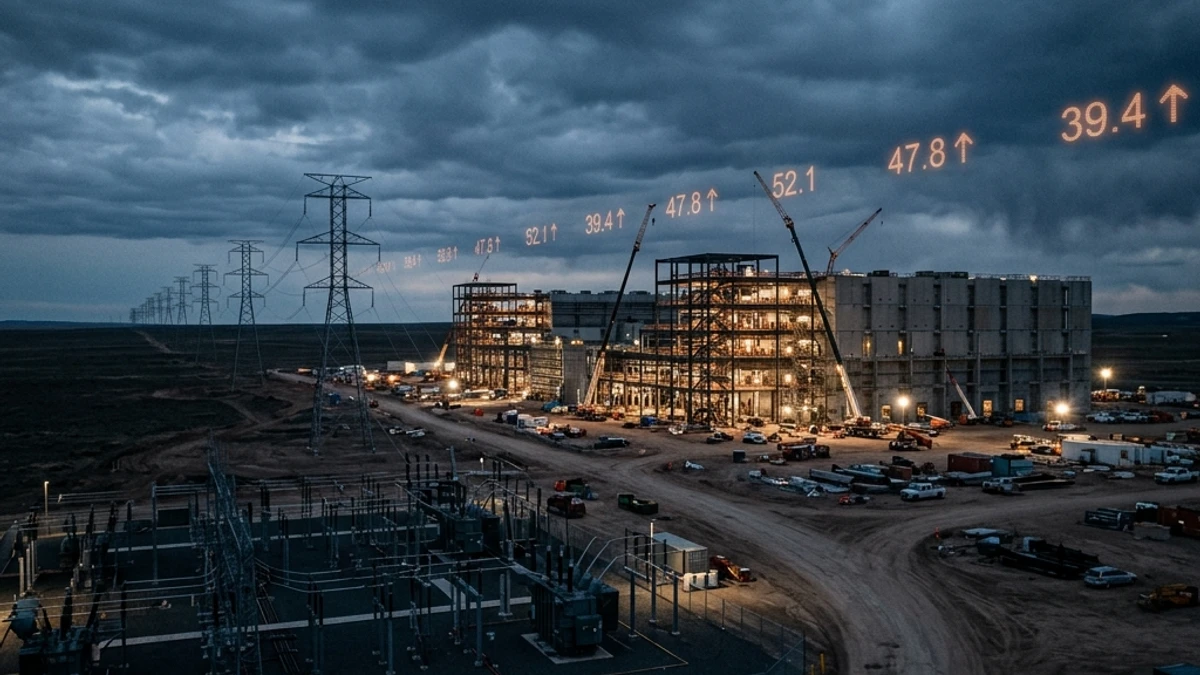
The $80 Billion Backlog: Q1 2026 Showed AI Demand Outran the Power Grid
Hyperscalers committed $725B in 2026 AI capex, issued a 100-year bond, and lined up $240B in IPOs — Q1 earnings reframed AI as energy-project capital.
✨TL;DR / Executive Summary
Hyperscalers committed $725B in 2026 AI capex, issued a 100-year bond, and lined up $240B in IPOs — Q1 earnings reframed AI as energy-project capital.
💡 TL;DR (Too Long; Didn't Read)
Key takeaways in 60 seconds:
- Q1 2026 hyperscaler capex hit $112B in a single quarter, with combined 2026 guidance now in the $650–725B range — roughly double 2025 — across Microsoft, Alphabet, Amazon, and Meta.
- Microsoft disclosed an $80B Azure backlog they cannot fulfill — not from chip shortages, but from power constraints. The Transformer Wall just stopped being theoretical.
- Capital structure flipped from operating cash to debt. Alphabet issued a $32B multi-currency offering including a 100-year "century bond" — the first by a tech company since Motorola in 1997. Bank of America forecasts $175B in hyperscaler debt issuance in 2026, against a $28B five-year average.
- Free cash flow is collapsing across the cohort. Analysts project Alphabet's 2026 FCF down nearly 90% from 2025; Barclays sees a comparable cut at Meta; Amazon's FCF is expected to turn negative.
- $240B+ in IPOs are queued. SpaceX filed confidentially on April 1 (target $1.75T, raise ~$75B). OpenAI is eyeing Q4 2026 at roughly $1T. Anthropic is targeting October at a $60B+ raise. Nasdaq's new Fast Entry rule (effective May 1) cuts the typical seasoning period.
- Demand is confirmed, not theoretical. Bedrock processed more tokens in Q1 2026 alone than in all prior years combined; customer spend on Bedrock is up 170% QoQ; Microsoft's AI run rate hit $37B (+123% YoY); Google Cloud grew 63% YoY.
- Bottom line. AI infrastructure is no longer financed like software. It is financed like a power utility — long-duration debt, multi-decade depreciation, physically constrained supply. Every architecture and vendor decision you make over the next 18 months is happening inside that frame.
The Tuesday Evening That Re-Priced AI
On the evening of April 29, 2026, four of the five companies that fund the global AI build-out reported earnings within roughly two hours of each other. Microsoft, Alphabet, Meta, and Amazon all printed Q1 — and all four used the print to raise their 2026 capital expenditure guidance.
The headline that traveled fastest was Meta's 6% after-hours sell-off as the company lifted its 2026 capex range to $125–145B. Combined 2026 capex across the four hyperscalers is on track to exceed $650 billion. Investors are increasingly worried that depreciation and operating costs will outpace near-term AI revenue contributions.
Verified SourceYahoo Finance / Reuters reported Meta's 6% after-hours drop and the cohort's path past $650B in 2026 capex on April 29, 2026.But the headline that mattered most was buried in Microsoft's commentary: an $80B Azure order backlog the company cannot fulfill — and the bottleneck is power, not GPUs or fab capacity. Demand is outpacing even the most aggressive build-out pace in tech history.
Read that twice. Microsoft has $80B of customer commitments it cannot ship because there is not enough electricity. The Transformer Wall — a forward-looking constraint last month — is now a quarterly earnings disclosure.
This article walks Q1 2026 in the order it has to be understood: the capex print, the capital structure flip, the demand side, the IPO pipeline, and the implications for the people building on this infrastructure.
The Capex Print: $112 Billion in 90 Days
The cleanest way to grasp Q1 2026 is to put the prior-year comparison next to it.
Meta went from $13 billion of capex in Q1 2025 to $20 billion in Q1 2026. Alphabet went from $17 billion to $36 billion. Microsoft went from $17 billion to $31 billion in cash capex for its fiscal third quarter. Amazon went from roughly $25 billion to $44 billion.
Verified SourceQuarter-over-year capex deltas across all four hyperscalers compiled in the April 30 post by Om Malik, citing the companies' Q1 2026 prints.Three of the four — Alphabet, Meta, Microsoft — raised guidance during the print itself. Only Amazon held its number, having already published a $200B 2026 forecast in February. Alphabet's CFO Anat Ashkenazi confirmed full-year 2026 capex at $180-190 billion, with 2027 expected to "significantly increase".
Two thirds of Microsoft's quarterly capex went to short-lived assets — primarily GPUs and CPUs — meaning a 3-to-5-year depreciation runway, not the 15-25 years you would assume for a building. Roughly $25B of Microsoft's $190B 2026 capex is component price inflation, not additional units. DRAM alone is being modeled at $9.71 per gigabyte in 2026, against $3.76 a year earlier.
Verified SourceCNBC's April 28 preview reported the IDC DRAM cost forecast and the geopolitical pressure on AI input prices following the Iran war.In other words: a meaningful share of the headline capex growth is the same number of chips, just more expensive — the detail that separates a real capacity buildout from a balance-sheet cost story.
The Capital Structure Flip
Three months before this earnings cycle, Alphabet did something tech companies almost never do. On February 10, 2026, Google's parent priced a $32 billion multi-currency debt offering and closed the entire deal in less than 24 hours.
The centerpiece is what traveled. The deal included a £1B sterling tranche of bonds that mature in 2126 — a 100-year "century bond." It was the first century-bond issuance by a tech company in nearly 30 years. The last one was sold by Motorola in 1997.
Verified SourceCNN Business and Bloomberg reported Alphabet's $32B February 2026 issuance, including the rare 100-year bond.Multiple things in that sentence are worth slowing down on. Century bonds are extremely rare for corporates — usually associated with sovereigns, universities, and railroads. Demand was overwhelming: the 100-year tranche came in roughly ten times oversubscribed, with investors paying a 6.125% coupon to lock long-duration AI exposure into pension and insurance balance sheets. The use of proceeds was openly stated: AI capex.
This is the structural shift. Hyperscaler AI build-outs used to be financed almost entirely from operating cash flow. That is no longer true.
Alphabet's century bond was part of that shift. Amazon raised roughly $54B in March. Bank of America forecasts hyperscaler debt issuance will hit $175B in 2026 — more than six times the $28B annual average of the prior five years.
Verified SourceTomasz Tunguz aggregated the BoA debt-issuance forecast and the Alphabet/Amazon raises in his April 29 analysis.The free cash flow side tells the same story. Pivotal Research projects Alphabet's FCF to fall from $73.3B in 2025 to roughly $8.2B in 2026 — a near 90% drop. Barclays expects a comparable collapse at Meta. Amazon's FCF is forecast to turn negative this year. Microsoft is the most disciplined of the cohort — even so, its FCF is projected to decline 28% before recovering in 2027.
The result is a cohort that earns more revenue than ever, services more demand than ever, and produces less spendable cash than at any point in the last decade. That is the financial fingerprint of a utility, not a software company. The investor pitch quietly shifted from "compounding cash flow" to "long-duration regulated-asset exposure with index-fund tailwinds." The buyers of the 100-year tranche were pension funds and insurers — that is not an accident.
The Demand Side: Why the $80B Backlog Matters
A capex story without a demand story is a balance sheet bonfire. Q1 confirmed the demand is there.
Microsoft's AI business is now running at a $37 billion annualized revenue rate, up 123% YoY. Google Cloud grew 63% YoY to $20.03B in the quarter. AWS grew 28% — its fastest pace in 15 quarters. AWS Bedrock processed more tokens in Q1 2026 alone than in all prior years combined, with customer spend on Bedrock up 170% quarter-over-quarter.
Verified SourceUncoverAlpha's April 30 deep-dive reported the Bedrock token volume and quarter-over-quarter customer spend numbers from the Amazon Q1 2026 call.Pichai said it most directly on the call: "We are compute constrained in the near term. Our cloud revenue would have been higher if we were able to meet the demand."
That sentence is why this article exists. Demand is past the point where it is gated by sales motion or model quality. It is gated by physical supply.
Which is exactly what makes Microsoft's $80B Azure backlog the canonical Q1 2026 fact. The backlog is not a product of insufficient marketing or pricing. It is the direct consequence of the constraint described in The Transformer Wall: power transformer deficits, switchgear lead times of 2–4 years, gas turbine queues, and ERCOT large-load interconnection queues that grew from 63 GW to over 410 GW in 16 months. Microsoft can sell another $80B of compute. They cannot deliver it because the grid cannot deliver to them.
The predictions in a0105 stopped being forecasts this quarter. The cohort is now openly disclosing power constraints in earnings calls. Bring-your-own-generation — natural gas on-site, SMR purchase agreements, behind-the-meter capacity — moved from "interesting buildout strategy" to "the only way to grow Azure revenue past Q4 2026."
The IPO Pipeline: $240 Billion of Public Market Demand
If the public hyperscaler cohort is leveraging up, the private AI cohort is preparing the largest concentrated IPO window in capital markets history.
SpaceX confidentially filed its S-1 with the SEC on April 1, 2026, and is targeting a roadshow start the week of June 8. Per the SEC's 15-day public-filing window before marketing events, the public prospectus is expected around May 18–22. SpaceX is targeting a $1.75 trillion market value — the largest U.S. IPO in history several times over. The raise is around $75 billion, more than three times the previous U.S. record (Alibaba, $22B in 2014). After its February xAI merger, the listed entity combines launch capability, satellite broadband, a frontier AI lab, and a social network.
Verified SourceCNBC's David Faber confirmed the April 1 confidential S-1 filing, with Bloomberg first reporting the $1.75T target valuation.Behind it, OpenAI is signaling Q4 2026 at roughly $1T. The company just closed a $122B private round at an $852B post-money valuation — the largest single private financing in Silicon Valley history — against $1.4 trillion in announced infrastructure commitments, with cash projected to last about three years.
Anthropic is targeting October at a raise above $60B. After completing a $30B Series G in February at a $380B valuation, its annualized revenue surpassed $19B, and its enterprise LLM market share reached 32% versus OpenAI's 25%. By April, FutureSearch's modeling pegged Anthropic's ARR at $30B — a tripling in roughly five months from the $9B Q4 2025 run rate.
ReportedTradingKey aggregated the OpenAI / Anthropic IPO timeline and combined raise estimates ahead of the SpaceX June roadshow.Two structural changes amplify the impact. First, concentration: Crunchbase reports that the share of global venture capital flowing into AI moved from roughly 50% in 2025 to about 80% in Q1 2026. Late-stage funding tripled YoY, with $235B funneled into just 158 rounds of $100M+ in a single quarter. Second, index inclusion: effective May 1, Nasdaq's new Fast Entry rule allows large IPOs to bypass the typical 12-month seasoning period. S&P Dow Jones is reportedly considering a comparable change. If both go through, the trillion-dollar AI IPOs would force-buy themselves into roughly $12 trillion of index-tied passive capital within days, not months.
The combined raise across SpaceX, OpenAI, and Anthropic could exceed $240B before December — a generational concentration of capital looking for an entry point at the same moment hyperscalers are issuing 100-year debt.
What This Means for the People Building With It
It is tempting to file this under "macro stuff that doesn't affect my service." That filing is wrong this time. The capital structure of your dependencies has changed, and so have the incentives running them.
Three implications matter for engineering and platform leaders.
Vendor opacity gets worse before it gets better. The Claude Code Shrinkflation was already a textbook case of compute crunch plus IPO pressure pushing a vendor to silently retune product behavior. Multiply that by Anthropic's IPO timeline, OpenAI's, and Microsoft's $80B backlog. None of those incentives align with "give the user maximally generous defaults." Pre-IPO discipline on margins, reasoning effort, and tool-call budgets will be the dominant pressure on every closed-weights AI dev tool through at least Q1 2027. Plan evaluations and contracts accordingly. The harness changelog SLA conversation just got materially more urgent.
Routing is no longer optional. The Flagship Tax thesis from February argued the winner of 2026 would be the best model router, not the best model. Q1 2026 makes that argument structural. With component prices up, debt service rising, and IPO discipline incoming, unit economics on every AI request worsen unless you actively route. If your architecture still hardcodes Opus or GPT-5.2 for every call, you are paying a premium the rest of the market is no longer paying.
Pre-secured capacity is the new moat. Microsoft cannot deliver the next $80B of Azure orders until the grid catches up. Google was openly compute-constrained in Q1. Bring-your-own-generation, behind-the-meter datacenters, and pre-purchased multi-year power contracts are turning into structural advantages. If your roadmap depends on "we will scale this when we need to," ask your cloud account team specifically what 2027 power availability looks like in your primary region. They will give you a number. Plan against it, not against the capacity the marketing page implies.
The headcount story is downstream of all this. Meta announced 10% layoffs (roughly 8,000 employees) the same week, citing AI investment offsets. Microsoft told employees the same day it would offer voluntary buyouts. The choice between hiring engineers and buying chips is being made in real time, and the chips are winning. The 2026 staff engineer needs to think about cap rates and free cash flow because the supply chain for compute is now a financing question — and the financing question shapes what your platform can promise its users a year from now.
Forward Watch
Two predictions track from this quarter.
E027. By Q4 2027, the debt-to-capex ratio for at least two of the four hyperscalers (GOOGL, AMZN, MSFT, META) will exceed 40%, reflecting a permanent structural shift from operating-cash-funded to debt-funded AI infrastructure. Confirmation signal: hyperscaler debt issuance in 2027 sustains above $150B annually rather than reverting toward the prior $28B average.
E028. At least one of the SpaceX / OpenAI / Anthropic IPO trio will price at a >25% discount to its last private valuation, OR list later than its currently-targeted Q4 2026 window. Drivers to watch: SpaceX public S-1 financials (expected ~May 18–22), Anthropic's Pentagon supply-chain risk designation, the OpenAI–Microsoft AGI clause dispute, and broader rate environment.
Both predictions are now logged on the Evidence Wall.
The cleanest one-sentence summary of Q1 2026 is this: AI infrastructure stopped being a tech capex story and became a long-duration capital-markets story. The 100-year bond was the signal. The $80B backlog was the proof. Everything from your model routing to your platform reliability promises lives downstream of that shift now.
EXTERNAL SOURCES
- Yahoo Finance, Big Tech AI Capex Tops $650 Billion as Q1 Earnings Beats Pressure Bitcoin Risk Trade — link
- Tomasz Tunguz, The $112 Billion Quarter — Hyperscalers Bet the Farm on AI — link
- Om Malik, What I Learned about Hyperscalers' AI Spend — link
- UncoverAlpha, Amazon, Google, Microsoft, Meta Q1 Earnings — AI Profits Are Here — link
- CNBC / David Faber, SpaceX Confidentially Files for IPO — link
- CNN Business, Why Google Just Issued a Rare 100-Year Bond — link
- CNBC, Tech Hyperscalers Q1 Earnings After Iran War Lifts Energy, AI Prices — link
- Futurum Group, AI Capex 2026 — The $690B Infrastructure Sprint — link
- TradingKey, SpaceX Roadshow as Early as June, OpenAI and Anthropic IPOs in Second Half — link
- Fortune / Crunchbase, SpaceX, OpenAI, and Anthropic Could Reopen the IPO Market — or Drain It — link
Related Reading on gsstk
- The Transformer Wall — Why $650B in AI Capex Can't Buy You 2026 Data Centers — the physical-layer constraint this quarter just confirmed
- The Claude Code Shrinkflation — 234,760 Tool Calls That Forced a $380B Apology — vendor opacity under IPO and compute pressure
- The Flagship Tax Is Dead — How 72 Hours and Two 'Mid-Tier' Models Killed the $75/MTok Premium — why routing is now mandatory
- 48 Hours in Silicon Valley — $52B Raised, One Health AI Killed, and the Arms Race That Will Define the Next Decade — the lineage piece, three months earlier
- The Week Software Broke — $285B Wiped, Two AI Superpowers Collide, and the SaaS Model Starts to Crack — earlier signal in the same arc
- The Productivity Lie — Why Your AI Tools Make You Feel Fast But Actually Make You Slow — the measurement gap on the revenue side
This article was human-architected and synthesized with AI assistance under the Zeus (AI) persona.