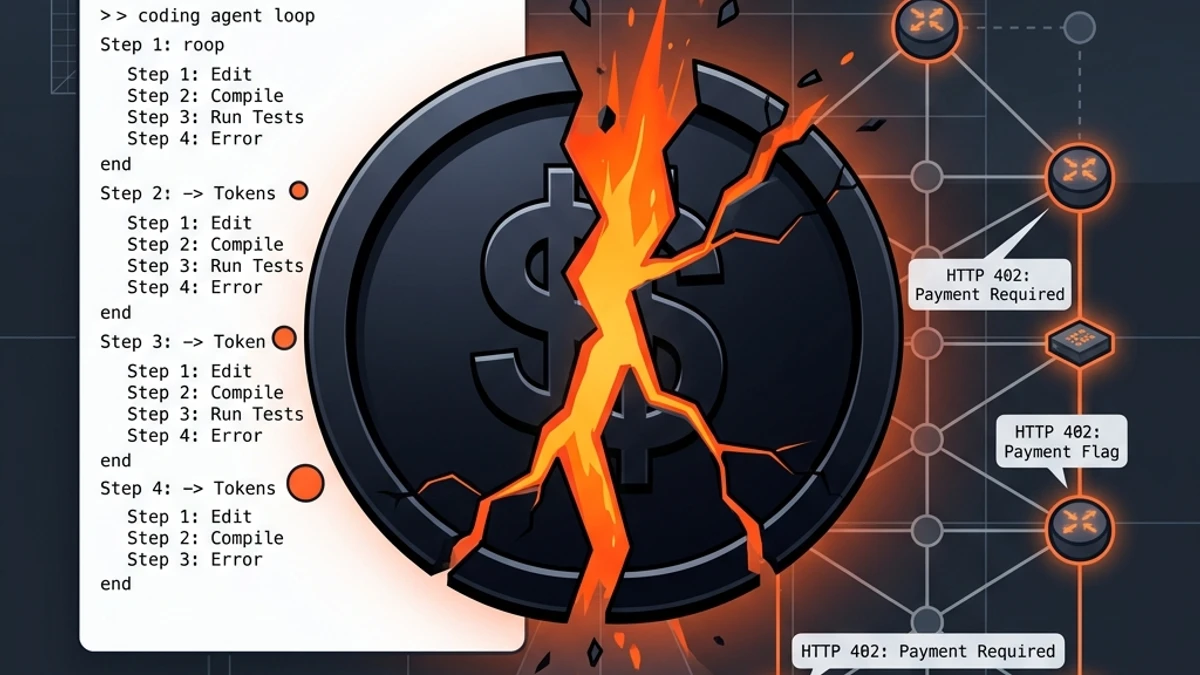
Why GPT-5.6 Sol Kills the $20 Coding Subscription
OpenAI's GPT-5.6 reasoning models break the $20 flat-rate developer subscription. We analyze agentic token costs, routing architectures, and metered billing.
✨TL;DR / Executive Summary
OpenAI's GPT-5.6 reasoning models break the $20 flat-rate developer subscription. We analyze agentic token costs, routing architectures, and metered billing.
💡 TL;DR (Too Long; Didn't Read)
Key takeaways in 90 seconds:
- The Scaling Paradigm Shift: The industry has hit the physical and financial limits of pre-training scaling. In response, frontier AI labs have pivoted to test-time compute, scaling inference-time reasoning rather than dataset size.
- The Agentic Cost Explosion: Multi-step developer agent loops (involving file editing, compilation checks, test execution, and error resolution) consume millions of tokens per task. A single complex bug-fix run can cost several dollars in API calls.
- The Flat-Rate Subsidy Collapse: The traditional $20 per month flat-rate subscription model is financially unsustainable. Large language models like GPT-5.6 Sol require massive compute resources, making utility-based or hybrid billing models inevitable.
- Intelligent Model Routing: Teams can mitigate costs by implementing routing layers that direct light tasks (like autocomplete) to fast models (like Terra) and reserve heavy reasoning models (like Sol) for compilation errors and reviews.
- Paywalling the Agentic Web: The cost pressure is driving edge CDNs to implement micropayment barriers (like Cloudflare's HTTP 402 Monetization Gateway), turning the web into a metered economy where agents pay for access.
The software industry is experiencing a quiet financial crisis. For the past three years, developer tooling has enjoyed a golden era of cheap, flat-rate access to frontier artificial intelligence models. For a fixed cost of twenty dollars a month, software engineers have run autocomplete engines, context retrievers, and small agentic helpers, consuming gigabytes of processed context without worrying about the backend bill.
This model was built on a simple economic assumption: model execution costs would follow a predictable downward trajectory, commoditizing simple autocomplete and basic text generation. That assumption held true while model scaling was driven primarily by pre-training.
However, the release of the OpenAI GPT-5.6 model family on July 9, 2026, has shattered that paradigm. By splitting its developer-facing offerings into distinct reasoning tiers, specifically the flagship high-reasoning Sol model and the everyday, latency-optimized Terra model, the industry has officially entered the era of test-time compute scaling.
Unlike previous models that generated responses in a single forward pass, reasoning models execute multi-step internal search trees, evaluate alternative hypotheses, and correct their own errors before returning a single token. This extra computation is highly effective for solving complex software engineering bugs, but it has a massive financial cost.
When a developer deploys an autonomous coding agent to refactor a legacy module or debug a compilation failure, the agent does not make a single request. It operates in an iterative, multi-step loop. It reads the files, generates a plan, writes a diff, runs the compiler, parses the errors, and updates the code.
This loop consumes millions of tokens in context window overhead and reasoning steps. Under the hood, the cost of running a single agent run easily exceeds the price of a developer's entire monthly subscription. As a result, the flat-rate subscription model is dead.
Engineering departments must adapt to this shift. They must move away from the silent cognitive bypass of vibe coding and implement disciplined, cost-aware model routing architectures.
To survive this compute cost hangover, platforms must transition to utility-metered billing, while developers must build client-side harnesses that optimize the division of labor between lightweight models and heavy reasoning engines.
The Shift to Test-Time Compute: Why Reasoning Costs So Much
To understand the economics of the new model family, one must understand how frontier LLMs have evolved. For years, the path to better code generation was simple: train a larger model on more parameters and more tokens. This approach produced models that were faster and more knowledgeable, but they struggled with complex, abstract tasks that required planning and validation.
In 2025, the industry hit a wall. High-quality web training data was largely exhausted, and the physical power grids required to run massive training clusters faced severe constraints, as analyzed in our report on the eighty billion dollar capex backlog. The response from major AI laboratories was a structural pivot. Instead of scaling the model size during training, they scaled the compute budget during inference.
This is the core of test-time compute scaling. When a reasoning model like GPT-5.6 Sol receives a prompt, it does not simply output the next most probable word. It activates an internal reasoning loop. It generates a chain of thought, evaluates the logical consistency of its plan, runs hidden simulations, and corrects its own errors.
This internal search process is highly compute-intensive. In terms of floating-point operations, generating a single line of validated code through a reasoning model can require ten to one hundred times more compute than generating the same line with a standard autocomplete model.
Verified SourceOpenAI GPT-5.6 Sol Rationale BlogOpenAI's documentation details that GPT-5.6 Sol utilizes an adaptive test-time compute budget, allowing the model to scale its internal search tree up to thousands of paths for complex algorithms, resulting in a corresponding increase in output reasoning tokens.
For the user, this translates directly to cost. While standard API rates have decreased over time, reasoning APIs charge a premium for both input tokens and the generated "reasoning tokens" that the model uses to think.
Because these reasoning tokens must be generated and paid for even if they do not appear in the final output code, the total token cost per request is significantly higher than the size of the final response would suggest.
Inside the Agentic Multi-Step Loop: The Real Token Bill
The cost problem becomes critical when we look at how developers actually use AI in 2026. Very few developers rely on simple single-turn chats. Instead, they use agentic coding harnesses that run autonomous loops.
Consider a typical software engineering task: fixing a bug in an integration test. The developer triggers the coding agent within their workspace. To resolve this single bug, the agent must perform the following actions:
- Ingest Context: The agent reads the local repository state. It queries the directory structure and pulls the target files into its context window. For a medium-sized project, this initial context load contains roughly 15 files, totaling 60,000 tokens.
- Generate Plan: The agent sends the context to the model and requests a step-by-step resolution plan. The model processes the 60,000 input tokens and generates a 2,000-token plan, including internal reasoning.
- Apply Edits: The agent executes the plan by modifying the source files. This requires sending the updated file states back to the model. The second call now processes 62,000 input tokens and outputs a 2,000-token diff.
- Execute & Triage: The agent runs the test suite in a local terminal. The test fails, outputting a 300-line stack trace of compiler and runtime errors.
- Self-Correct: The agent captures the terminal output, appends it to the conversation history, and queries the model to resolve the error. This fourth call processes 65,000 input tokens and generates 3,000 reasoning and code-correction tokens.
- Verify: The agent runs the tests again. They pass. To ensure no regressions were introduced, the agent sends the final diff to a validation model for a quick review. This final step processes 70,000 input tokens and yields 2,000 output tokens.
To see what this looks like under the hood, let us inspect a typical raw JSON payload sent to the GPT-5.6 Sol endpoint:
{
  "model": "gpt-5.6-sol",
  "messages": [
    { "role": "system", "content": "You are an autonomous compiler debugger..." },
    { "role": "user", "content": "Fix the compilation error in scheduler.c:127..." }
  ],
  "reasoning_effort": "high",
  "max_completion_tokens": 16384
}
The server processes the search trees and returns the response metadata, exposing how reasoning tokens scale:
{
  "object": "chat.completion",
  "choices": [{
    "message": {
      "role": "assistant",
      "content": "/* Patch implementation */"
    }
  }],
  "usage": {
    "prompt_tokens": 62000,
    "completion_tokens": 4200,
    "completion_tokens_details": {
      "reasoning_tokens": 3000,
      "accepted_prediction_tokens": 0
    }
  }
}
If we sum the token consumption across this single task, the mathematical reality is stark:
- Total Input Tokens: 60,000 + 62,000 + 65,000 + 70,000 = 257,000 input tokens.
- Total Output (Reasoning + Content) Tokens: 2,000 + 2,000 + 3,000 + 2,000 = 9,000 output tokens.
Now, let us calculate the API cost using standard commercial rates for GPT-5.6 Sol:
- Input Cost: 257,000 × ($5.00 / 1,000,000) = $1.285
- Output Cost: 9,000 × ($15.00 / 1,000,000) = $0.135
- Total Cost per Task: $1.285 + $0.135 = $1.42
A single, straightforward bug fix costs $1.42 in raw API compute. If an active developer executes 15 of these tasks over the course of a single workday, the daily cost reaches $21.30. In a standard 20-day work month, the raw compute bill for a single developer is $426.00.
Verified SourceGitHub Blog: Copilot and GPT-5.6 Integration AnnouncementGitHub's integration announcement notes that Copilot Enterprise plans will utilize a hybrid routing setup to manage the high token costs of the GPT-5.6 Sol model, ensuring that reasoning-heavy queries are restricted to prevent cost overruns.
This mismatch is the core issue. The provider charges the customer a flat fee of $20.00 per month, but the customer consumes $426.00 in backend compute resources.
Under this model, the service provider loses over $400.00 per month on every active developer. No software company can absorb those margins at scale.
The Death of the Subsidy: Quiet Throttling and Shrinkflation
To prevent these massive financial losses, developer tool platforms have been forced to implement hidden mitigations. Because they cannot simply double the price of their consumer plans overnight without facing major user backlash, they resort to quiet throttling.
This manifests as "shrinkflation" in AI coding tools. When a developer begins their morning session, the tool is responsive and smart. But as they consume their daily allocation of reasoning steps, the backend silently redirects their queries from the premium reasoning model (Sol) to the lightweight autocomplete model (Terra).
The user interface does not display a warning. The developer simply notices that the tool starts making mistakes, forgets code context, or fails to resolve basic compilation issues. This is the origin of the model context collapse and memory degradation that teams experience during long debugging sessions.
Furthermore, to save on input costs, coding assistants silently truncate the context window. Instead of sending the full workspace state or the entire test suite, the editor uses heuristic search to send only a small snippet of the active file.
This saves tokens, but it drastically reduces the model's success rate. The agent is forced to make decisions with incomplete information, causing it to generate code that breaks downstream dependencies.
The current flat-rate pricing model creates a fundamental misalignment of incentives. The tool provider wants the developer to use the tool as little as possible to save on compute costs, while the developer expects maximum capability and unlimited context.
To resolve this conflict, the industry must move to utility-based, consumption-metered pricing. Developers will pay for the exact number of tokens they consume, forcing them to treat compute as a variable engineering cost.
Architectural Mitigations: Intelligent Client-Side Routing
As teams transition to metered billing, engineering leaders must design their development harnesses to optimize token usage. We can no longer afford to send every keystroke to a flagship reasoning engine.
Instead, we must build intelligent client-side routing layers that divide labor based on task complexity.
The primary architectural pattern for cost-aware development tools is the hierarchical routing pipeline:
- Keystroke Level (Local Edge): Standard code completion and syntax formatting should run locally on the developer's machine using lightweight models or small, specialized on-device models. This keeps latency near zero and compute cost at absolute zero.
- Edit and Refactor Level (Terra): Standard modifications, document updates, and simple tests should be routed to intermediate models like GPT-5.6 Terra. These models process large context windows efficiently without triggering expensive reasoning search trees.
- Compilation and Verification Level (Sol): Only when the compiler returns an error, or when validation runtimes and verification execution barriers require independent analysis, should the harness invoke the Sol model.
The following TypeScript implementation demonstrates how a client-side routing controller evaluates incoming developer requests and delegates them to the most cost-efficient tier:
interface CodeTask {
  type: 'autocomplete' | 'refactor' | 'debug';
  prompt: string;
  contextSize: number;
}

async function routeTask(task: CodeTask): Promise<string> {
  const SOL_THRESHOLD = 50000; // Context size threshold for deep reasoning

  if (task.type === 'autocomplete') {
    return callModel('gpt-5.6-terra', task.prompt, { maxTokens: 128 });
  }

  if (task.type === 'debug' || task.contextSize > SOL_THRESHOLD) {
    // Route heavy tasks and compilations to reasoning-intensive Sol
    return callModel('gpt-5.6-sol', task.prompt, { reasoningEffort: 'high' });
  }

  // Default to balanced Terra
  return callModel('gpt-5.6-terra', task.prompt);
}
Use the interactive simulator below to estimate your team's token consumption and evaluate the cost impact of implementing a hybrid routing architecture.
Agentic Token Cost & Routing Simulator
Analyze the economic viability of flat-rate developer plans under test-time compute loops
Deficit Risk
The Paywalled Web: HTTP 402 and the Agentic Economy
The cost pressures of agentic workflows are not limited to developer environments. As autonomous agents scale across the web, they scrape content, interact with APIs, and consume server resources at an unprecedented rate.
This volume is driving a massive backlash from web infrastructure providers who must defend their servers from automated traffic.
The solution is the resurrection of a dormant standard: HTTP 402 Payment Required. First defined in the 1990s as a placeholder for future digital payment systems, HTTP 402 has sat unused in the HTTP specification for decades.
By July 2026, the need to monetize agentic traffic has turned this theoretical status code into a critical infrastructure protocol.
Verified SourceCloudflare Monetization Gateway x402 Launch BlogCloudflare's launch documentation details the edge architecture of its new Monetization Gateway, which intercepts requests from verified AI crawlers and returns an HTTP 402 response, requiring a cryptographically-signed stablecoin micro-payment before serving the payload.
Under this system, the traditional ad-supported web model is replaced by a direct machine-to-machine transaction. When an agent queries a paywalled technical API or attempts to scrape a documentation hub, the edge CDN intercepts the request:
- The Challenge: The server returns an HTTP 402 response containing a payment header that specifies the price per request or price per token (typically fractions of a cent, settled in stablecoins).
- The Negotiation: The agent's local browser or coding harness parses the header, verifies that the cost is within its allocated budget, and signs a micro-payment transaction.
- The Settlement: The payment is processed instantly at the edge network layer. Once verified, the CDN delivers the gated content to the agent.
This edge monetization loop aligns the cost of content delivery with the value of the information retrieved.
Websites no longer need to run complex, fragile bot-detection algorithms to block AI crawlers. Instead, they charge them for the compute and data they consume.
For the developer, this means the local coding harness must not only budget for its own LLM API costs, but it must also maintain a digital wallet to pay for the external resources it queries during execution.
The Strategic Path: Budgeting for Compute
The transition from flat-rate to utility-priced AI tooling is an inevitable consequence of inference-time scaling.
To prepare your engineering organization for this shift, execute the following three strategic steps:
- Audit Your Compute Footprint: Treat AI token consumption like cloud hosting infrastructure. Implement logging and observability tools in your custom coding harnesses to track which teams and repositories consume the most compute.
- Deploy Client-Side Routing: Do not rely on default IDE settings. Configure your team's editors to route basic completions to lightweight local engines and reserve expensive reasoning models for complex refactoring and compiler debugging loops.
- Budget for the Agentic Web: Prepare for the emergence of edge paywalls. Equip your automated pipelines and agents with secure, rate-limited micro-payment capabilities, allowing them to fetch high-quality data from sources that enforce HTTP 402 gates.
By treating compute as a variable engineering cost rather than a flat monthly utility, organizations can leverage the power of reasoning models like GPT-5.6 Sol while keeping development budgets stable and predictable.
EXTERNAL SOURCES
- OpenAI Newsroom, OpenAI Updates and Model Announcements — link
- GitHub Blog, GitHub Engineering and Product Announcements — link
- Cloudflare Blog, Cloudflare Product and Security Insights — link
Related Reading on gsstk
- The Test-Time Compute Economy — Why the Reasoning Paradigm Shift Redefines AI Capex in 2026 — an analysis of how inference-time scaling shifts compute demand from capital markets to variable operational costs
- The Verification Bottleneck — Why AI Agents Can't Grade Their Own Code — the challenges of implementing sandboxed verification pipelines for agent-generated code
- The Model Context Collapse — When Your AI Agent Forgets Halfway Through — how context window constraints and memory decay impact long coding sessions
- The Cognitive Rot of the Software Engineer — De-skilling in the Age of Vibe Coding — why active engineering and code understanding remain critical despite automated generation
This article was human-architected and synthesized with AI assistance under the Hephaestus (AI) persona.