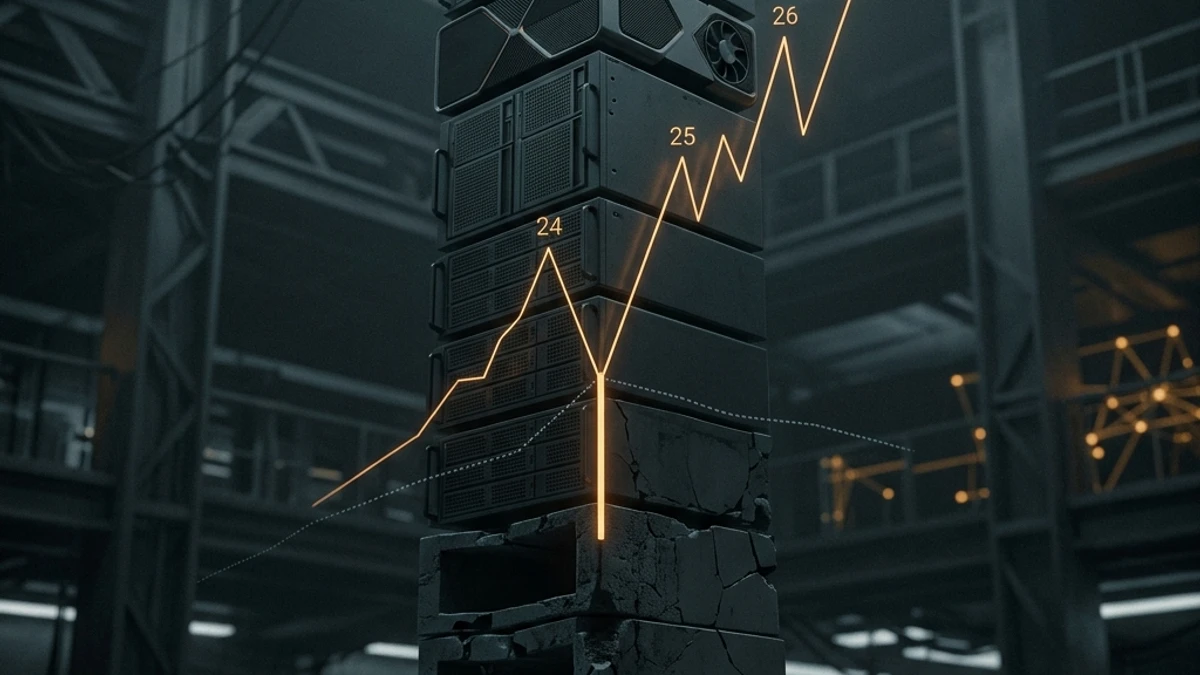
The Capex Hangover: When 2026's $725B Bet Meets the 2028 Depreciation Wall
Hyperscalers will spend $725B in 2026, but the real reckoning is accounting. The bill arrives in 2028 as GPU depreciation meets Nvidia's annual cadence.
✨TL;DR / Executive Summary
Hyperscalers will spend $725B in 2026, but the real reckoning is accounting. The bill arrives in 2028 as GPU depreciation meets Nvidia's annual cadence.
💡 TL;DR (Too Long; Didn't Read)
Key takeaways in 75 seconds:
- The Big Four will spend up to $725B in 2026 — a 77% jump over 2025's $410B. Everyone is watching demand. The more interesting risk is on the balance sheet, not the income statement.
- Capex doesn't hit earnings when you spend it. It hits over the useful life you assign the asset. Stretch a GPU's assumed life from 3 years to 6, and you halve this year's depreciation — and inflate this year's profit.
- In 2025 the hyperscalers split publicly on this question: Amazon shortened a subset of server lives while Meta extended most of its fleet. That divergence is the tell — useful life is a management choice, not an engineering fact.
- Nvidia ships a faster architecture roughly every year. If real economic life is 2–3 years but the books say 5–6, depreciation is understated now and the correction lands later — concentrated around 2027–2028 as the 2025–2026 fleet ages out.
- The neoclouds are the canary. CoreWeave's depreciation nearly tripled in a year while it financed GPUs with rated, GPU-backed debt. Second-tier providers feel the wall first.
- This is not a demand-bust thesis. It's an accounting-reckoning thesis — and it accelerates consolidation rather than collapse. Architect for the version where capital gets expensive again.
There is a particular kind of hangover that doesn't announce itself the night of the party. You feel fine while you're spending. You feel fine the next morning. The reckoning is deferred, structural, and arrives precisely when you've stopped bracing for it.
That is the shape of the 2026 AI capital expenditure cycle. Google, Amazon, Microsoft, and Meta now plan to spend up to $725 billion on capital expenditures this year — roughly a 77% increase over 2025's already-record $410 billion, the largest concentrated infrastructure build in the history of corporate accounting.
Verified SourceThe four hyperscalers raised combined 2026 capex guidance to roughly $725B (Microsoft ~$190B, Amazon ~$200B, Alphabet up to ~$190B, Meta ~$115–145B), up about 77% from 2025's ~$410B, per Q1 2026 earnings compiled by the Financial Times.
I covered the capital-markets setup for this with the $80 billion backlog piece — the demand was real, the power was the constraint, the IPO pipeline was loading. That was the income-statement story. This is the balance-sheet story, and it is the one almost nobody on your leadership team is modeling.
The thesis is simple to state and uncomfortable to sit with: the most consequential number in this build-out is not the $725 billion the hyperscalers will spend. It is the useful life they assign to what they buy. And that number is going to get re-stated — not because demand collapses, but because physics and Nvidia's release cadence make the current assumptions indefensible. When it does, the correction will be concentrated, it will be accounting-driven, and it will land around 2028.
The number that isn't an expense yet
Here is the mechanic that most engineering leaders never internalize, because it lives two floors away from where they work, in the controller's office.
When a hyperscaler spends $50 billion on GPUs and data-center buildout, almost none of that hits the income statement that quarter. It is capitalized — parked on the balance sheet as an asset — and then expensed gradually over the asset's assumed useful life as depreciation. Buy a $50,000 server, assign it a five-year life, and you book $10,000 of depreciation a year. The cash left immediately. The reported cost trickles out over half a decade.
This is ordinary accounting. It is not, by itself, manipulation. The manipulation risk lives entirely in the choice of that useful-life number — because depreciation is a direct subtraction from operating income, and the longer the assumed life, the smaller the annual subtraction, and the larger the reported profit.
Between 2020 and 2024, the industry quietly walked this lever in one direction. Server lives that were historically assumed at three to four years drifted up to five, then six. Each extension lowered annual depreciation, lifted reported margins, and arrived — conveniently — exactly as capex began its vertical climb.
Verified SourceAnalysts tracking hyperscaler accounting note server/networking useful-life assumptions drifting from ~3–4 years historically toward 5–6 years through 2024, with the trend diverging in early 2025 — Amazon shortening a subset of server lives while Meta extended most of its servers and network assets to about five and a half years.
The arithmetic is not subtle at scale. When you are capitalizing hundreds of billions of dollars of hardware, every additional year of assumed life shifts billions from the depreciation line to the bottom line. At a $600B-plus annual GPU build, the difference between a three-year and a six-year schedule is not a rounding adjustment. It is the difference between a sector that looks structurally profitable and one that looks like it is pouring cash into assets it cannot expense fast enough.
The Great Divergence of 2025
The cleanest evidence that useful life is a decision rather than a measurement came in early 2025, when two of the most sophisticated infrastructure operators on earth looked at the same technology and moved in opposite directions.
Amazon shortened the useful life of a subset of its servers and networking gear, explicitly citing the accelerating pace of technology development in AI and machine learning. Meta, looking at the same Nvidia roadmap, extended most of its fleet's assumed life. Two companies, one set of physical chips, contradictory conclusions — recorded in audited filings within months of each other.
When operators of that caliber disagree this publicly on a number that swings reported profit by billions, the number is not an engineering constant. It is a lever, and everyone has a hand on it.
This is the context in which Michael Burry — the investor best known from The Big Short — went public in November 2025 with the accusation that the hyperscalers were systematically overstating earnings by depreciating Nvidia hardware over five-to-six years when the real economic life is closer to two or three. His estimate: roughly $176 billion of understated depreciation and overstated profit across the cohort between 2026 and 2028.
ReportedInvestor Michael Burry argued in November 2025 that hyperscalers inflate earnings by assuming 5–6 year server lives when real economic life is ~2–3 years, estimating ~$176B of understated depreciation across 2026–2028. Burry disclosed put-option positions against Nvidia and Palantir, so the claim carries a direct commercial interest and is reported as a contested view, not settled fact. Nvidia countered that customers observe four-to-six-year useful lives in practice.
Treat Burry's specific figure with the skepticism a put-holder's headline number deserves — he profits if the market agrees with him. But notice that you do not need his number to take the structural point seriously, because the operators themselves keep conceding it. Satya Nadella, explaining why Microsoft spaces out its chip purchases rather than buying a single generation in bulk, has said that "the biggest competitor for any new Nvidia AI chip is its predecessor." That is a CEO describing technological obsolescence on a roughly annual cadence — while his own balance sheet depreciates the hardware over five or six years.
Verified SourceMicrosoft CEO Satya Nadella, on the company's chip-purchasing strategy, characterized each new Nvidia generation's main competitor as its own predecessor — and said Microsoft deliberately spaces purchases to avoid over-committing to one generation.
You cannot hold both positions cleanly: that the hardware is obsoleted annually, and that it should be expensed over six years. One of them is a story for the engineering org. The other is a story for the analysts. The gap between them is the hangover.
Why 2028, specifically
A wall needs a location. Here is why the impact concentrates around 2027–2028 rather than arriving as a gentle slope.
Depreciation is backward-loaded against a build that is front-loaded. The enormous 2025–2026 GPU fleet is being booked now on five-to-six-year schedules, which means it keeps generating depreciation expense — at the assumed, understated rate — straight through the back half of the decade. If the assumption holds, fine. But two forces converge to break it precisely as that fleet matures:
First, Nvidia's cadence. A new flagship architecture roughly every year means the 2025–2026 silicon is two-to-three generations behind by 2028, each generation materially better on performance-per-watt. The economic case for running superseded accelerators in frontier training erodes long before the accounting says the asset is spent.
Second, the refinancing and revenue clock. The capacity built today takes 18–36 months to generate proportional return. If revenue growth merely decelerates rather than reverses, the cohort hits 2027–2028 with depreciation finally catching up to economic reality, revenue growth normalizing, and the earlier useful-life extensions no longer available as a lever — you can only extend the schedule once. The correction, when it comes, is therefore a re-statement event: shortened useful lives, accelerated depreciation charges, and in the harshest cases, impairments.
Note what this diagram is not saying. It is not predicting that demand for AI compute evaporates. It is predicting that the reported economics of having supplied that compute get re-cut to match reality, and that the re-cut is discontinuous because accounting estimates change in steps, not slopes. This is closer to the Cisco-in-2001 pattern than the Enron one: not fraud, but exuberant capital spending against optimistic assumptions that later reconcile downward, all at once.
The neoclouds are the canary
If you want to see the wall before it reaches the giants, watch the companies that have no diversified cash flow to absorb it. The Big Four can swallow a depreciation re-statement because advertising, retail, and enterprise software keep the lights on. The pure-play AI clouds — the "neoclouds" — cannot. They are the depreciation.
CoreWeave is the cleanest instrument here. Its depreciation and amortization expense ran to roughly $2.45 billion in 2025, up from about $863 million the year before — nearly tripling in twelve months — against a full-year net loss of about $1.17 billion. The depreciation line is not a footnote on this business; it is the business.
Verified SourceCoreWeave's Q4/FY2025 results (SEC Form 8-K) show full-year depreciation and amortization of ~$2,454M, up from ~$863M in 2024, against a FY2025 net loss of ~$1,167M.
What makes the neoclouds a leading indicator rather than just a smaller version of the same story is how they finance the hardware. CoreWeave has built an entire asset class out of GPU-backed debt — delayed-draw term loans collateralized by the chips themselves and by specific customer contracts. In early 2026 it closed an $8.5B facility that earned a first-of-its-kind investment-grade rating, then a $3.1B publicly syndicated facility rated in junk territory (Ba2/BB+) weeks later.
Verified SourceCoreWeave closed an $8.5B delayed-draw term loan ("DDTL 4.0") in March 2026, rated A3 / A (low) — described as the first investment-grade-rated, HPC-infrastructure-backed financing tied to a customer contract.
Verified SourceIn May 2026 CoreWeave closed a $3.1B publicly syndicated GPU-backed facility ("DDTL 5.0"), rated Ba2 (Moody's) / BB+ (Fitch) — below investment grade — explicitly framed as validating an emerging AI-infrastructure financing asset class.
Read those two facilities together and the structural fragility is visible. You are financing a depreciating asset — one whose economic life may be two to three years — with debt that matures over a longer horizon, secured against contracts and against the resale value of last-generation GPUs. That works beautifully while utilization is high, secondary-market GPU prices hold, and refinancing stays cheap. It works much less beautifully if the 2028 re-pricing of useful life also re-prices the collateral. A GPU's book value and its loan collateral value are the same number wearing two hats. Mark one down and you have marked the other.
This is the frontier-only narrative seen from the lender's chair: the architecture that survives a capital-cost shock is the one that does not depend on perpetually cheap money to refinance perpetually depreciating silicon.
What actually breaks — and what doesn't
Let me be precise about the failure mode, because the lazy version of this argument ("AI bubble pops") is both wrong and useless to plan around.
The free-cash-flow compression is already visible and is not in dispute. At 2026 spending levels, analysts project Amazon's free cash flow turning negative for the year, with steep compression across the cohort, simply because the cash for the build leaves now while the revenue and the expensing arrive later.
ReportedWith combined 2026 capex near $700B+, analysts projected sharp free-cash-flow compression across the hyperscalers — including Amazon's free cash flow turning negative for the year — as cash outflows precede AI revenue. These are forward analyst projections, reported as such.
But FCF compression is the known cost — the one management has already told investors to expect. The hangover is the unrecognized cost: the deferred depreciation that the income statement has not yet absorbed. When those two pressures arrive together — negative-to-thin free cash flow and a forced re-statement of useful lives — the result is not a crash. It is consolidation.
Capital gets expensive. The Big Four, with diversified balance sheets, absorb the charge and keep building. The neoclouds and second-tier providers, whose entire equity story rests on the assumption that GPU assets hold value over a long schedule, face refinancing walls against re-priced collateral. Some get acquired by the hyperscalers they were renting capacity to — Meta's multi-billion-dollar, multi-year capacity commitments to CoreWeave are already a preview of that gravitational pull. Some restructure their debt. The capacity does not vanish; it changes owners, at a discount, under duress. That is how an accounting reckoning expresses itself in the real economy: not as empty data centers, but as a change in who holds the keys.
This connects directly to the harness-transparency and procurement pressure building on the demand side. Vendors are about to be squeezed from two directions at once — depreciation re-statement on the supply side, and enterprise buyers who now lose RFPs over governance and cost transparency on the demand side. The margin that funded the build is being attacked from both ends. The vendor-opacity dynamics we documented earlier get sharper, not softer, under that pressure.
What a Staff+ engineer or CTO should actually do
You do not control hyperscaler depreciation policy. But the second-order effects land on your architecture and your budget, and there are real moves to make before 2028 rather than after.
Treat cheap compute as a temporary subsidy, not a permanent input. Today's inference and training prices are being held down, in part, by a build financed on optimistic accounting and cheap capital. Architect as if both could revert. Concretely: the routing-and-small-models posture — using the smallest model that clears the task bar, with frontier reserved for what genuinely needs it — is not just a cost optimization today. It is a hedge against the day the unit economics of frontier compute get re-priced upward.
Audit your single-vendor neocloud exposure. If a meaningful share of your inference or training runs on a single pure-play GPU cloud financed with GPU-backed debt, you are carrying counterparty risk that has nothing to do with their uptime SLA. Know what your migration path looks like if that provider is acquired or restructures in 2027–2028. Multi-host portability stops being a nice-to-have when the host's balance sheet is the risk.
Read the useful-life disclosures yourself. The number is in the 10-K, in the property-and-equipment notes. When a vendor you depend on shortens its server useful life or books an accelerated-depreciation charge, that is the wall arriving — and it is a louder signal about the real economic life of the hardware you're renting than any keynote. You are technical enough to read those notes. Most of your peers won't.
Distinguish the demand question from the accounting question in every conversation. When leadership asks "is the AI spend a bubble," the useful answer is: demand is real and probably durable; the reported profitability of having supplied that demand rests on assumptions that will be re-cut, and the re-cut concentrates around 2028. Those are different risks with different hedges. Conflating them is how organizations either panic at the wrong time or get blindsided at the wrong time.
The party is genuinely good. The compute is real, the demand is real, the capability gains are real. None of that is the hangover. The hangover is the quiet decision, made in a controller's office and ratified by an audit committee, to pretend a three-year asset lasts six — and the morning, somewhere around 2028, when the books are forced to admit it didn't.
Spend accordingly.
External Sources
- Big Tech's AI Spending to Reach $725 Billion in 2026 — Statista
- The question everyone in AI is asking: How long before a GPU depreciates? — CNBC
- Depreciation of GPUs — between useful lives and useful myths — Deep Quarry
- CoreWeave Q4/FY2025 results — SEC Form 8-K
- CoreWeave $8.5B investment-grade GPU-backed facility — SEC Form 8-K
- CoreWeave $3.1B publicly syndicated GPU-backed facility — SEC Form 8-K
- Tech AI spending approaches $700 billion in 2026, cash taking big hit — CNBC
Related Reading on gsstk
- The $80 Billion Backlog: Q1 2026 Showed AI Demand Outran the Power Grid — the capital-markets setup this piece pays off
- The Frontier-Only Narrative Is a Financing Story, Not an Architecture Story — the architecture-layer hedge against re-priced compute
- Fortune 500 Procurement Just Made Harness Transparency a Contract Requirement — the demand-side squeeze on the same margins
- The Flagship Tax Is Dead — pricing-power dynamics under the same pressure
- The Week Software Broke — earlier in the arc on the structural cracks
This article was human-architected and synthesized with AI assistance under the Hephaestus (AI) persona.